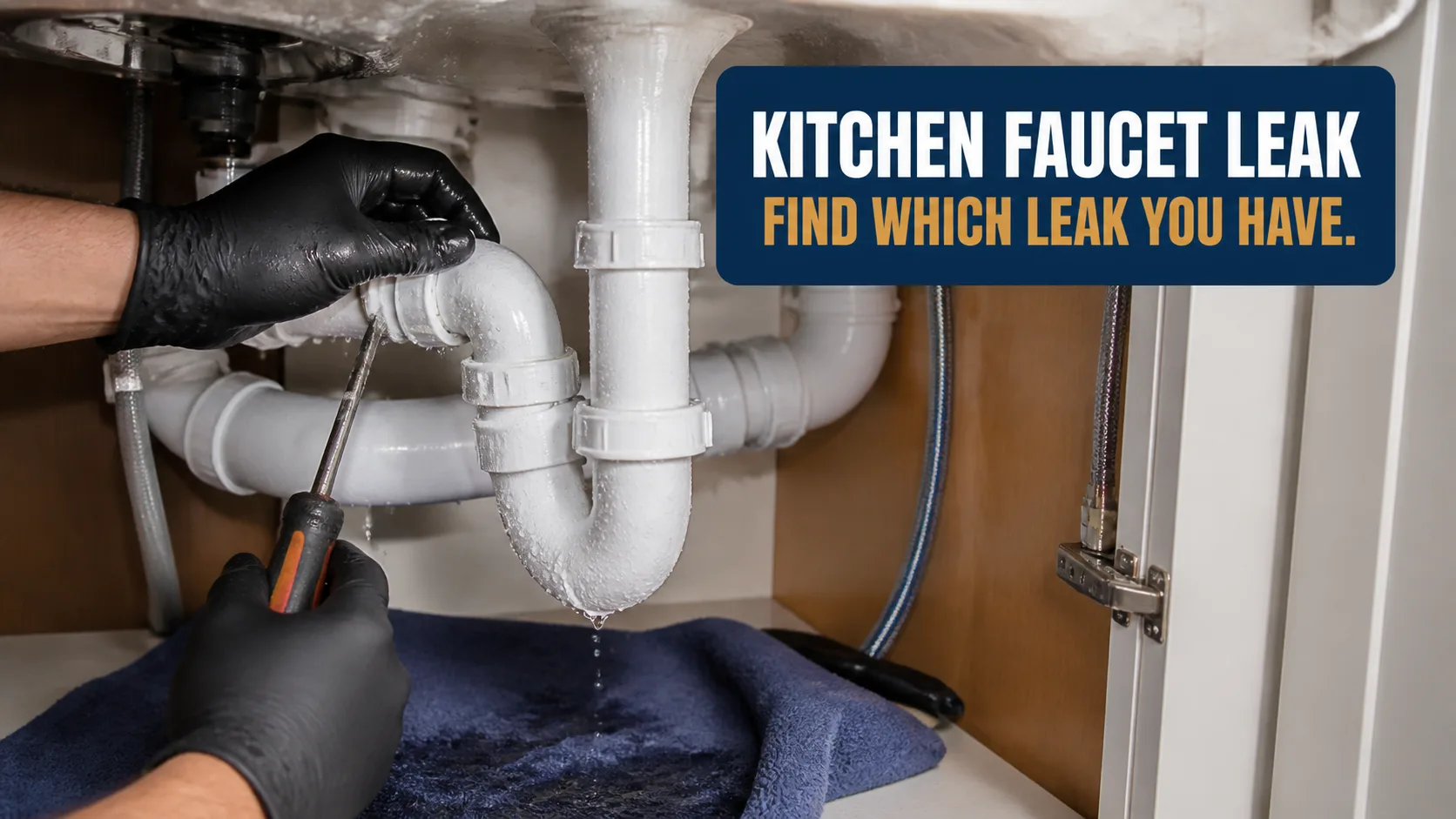
Open the cabinet and touch everything with a dry hand: supply connections, faucet mount, sprayer hose, drain. Wet with the faucet **off** means a pressurized supply leak — close the shut-off valves under the sink now. Wet only when running means seals or drain-side — fix it this week, because every use waters a closed cabinet that cannot dry. Either way, pull everything out of the cabinet and check its floor: that is where months of drips have been landing.

The four kitchen faucet leaks
1. Supply connections (under the counter). The braided or plastic lines from the shut-off valves to the faucet, pressurized around the clock. The most damaging version because it drips at 3 a.m. as reliably as at dinner.
2. Faucet base (at the deck). Worn O-rings let running water pool at the base — and drain through the mounting holes into the cabinet. Looks cosmetic from above; isn’t.
3. Sprayer/pull-down hose. The hose or its quick-connect weeps inside the cabinet when the sprayer runs, then hangs there dripping.
4. Spout drip. The classic worn-cartridge drip into the basin. Annoying and wasteful, but the only one of the four that isn’t a water-damage risk — the water lands in the drain.
Warning signs you have been leaking for months
The cabinet is telling you first:
- A dark tide line along the back edge of the cabinet floor, or a deck that flexes under a thumb
- Cleaning-supply bottles with rusted bases or peeling labels
- Dark spotting on the underside of the deck, visible only when you empty the cabinet and look up from the toe-kick
The room is telling you second:
- A musty smell that returns within a day of cleaning — a smell like that is a moisture finding before it is anything else
- Flooring in front of the sink darkening at the seams or lifting at the edges
- Baseboard beside or behind the cabinet swelling along its bottom inch
The fittings are telling you why: green or white crust at a compression nut, a supply line gone stiff and chalky, an aerator that needs soaking every few months. Houston water runs around 10 grains per gallon of hardness, and those minerals build at every fitting until one stops sealing.
The paper towel diagnostic
Ten minutes, definitive:
- Towel-dry every line, fitting, and surface in the cabinet.
- Lay dry paper towels across the cabinet floor and under the trap.
- Run the sequence: faucet off 10 minutes → hot on → cold on → sprayer → fill and drain the basin.
- Check the towels after each step. First wet spot = your leak, and which step produced it = supply, base/sprayer, or drain-side.
Wet during the off phase is your cue to close both shut-off valves and treat it as today’s problem.
What the cabinet floor is hiding
Sink cabinets are where slow leaks go to work unobserved: dark, closed, full of cleaning supplies nobody moves for months. By the time a drip is noticed, the pattern we find is consistent —
- Cabinet floor (particleboard) swollen, delaminating, often moldy on the underside
- The wall behind the cabinet wicking moisture upward
- Subfloor beneath reading wet in a radius the cabinet hides
- In slab homes, moisture tracked sideways under adjacent flooring
That is why the checklist below says empty the cabinet — not glance in it.
What to do right now
- Shut-off valves closed if the leak is supply-side (or the house main if the valves are seized — then have those valves replaced too).
- Empty the cabinet completely. Everything out, doors open.
- Photograph the cabinet interior as found — swelling, staining, mold, the leak point.
- Fix the leak: tighten/replace the supply line, reseat the faucet with new O-rings, re-clamp the sprayer connect — or call a plumber for anything seized.
- Judge the moisture honestly. Swollen cabinet floor, staining beyond the cabinet, musty smell = get it metered. Cabinet interiors and the subfloor below are exactly where Houston humidity keeps water alive for weeks. Photo to (346) 271-7004 gets you a straight answer.
What does a wet sink cabinet cost to put right?
The faucet is the cheap half — a cartridge, a set of O-rings, or braided supply lines is parts-store money and an afternoon. The cabinet and what is under it are the number nobody quotes on the phone, so here are the variables.
- How long it dripped. A week is a dry-out. Six months is a dry-out plus a cabinet deck plus, often, remediation.
- Whether the deck comes out. A swollen particleboard deck can be cut out and replaced with plywood for a fraction of a new cabinet, and that is the only honest way to read the subfloor beneath.
- How far the water traveled. Slab-on-grade construction covers most of the Houston area, so water leaving the cabinet spreads sideways across the slab under the flooring. The wet zone routinely meters two or three feet past the last visible stain.
- Whether growth started. Dark spotting on swollen particleboard is not cleanable — the material absorbed it, and that is a remediation rather than a drying job.
A single sink cabinet with the deck removed and a few days of equipment usually runs in the high hundreds. It moves into the low thousands once water tracked out under the kitchen flooring or a section of subfloor has to be cut and replaced. Removal drives the number, not drying time — the structure is in what mitigation costs in Houston.
How long does the drying take?
Three to five days for a single cabinet, once it is emptied, the doors are off their hinges, and an air mover is pushing into the box rather than across the front of it. Longer when the deck came out and the subfloor was wet, longer again when water reached the wall cavity behind.
Readings decide the end date, not the calendar. Deck, subfloor and the bottom plate of the wall behind all have to hit dry standard before anything goes back in. A useful home check meanwhile: after three or four days of air, push a thumb hard into the back corners of the deck — any give means the core is still wet and the air was never reaching it. More on what sets a drying timeline.
Does insurance cover a leaking kitchen faucet?
The sudden version — a supply connection lets go and the cabinet floods — is commonly covered as sudden and accidental discharge. The slow version, a weep that ran for months under a cabinet full of cleaning supplies, is the textbook gradual-damage dispute, and carriers deny it routinely.
Three things keep a slow-leak claim alive: a discovery date with photographs taken that day, evidence you acted immediately, and a professional moisture map showing the real extent rather than the visible stain. The faucet repair itself is generally your cost either way — policies cover what the water damaged, not the part that failed. If a claim comes back denied, there is usually a specific reason and a route back.
What NOT to do
- Don’t put the cleaning supplies back over a damp cabinet floor — you are re-covering the evidence and blocking the drying.
- Don’t seal a swollen cabinet floor with paint or contact paper. Moisture in, mold next.
- Don’t hand-tighten a weeping compression fitting “one more turn” repeatedly — over-torqued ferrules crack, and the weep becomes a spray.
The free things worth doing tonight
- Close both shut-off valves if anything was wet with the faucet off.
- Empty the cabinet completely — every bottle, every sponge — and take the doors off their hinges.
- Push a thumb hard into the deck at the back corners and along the front edge. Give means the core took water.
- Look up at the underside of the deck from the toe-kick with a flashlight. Growth shows there first.
- Point a fan into the cabinet, not across the front of it, and shut the kitchen off from the rest of the house.
- Photograph everything with the date stamp on and write down today’s date as the discovery date.
Prevention
- Braided stainless supply lines, replaced on their warranty windows
- Exercise the shut-off valves twice a year so they close when needed
- A $15 water alarm on the cabinet floor — the single best return-on-investment in the kitchen
- Add the sink cabinet to your twice-yearly walkthrough: one touch of the trap and lines with dry fingers
Where the plumber ends and we begin
TruePoint Restoration is not a plumbing company and not a cabinet shop. We do not replace faucets, re-run supply lines, swap cartridges, or build you a new sink base, and we say so on the phone rather than after the estimate. A seized shut-off valve, a corroded compression fitting, or a faucet that needs pulling is a plumber’s work, and the two trades are not interchangeable.
What we do is the water the plumber leaves behind: metering the cabinet deck, the subfloor, the wall bottom and the flooring out into the room, removing what cannot be dried, drying the rest with commercial equipment and logged daily readings, and handing you a documented file your adjuster can work from.
Sometimes the honest answer is that an empty cabinet, an open door and a fan will do it — and we would rather say that than sell you equipment days you do not need. Send photos to (346) 271-7004. We serve Pearland, Manvel, Friendswood, League City and the Greater Houston area.