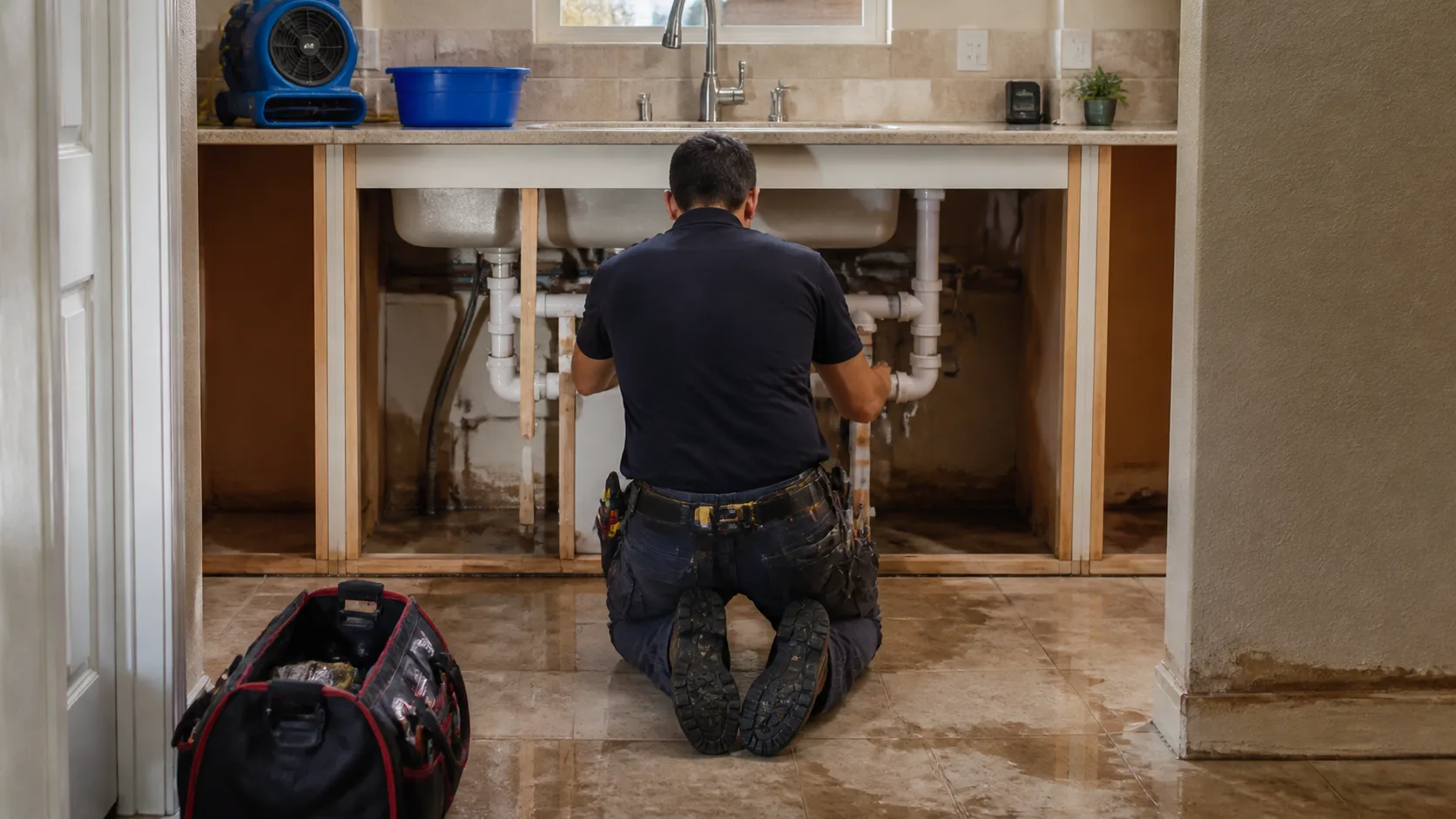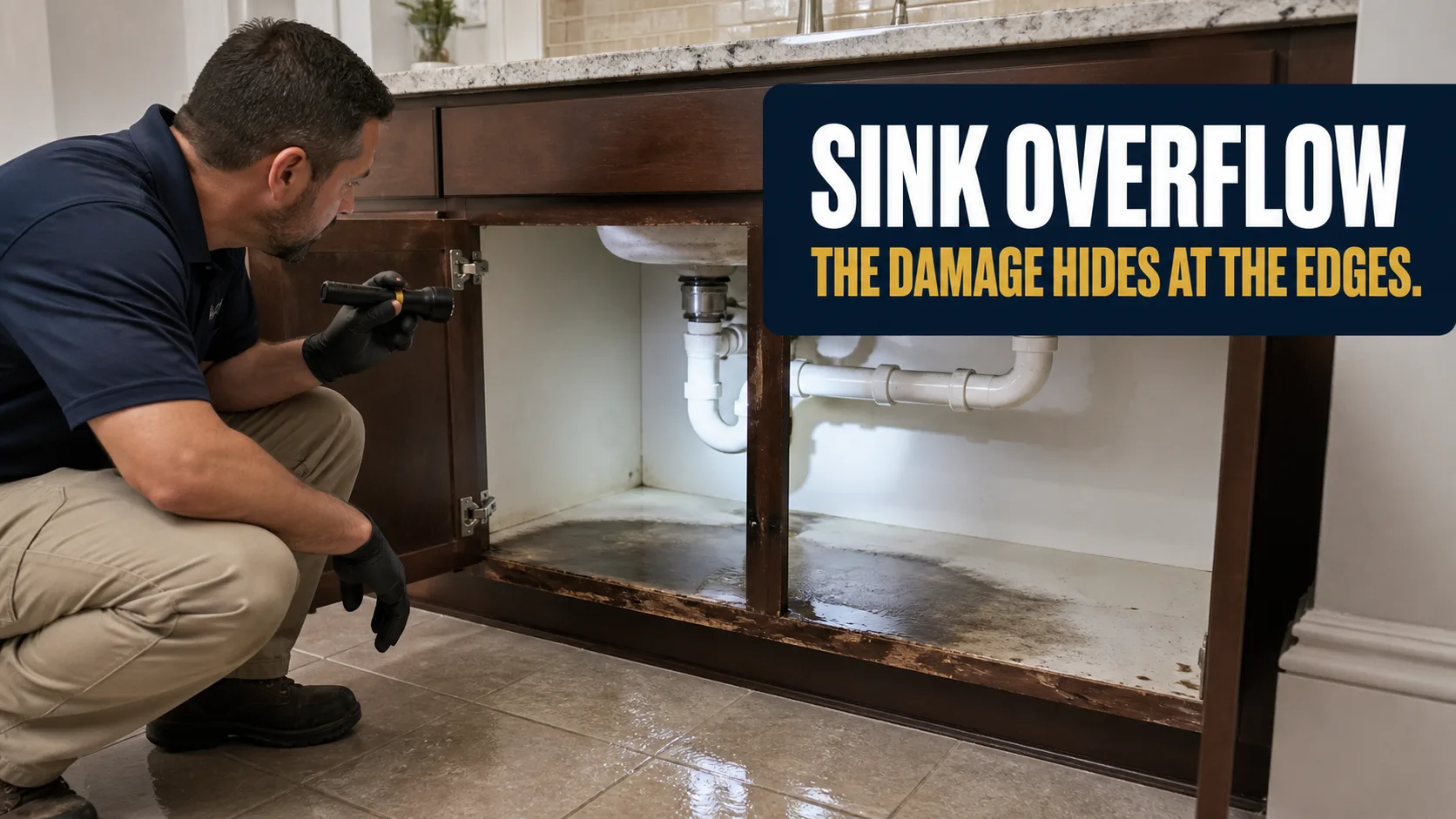
Turn off the faucet or, if the water is coming *up* the drain, stop using water and treat it as a possible line backup. Extract standing water fast, empty and dry the cabinet below, and check the two places overflow water actually causes trouble: inside the cabinet (particleboard floors swell within hours) and at the room's edges, where water slips under baseboards and flooring. Surface-dry by dinner does not mean dry.
Two very different overflows
Water from above — a faucet left running against a closed or slow drain. Clean water, simple cause, and the response below.
Water from below — the sink filling by itself from the drain. That is not this page: water rising in fixtures means a blockage in the branch or main line pushing wastewater back up, and it escalates to sewer backup rules. Stop all water use in the house and read that guide instead.
What to do right now
- Stop the source — faucet off; if the drain is blocked and the disposal is involved, don’t run it “to help.”
- Extract standing water from counter and floor — towels, mop, wet/dry vac.
- Empty the cabinet below completely. Everything out, cabinet doors open, a fan pointed in. Cabinet floors are usually particleboard: they wick, swell, and delaminate fast, and a closed wet cabinet stays humid for weeks.
- Trace the water’s full path. Along the backsplash (into the wall seam?), off the counter edges (which side?), across the floor (did it reach walls or baseboards?).
- Photograph as found, before and during cleanup.
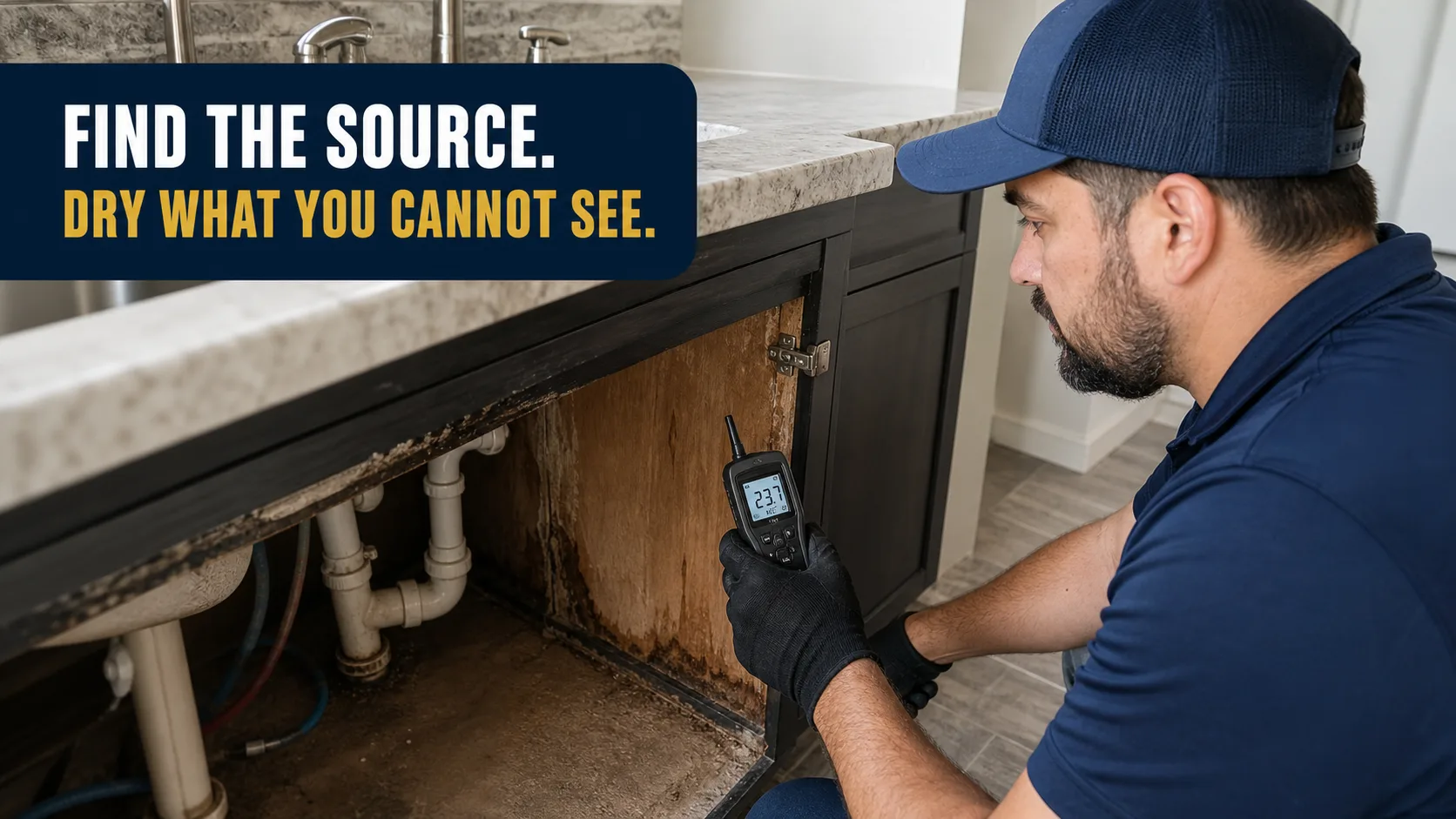
- Meter the edges if it pooled. Baseboards, flooring seams, cabinet toe-kicks. Ten minutes with a meter beats three months of wondering about the smell.
Warning signs the water went somewhere you have not looked
The counter dries in twenty minutes. These are the things telling you the rest of it did not.
The cabinet took the first of it:
- A dark line along the back edge of the cabinet floor, or a deck that flexes under a thumb
- Damp stored items, or bottles with wet bases, at the back where nobody looks
- A closed cabinet that smells different from the room an hour later
The water reached the room’s edges:
- Flooring seams darkening or lifting a foot or two out from the sink
- Baseboard swelling along its bottom inch, or paint blistering at the base of a wall
- A cool, damp feel underfoot at a threshold or an appliance bay
It got into the wall behind the backsplash: staining above the counter line, a fastener showing rust, or a musty smell at the counter-to-wall seam that returns after cleaning. That seam is the one route out of the room that shows nothing from either side.
Where overflow water hides
A sink overflow looks like the most superficial of water events — and on the counter, it is. The trouble is gravity plus geometry:
- The cabinet below catches the first and worst of it, through the faucet cutouts and the counter seam. Check the cabinet ceiling (underside of counter), floor, and the wall behind.
- The counter-to-wall seam feeds water into the wall cavity behind the backsplash — invisible from both sides.
- The floor’s edges: kitchens and baths are built with gaps at baseboards, thresholds, and appliance bays. Pooled water finds all of them, and the layer under the flooring dries at Houston-humidity speed, which is to say barely.
If more than a minute or two ran, or you found water at any edge: text a photo to (346) 271-7004 and we will tell you whether it needs a professional reading or just your fan and patience.
What you can check yourself tonight
Twenty minutes, no cost, and it decides whether this is a mop job or a metered one.
- Empty the cabinet below completely and take a flashlight to the back corners.
- Push a thumb hard into the cabinet deck at the back corners and along the front edge. Give means the particleboard core took water.
- Trace the water’s path out of the room. Which counter edge did it run off, and did it reach a wall, a threshold, or an appliance bay?
- Run a dry hand along the bottom inch of every baseboard it could have reached, and behind the toe-kicks either side.
- Press a paper towel into the flooring seams two and three feet out. Damp paper is a finding.
- Kill the breaker for that circuit if water ran across the counter into the backsplash outlets or down the disposal’s cord, and leave it off until the devices are dry and tested.
- Photograph everything with the date stamp on before and during cleanup, and write down the date and time.
What does a sink overflow cost to put right?
Most of them cost an hour with towels. The ones that do not are separated by how long the water ran, whether it got into the cabinet, and whether it reached the room’s edges.
- Runtime, not volume. An unattended faucet for twenty minutes is a different loss from a full basin tipped over.
- Whether the cabinet deck comes out. Swollen particleboard does not dry back to flat, and removing it is the only honest way to read the subfloor beneath.
- How far it traveled under the flooring. Vinyl plank and laminate carry water sideways on their underlayment, so the wet zone meters wider than the stain.
- Whether it reached a wall cavity. Water through the counter-to-wall seam adds a wall dry-out, and whether that drywall dries in place or comes out is a meter decision.
- Whether it went through a floor. An upstairs overflow that stained the ceiling below is a ceiling job as well, insulation and both drywall faces in scope.
A cabinet and its immediate flooring, caught the same day, usually runs in the high hundreds. It moves into the low thousands once the deck and a section of subfloor come out or a wall cavity is involved — the structure is in what mitigation costs in Houston.
How long does the drying take?
Two to four days for a cabinet and the flooring around it, once the cabinet is emptied, the doors are off, and air is pushing into the box rather than across the front of it. Longer when the deck came out, when water got into a wall cavity, or when a ceiling below is involved.
Readings decide the end date, not the calendar. Deck, subfloor, wall bottom plate and flooring edges all have to hit dry standard before anything goes back in. In this climate the surrounding air is already carrying enough moisture that a wet cabinet deck has almost no gradient to dry into, which is why equipment beats patience here — more in what sets a drying timeline.
Does insurance cover a sink overflow?
An accidental overflow — a tap left running, a sudden drain blockage — is generally treated as sudden and accidental discharge and covered, subject to your deductible.
The harder question is whether to file. Small overflows often land below the deductible, and a claim stays visible to carriers for about five years. Run the number first: if the cabinet, the flooring and a few days of equipment come in under or barely over the deductible, paying it yourself is usually the better trade. Document it anyway — dated photos and a moisture reading cost nothing and matter enormously if a smell or a stain surfaces months later. If water came up the drain rather than over the rim, different rules apply entirely, and that coverage is a separate endorsement most policies do not include by default.
What NOT to do
- Don’t close wet items back into the cabinet — the cabinet is a humidor.
- Don’t caulk over a swollen counter seam — you will seal moisture in.
- Don’t rely on the overflow hole to protect an unattended sink. It handles a trickle at best.
Prevention
- Never leave a filling sink unattended — the entire failure mode is attention
- Keep drains flowing; a sink that drains slowly today is the blocked drain in next month’s overflow
- A $15 water alarm on the cabinet floor catches both overflows and the slow trap and supply leaks that share that cabinet
- Teach the household where the main shut-off is — overflows are the beginner event; the habit pays off on the serious ones
The free things worth doing tonight
- Stop the source, and if the drain is blocked, stop using that fixture rather than running the disposal to help it along.
- Extract standing water from the counter and floor — towels, mop, wet/dry vac.
- Empty the cabinet completely, take the doors off their hinges, and point a fan into the box rather than across the front of it.
- Pull anything absorbent off the wet floor and get furniture legs onto foil or blocks.
- Pull loose baseboard away where it has already released, so air can reach behind it.
- Run a dehumidifier and shut the room off from the rest of the house. Do not open the windows — Houston outdoor air is usually wetter than what you are trying to dry.
- Photograph everything with the date stamp on and write down the date and time.
Where the plumber ends and we begin
TruePoint Restoration is not a plumbing company. We do not clear drains, replace disposals, or re-run traps, and we say so on the phone rather than after the estimate. A blocked drain is a plumber’s work, and water rising up a drain rather than over a rim is not an overflow at all — it is a sewer backup, with its own rules and its own risks.
Our part is the water that left the room: metering the cabinet deck, the subfloor, the wall bottom behind the counter and the flooring edges to find the real edge of the wet area, removing what cannot be dried, drying the rest with logged daily readings, and documenting it if this becomes a claim.
Most sink overflows do not need us, and we will say so. If more than a minute or two ran, or you found water at any edge, send photos to (346) 271-7004. We serve Pearland, Manvel, Friendswood, League City and the Greater Houston area.