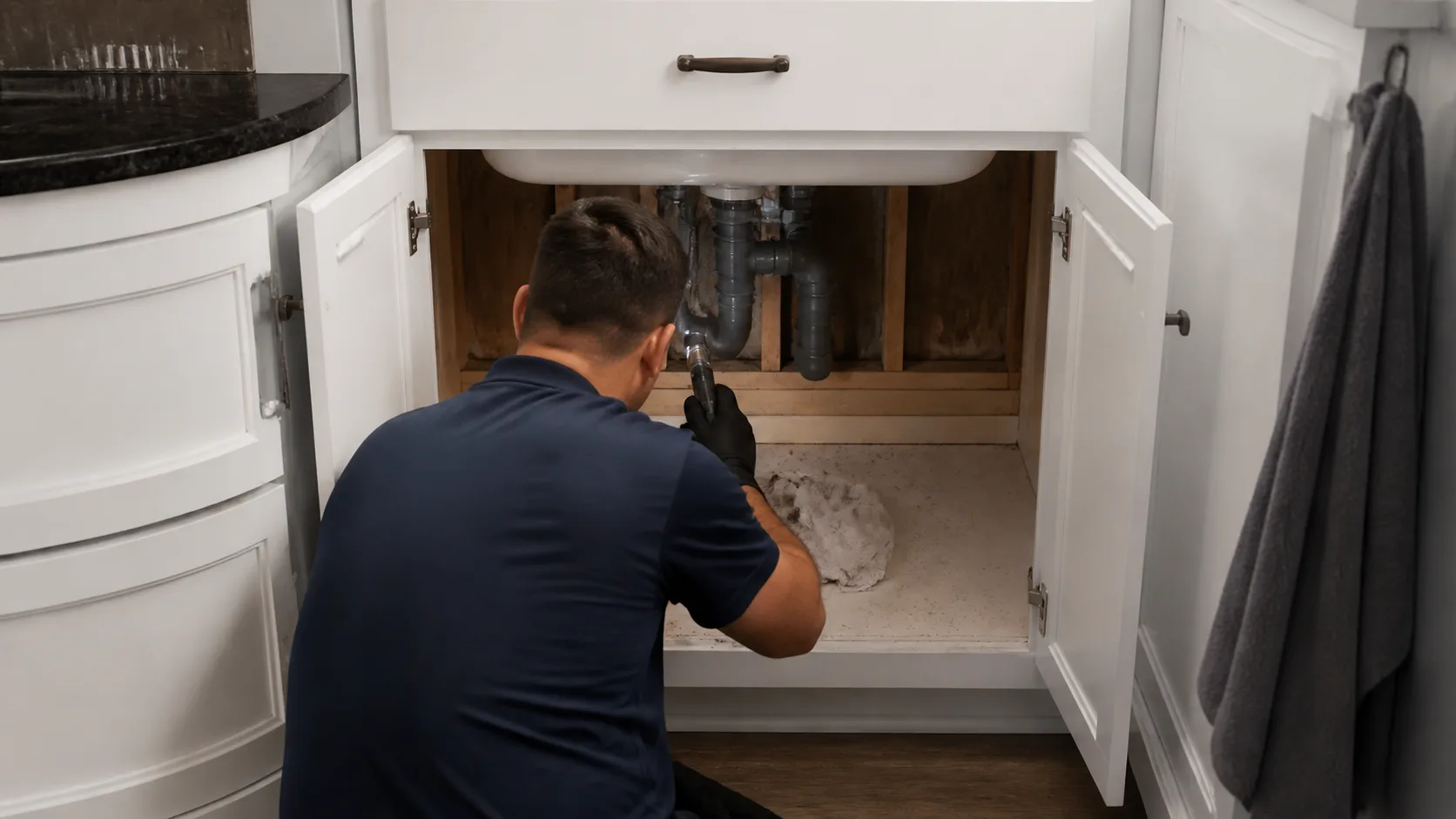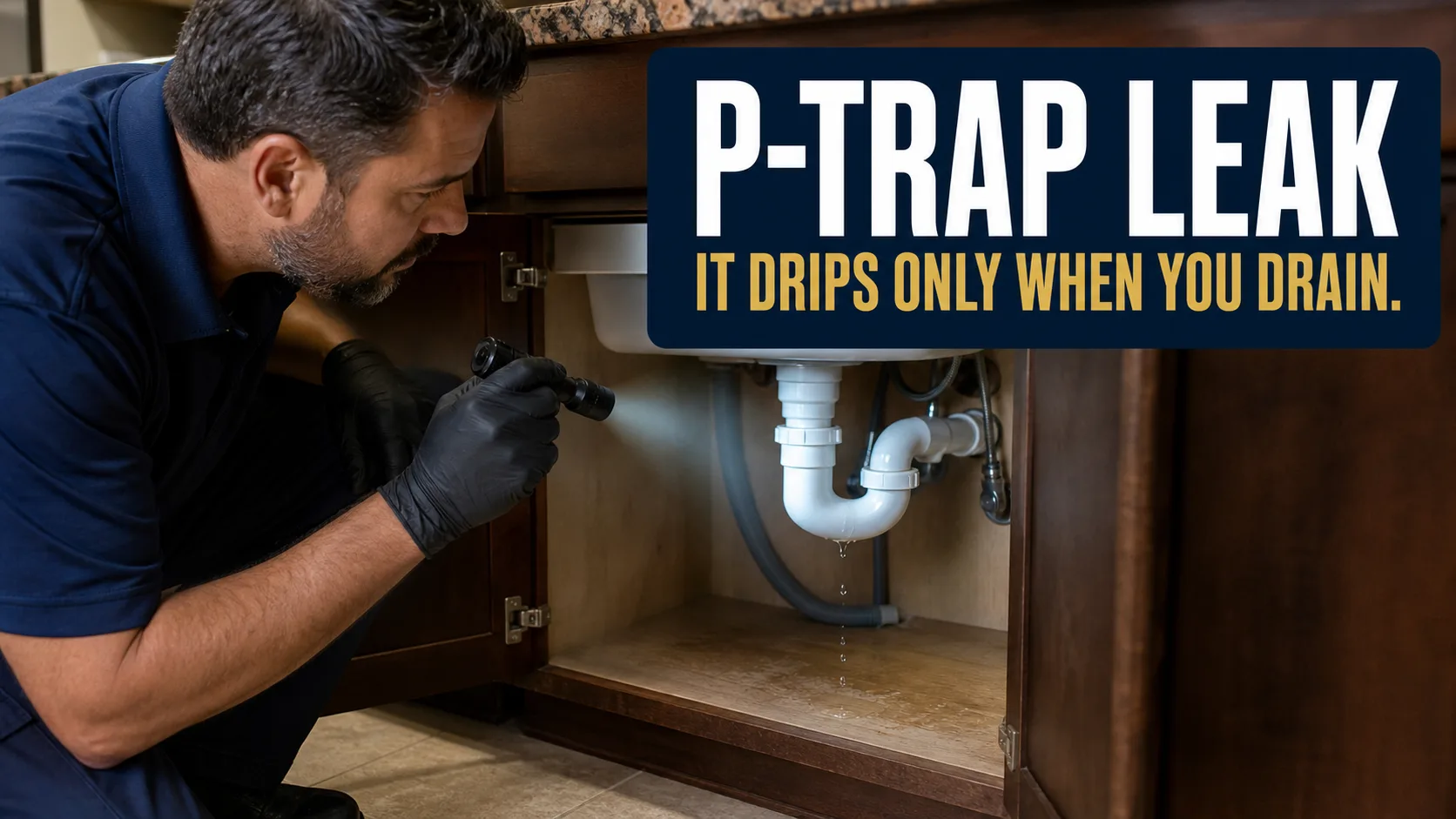
A P-trap leaks only when water flows through it, so confirm it with a controlled test: dry everything, paper towels under the trap, fill the basin, release. Drips during drain-down = trap or slip joints. The fix is usually a washer, a snugged slip nut, or a $10 trap kit — genuinely DIY. The part that is not optional: pulling everything out of the cabinet and honestly assessing what months of intermittent drips did to the cabinet floor below.
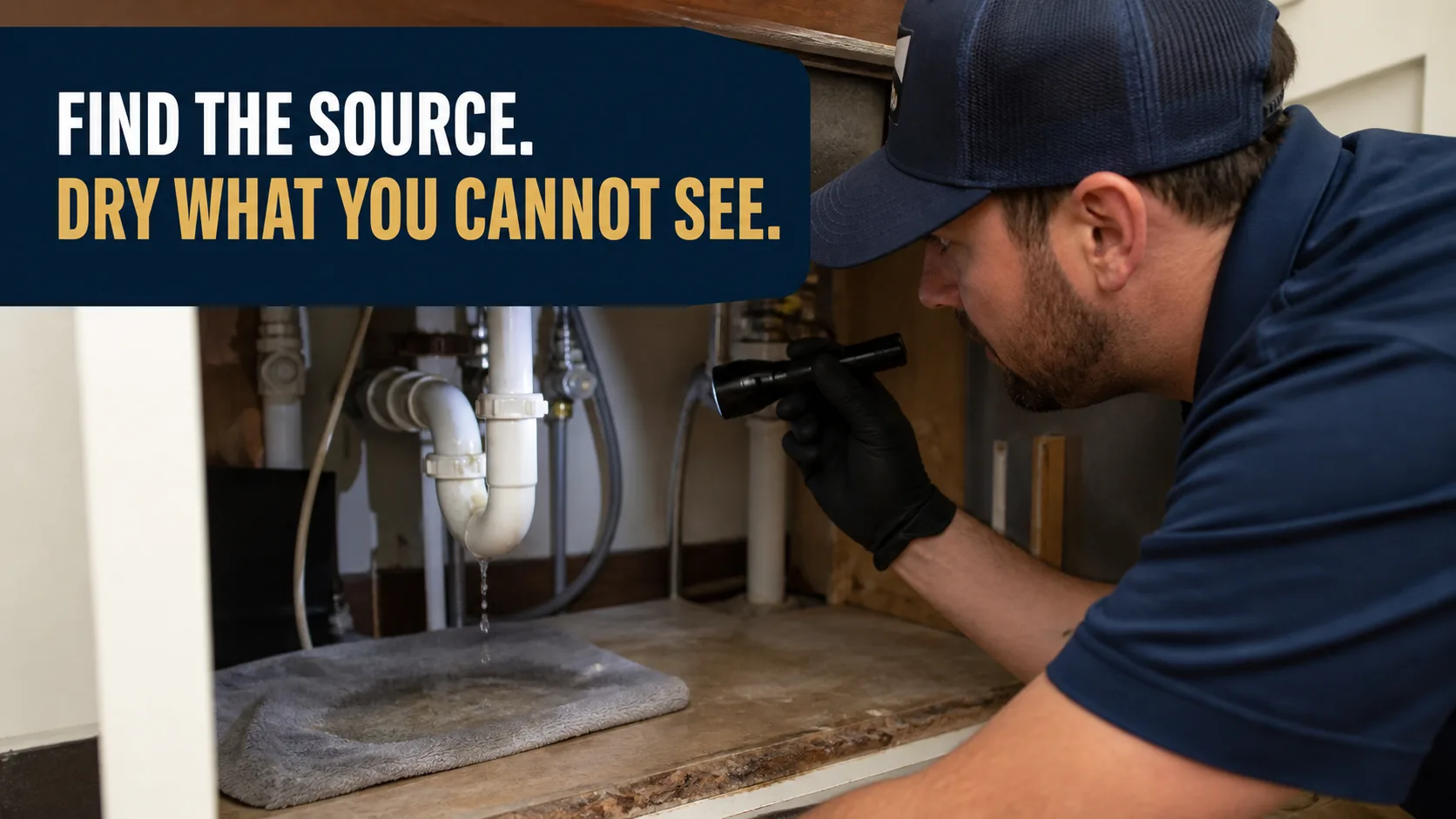
What the trap does
That U-bend under the sink is not a design quirk — it holds a standing plug of water that seals sewer gas out of your house. Every drain has one. It also happens to be assembled from the loosest connections in your plumbing: slip joints with plastic washers, hand-tightened, taken apart every time someone retrieves a ring.
Which makes it the most commonly disturbed, most casually reassembled joint under the sink — and a steady producer of slow leaks.
Why trap leaks fool people
Three reasons this leak runs longer than it should:
- It only leaks under flow. Check the pipes at random and they are dry. The leak exists for the ninety seconds a day the sink drains.
- It often leaks under volume only. A trickle passes; a full basin released at once finds the bad washer. Rinse your hands for a week: dry. Drain the pasta pot: drip.
- The evidence lands where nobody looks — the back half of a cabinet floor behind the cleaning supplies.
The warning signs, none of which look like a leak
A trap leak does not announce itself with a puddle. It announces itself with a cabinet that has changed.
The cabinet is holding water: the deck darkening at the back corners, the front edge swelling where it meets the door frame, a shelf liner that will not dry, or rust rings under anything metal stored down there.
The air has changed: a musty note when you open the doors that was not there last year, strongest low and worst on a humid morning. That is the smell a slow leak makes once material has been damp long enough to support growth.
Something outside the cabinet is wet: baseboard swelling on the far side of an island, flooring lifting at a seam several feet away, or a stain on the ceiling below an upstairs sink. Water runs off the back of the deck into the toe-kick space and travels along the slab from there.
The hardware is corroding: green or white crust on the slip nuts, or a metal trap that flakes when touched. Houston-area supply runs hard at around 10 grains per gallon, so scale works on chrome-plated brass from the inside while the humidity works on it from the outside.
The confirm-it test
- Towel-dry the trap, slip nuts, and tailpiece.
- Paper towels flat under the whole assembly.
- Fill the basin high. Release all at once.
- Watch the joints and check the towels.
- Repeat with hot water — heat expands a marginal joint.
Wet during drain-down: trap side. Wet at other times: faucet or supply side — different problem, more urgent, because supply is pressurized.
Fixing it
Most trap leaks are one of these, in order of likelihood:
- Loose slip nut — hand-snug plus at most a quarter turn with pliers. Over-tightening cracks plastic nuts and deforms washers; it is the most common way a “fix” creates the next leak.
- Worn or misseated washer — the beveled washers cost pennies; note their orientation (bevel toward the joint) when replacing.
- Cracked trap body — hairline cracks in old PVC or, on chrome-plated metal traps, corrosion from the inside out. Metal traps that show green/white crust or flake when touched are done: replace with a PVC kit, a few dollars and fifteen minutes.
- Misalignment — if the trap only seals when forced into position, the tailpiece and waste arm are out of line; correcting the geometry beats forever re-tightening the symptom.
No shut-off needed for trap work — just don’t run the faucet while it’s apart.
The part people skip: the cabinet
The repair takes fifteen minutes. Then comes the question that actually matters: how long was it dripping before you caught it?
Empty the cabinet completely and inspect the floor, especially the back corners: swelling, delamination, dark staining, mold spotting on the underside (lift the front edge if it’s loose), and the wall behind the cabinet. Gray water plus enclosed space plus Houston humidity is the standard recipe — cabinet interiors are among the most common places we find established mold behind a “minor” leak.
Looks rough, smells musty, or the particleboard has gone soft? Get a reading before restocking the cabinet: (346) 271-7004, a photo is enough to tell you which way it goes.
The twenty-minute cabinet inspection
Doors open, flashlight in hand, before anything goes back in.
- Empty the cabinet completely, shelf liner included. You cannot assess a deck you cannot see.
- Press hard into the back corners with a thumb. Firm is firm. Any give means the core has absorbed water and the panel is done.
- Lift the front edge of the deck if it is loose and look underneath. Growth shows there first, because the underside stays dark and never gets wiped.
- Run a dry hand up the wall behind the trap, then check outside the cabinet — the toe kick, the baseboard either side, and the flooring seam in front of the sink.
- Photograph all of it with the date stamp on, dry parts included. If the leak turns out to have reached the room, that dated set is the only record of what the cabinet looked like before anyone worked on it.
Soft, dark, or musty means the wet zone is wider than the cabinet, and that is a meter question rather than a fan question.
What does a trap leak actually cost?
The repair is the cheap half and it is nearly free: a PVC trap kit is $8 to $15, washers are pennies, and a plumber called out for only this runs $150 to $250. What varies is everything under it.
- How long it dripped. Weeks means dry the deck. A year means replace it.
- What the deck is made of. Particleboard absorbs water into its core and swells permanently — it gets cut out and replaced with plywood. Sealed plywood and solid wood often dry.
- Whether it left the cabinet. Water on the slab under the toe kick travels sideways, and a wet baseboard across the kitchen turns one cabinet into a room.
- Whether anything grew. Enclosed, unventilated, gray water, Gulf Coast humidity — cabinet interiors are one of the most common places mold gets established behind a minor leak.
Working range: a cabinet deck replaced with the surrounding material dried commonly runs in the high hundreds to low thousands, and climbs when the flooring beyond the toe kick is involved. It also commonly falls under a Texas deductible, which is why most trap leaks are paid out of pocket rather than filed.
How long does a wet cabinet take to dry?
Two to four days with the doors off and air pushed into the cabinet, longer when water reached the wall cavity behind the trap. Enclosed spaces dry slowly because the air inside them does not move, and in Gulf Coast humidity the room air will not pull moisture out of a cabinet for you.
Readings decide the end, not the calendar. The deck gets metered against the same material somewhere dry in the same kitchen, and restocking happens on the reading — drying timelines follow depth and material, never how small the leak looked.
Prevention
- After any trap disassembly (retrieving jewelry, clearing a clog), run the full-basin test before closing the cabinet
- Replace washers whenever the trap is opened — they are pennies, and reused washers are the top cause of the next leak
- Include one dry-fingered touch of the trap in your twice-yearly walkthrough
- A water alarm on the cabinet floor covers the trap, the supply lines, and the faucet base all at once
Where the plumber ends and we begin
TruePoint Restoration is not a plumbing company. We do not replace traps, tighten slip joints, or swap out garbage disposals, and we are not the cabinet shop that builds you a new deck. Most trap leaks are a $10 part and fifteen minutes you can do yourself.
What we do is the part that outlasts the repair: metering the deck, the wall behind it, the toe kick and the flooring outside it, removing material that absorbed water into its core, drying an enclosed space with equipment that actually moves air through it, and remediating mold when a leak ran long enough to start some.
Send a photo of the cabinet floor to (346) 271-7004 before you restock it. Sometimes the honest answer is doors off and a fan for four days, and we would rather say that. We serve Pearland, Manvel, Friendswood, League City and the Greater Houston area.