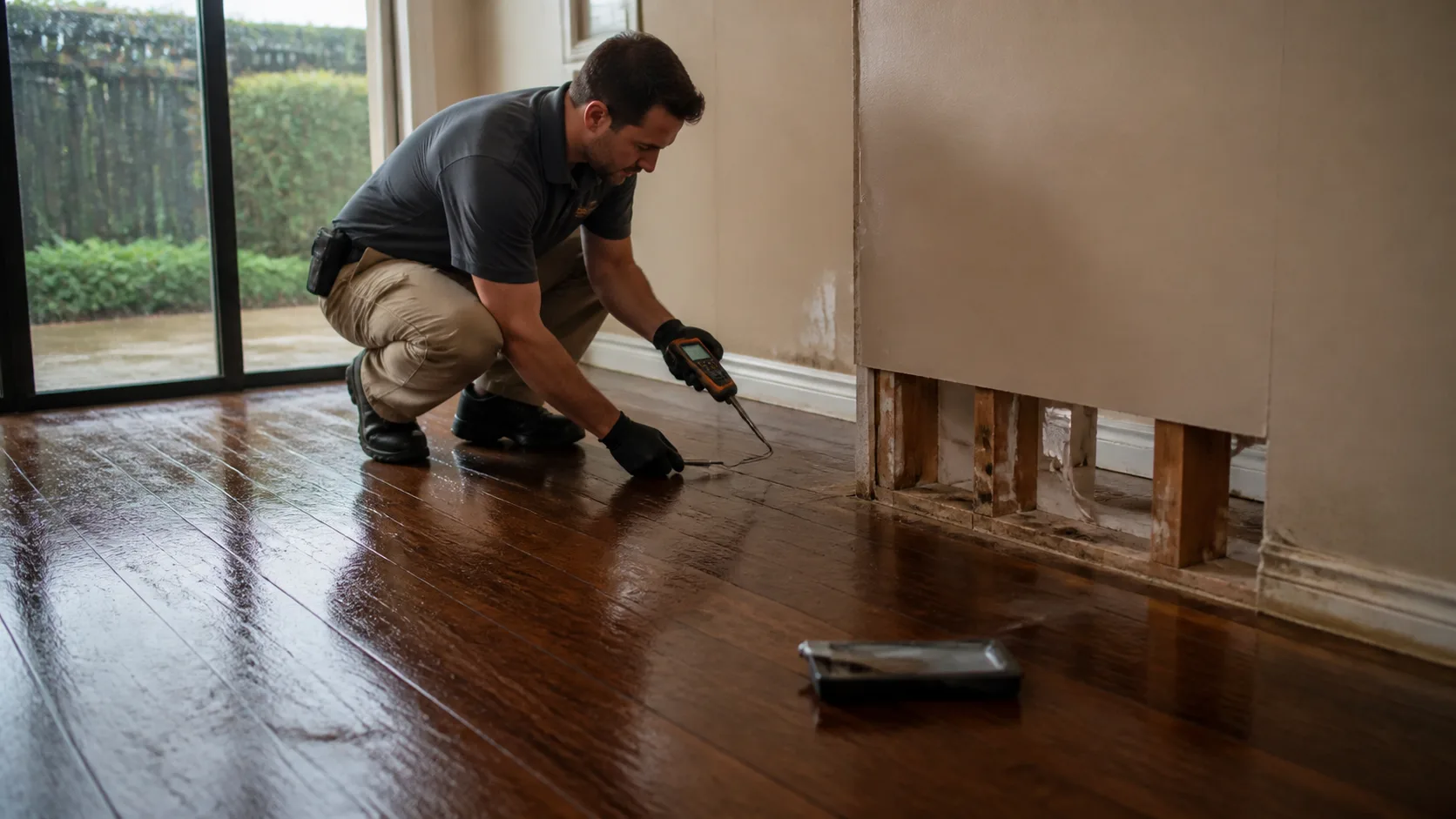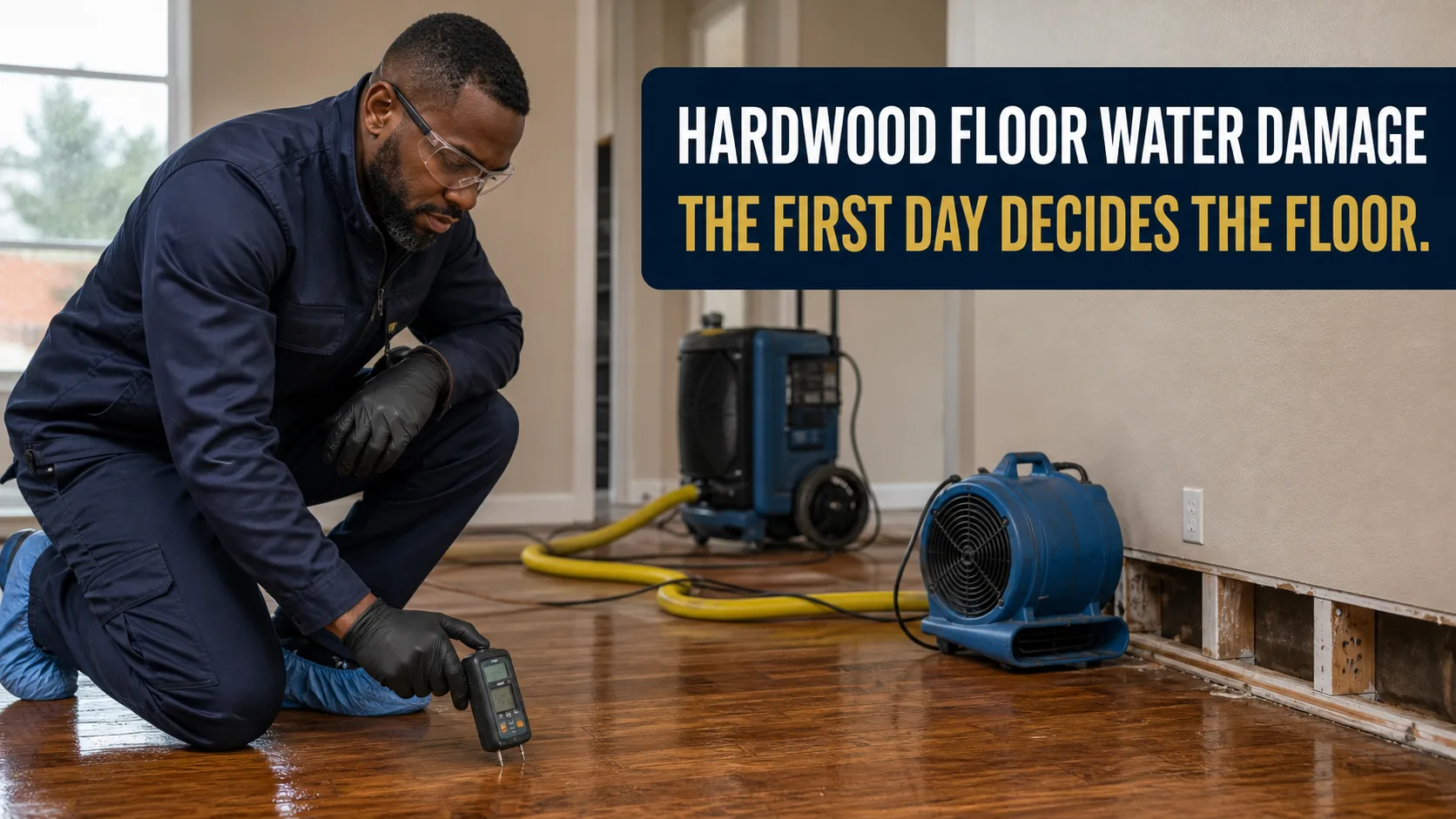
Whether your hardwood floor can be saved comes down to how fast it's dried. Wood wicks water quickly, so **cupping can start within hours**. A floor dried in place with proper equipment before it warps badly can often be sanded and refinished; a floor that stayed wet for days or buckled off the subfloor usually needs boards replaced. Get standing water off it now, don't sand it while it's wet, and call **(346) 271-7004** for real floor-drying — a box fan won't reach the moisture underneath.
Why wood floors are so unforgiving
Hardwood is designed to sit at a stable moisture content. Add water — from above or, worse, from below through the subfloor — and each board swells. Because the boards are locked together and fastened down, they can’t expand sideways, so they deform instead. That’s what cupping, crowning, and buckling are: the wood physically running out of room.
The catch is that most of the damaging water is under the floor, in the subfloor and between the boards, where a towel and a household fan never reach.
Reading the damage
- Cupping — board edges rise above the centers, making a washboard feel. Earliest sign; means moisture is coming from below.
- Crowning — centers rise above the edges. Often happens when a cupped floor was sanded too soon and then dried.
- Buckling — boards lift off the subfloor entirely. The most severe; usually means prolonged saturation.
- Staining and gaps — dark spots (water reacting with the wood and finish) and separations as boards move.
Warning signs the water is still under the boards
Wood floors dry from the top down, which means the surface looks recovered while the subfloor underneath is still holding water.
The floor is still wet underneath:
- Cupping that got better and then came back, which is the surface releasing moisture and the subfloor feeding it straight back
- A hollow or spongy sound when you walk one section compared with the rest
- Gaps at the board ends closing, then reopening a week later as the wood cycles
It reached the wall and the subfloor:
- Baseboard swollen or lifting where it meets the floor
- Carpet or tile in the next room feeling cool and heavy at the transition strip
- A musty smell rising from the floor when a rug has been down all day
It has gone too far to save in place: boards lifting off the subfloor, black staining that runs with the grain, finish clouding or peeling in sheets, or nails and staples backing out along a seam.
What to do right now
- Get the water off. Extract standing water immediately; every hour it sits, more wicks into the boards and subfloor.
- Pull rugs and furniture off the wet area so they don’t trap moisture or stain the floor.
- Don’t crank the heat or sand anything. Fast, uneven drying and premature sanding both lock in permanent damage.
- Photograph it — the standing water, the cupping, the source — for the claim.
- Call for real floor drying. Specialized systems pull moisture from beneath the boards and monitor the wood’s moisture content until it’s back to normal. (346) 271-7004.
What you can check yourself tonight
- Lay a straightedge across the boards — a level, a shelf, anything rigid. Light under the middle is cupping. Light under the ends is crowning. Photograph it with the straightedge in the frame, because that photo reads as evidence in a way a bare floor never does.
- Walk it barefoot and listen. Cool underfoot and a dull, dead sound means the subfloor is still holding water.
- Lift a floor vent or a transition strip and look down at the subfloor with a flashlight. It is the only free window into the layer that decides the outcome.
- Pull the rugs and leave them off. Anything on top of a drying floor traps moisture and stains the finish where it sat.
- Check the room below, if there is one. A ceiling stain underneath tells you the water went all the way through.
- Photograph the whole floor with the date stamp on, wide and then close on the worst boards, before anyone puts a fan on it.
Save-or-replace, honestly
- Likely savable: clean water, caught fast, mild cupping, dried in place with floor equipment and monitored to a normal moisture reading, then refinished.
- Likely replaced: days of saturation, buckling, black staining, or contaminated water (a dishwasher or sewage source) that soaked the boards.
- The subfloor matters too: even if the boards are replaced, the subfloor underneath has to be dried and verified — or the new floor fails the same way.
What hardwood drying and replacement cost
Wood is the most expensive material in a water loss to get wrong, and the cheapest to get right if you move on day one.
- Specialty drying equipment. Pulling water out from under a floor takes a mat system and panels, not air movers pointed at the surface. That equipment is a separate line and it runs longer than the rest of the job.
- Square footage and layout. Continuous flooring that runs through several rooms is one system with no natural stopping point, which is why the affected area is usually larger than the wet area.
- Engineered versus solid. Solid wood can often be dried and refinished. Engineered plank with a thin wear layer usually cannot take a sand, so it is replaced instead.
- The subfloor. If the plywood or OSB underneath stayed wet, it gets dried and verified or replaced, and that work happens whether the boards are saved or not.
- Refinishing. Sanding, staining and finishing after a successful dry is its own trade and its own invoice.
- Matching. Replacing part of a discontinued floor often means feathering into an area far larger than the damage, or replacing the whole run.
How long hardwood takes
Five to fourteen days with specialty floor drying equipment running continuously, and longer for a thick solid floor over a saturated subfloor. That is far longer than the three to five days the rest of the house needs, which is why the wood usually sets the schedule for the entire job.
Readings decide, not the calendar. Wood is dried to a moisture content target measured in the boards themselves and compared against unaffected wood in the same house, not to a look or a feel. Sanding or refinishing before it hits that number locks the deformation in permanently, and that is the mistake that turns a repairable floor into a replaced one.
What NOT to do
- Don’t sand a wet floor. It feels productive and it ruins the outcome; wait for a measured-dry reading.
- Don’t rely on a box fan. It dries the surface while the subfloor stays wet and the boards keep cupping.
- Don’t cover it back up with rugs or furniture until it reads dry — you’ll trap moisture and risk mold.
The realistic drying timeline for wood and everything else is here: how long does it take to dry out water damage.
Does insurance cover a water-damaged wood floor?
When the water event is covered and you acted quickly, generally yes — the carrier pays to dry, repair, or replace the flooring as resulting damage. Two things decide how much.
Speed, because a floor that was left to cup for a week reads as a delayed response, and delay is where carriers push back. And how the policy values it — a floor settled on actual cash value is depreciated for age and wear before you see a check, while replacement cost coverage pays to put an equivalent floor back. That difference is often thousands of dollars on flooring specifically, and it is explained in actual cash value versus replacement cost.
The free things worth doing tonight
- Work the wet vac across the boards rather than along them, so you are lifting water out of the seams instead of pushing it down them.
- Photograph it with a straightedge across the cupping, dated.
- Run the AC and a dehumidifier if you have one. Do not open the windows — on a humid Gulf Coast day the outdoor air carries more moisture than the indoor air, so opening up feeds the floor instead of drying it.
- Take the baseboards off the affected walls so the edge of the floor and the wall cavity can both breathe.
- Put foil or blocks under any furniture leg that has to stay in the room, so nothing stains the finish where it sits.
Where the flooring contractor begins and we end
TruePoint Restoration is a mitigation and remediation contractor. We do not sand, stain, or refinish floors, we do not install new hardwood, we do not repair the appliance or the pipe that soaked it, and we are not a public adjuster. Refinishing and replacement are a flooring trade with its own contract, and we say so rather than blurring the line.
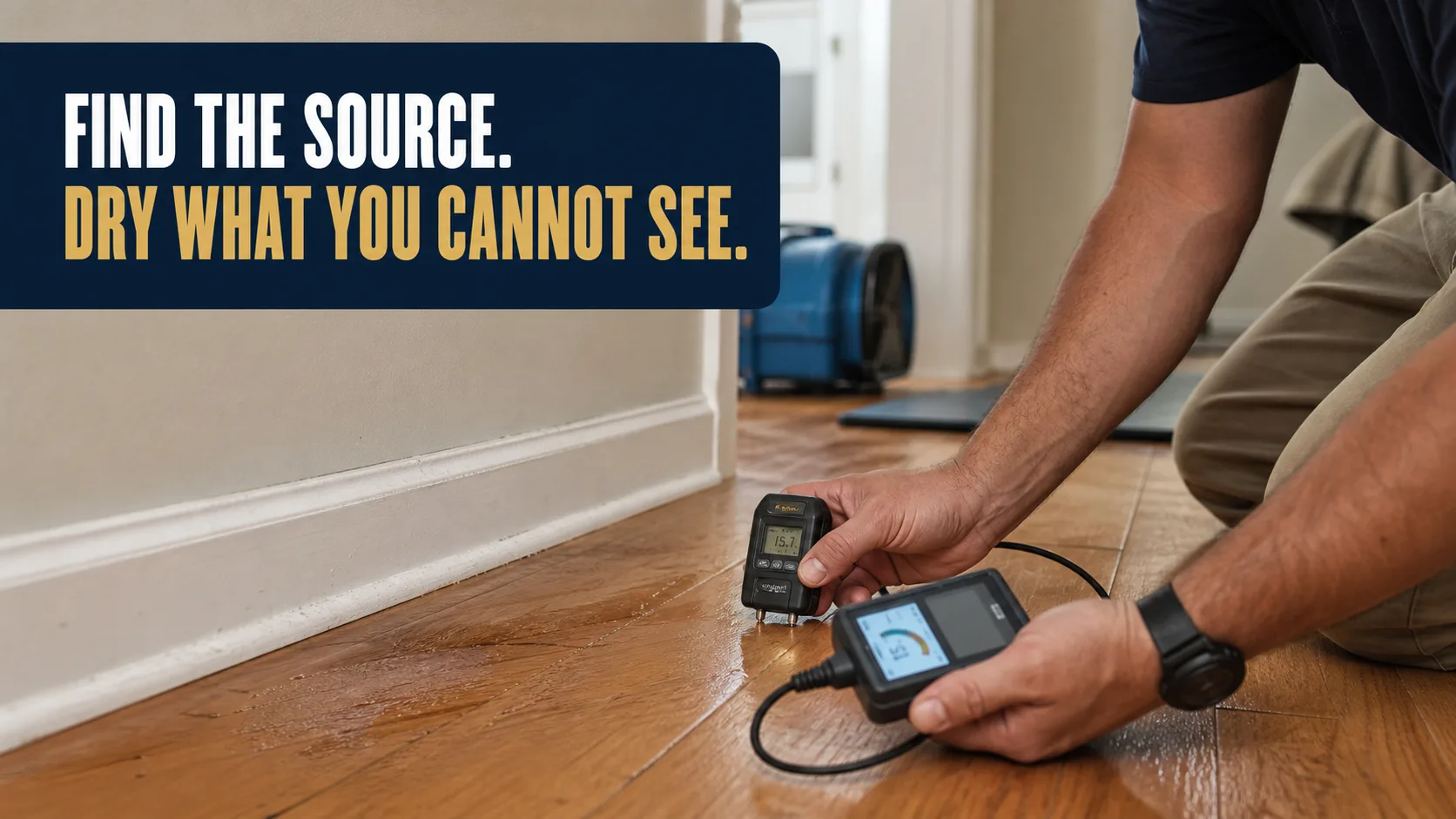
Our part is the race you win in the first day: extraction, specialty floor drying that pulls moisture from under the boards instead of off the top of them, daily moisture content readings on the wood and the subfloor compared against unaffected areas of the same house, the honest save-or-replace call once those readings are in, and the documented file your adjuster and your flooring contractor both work from.
Call (346) 271-7004. We work out of Pearland and serve Manvel, Friendswood, League City, Pasadena, Sugar Land and the Greater Houston area.