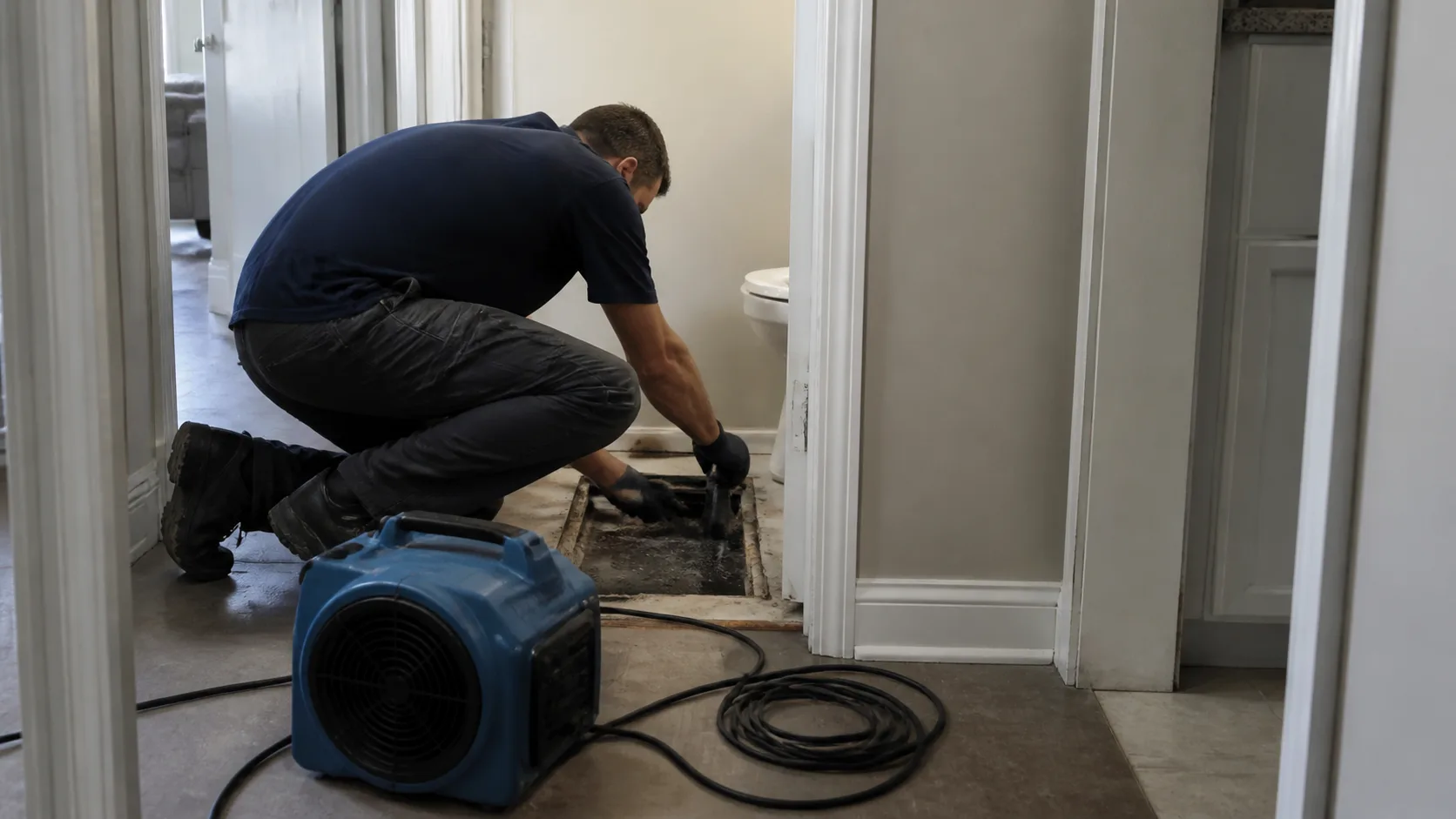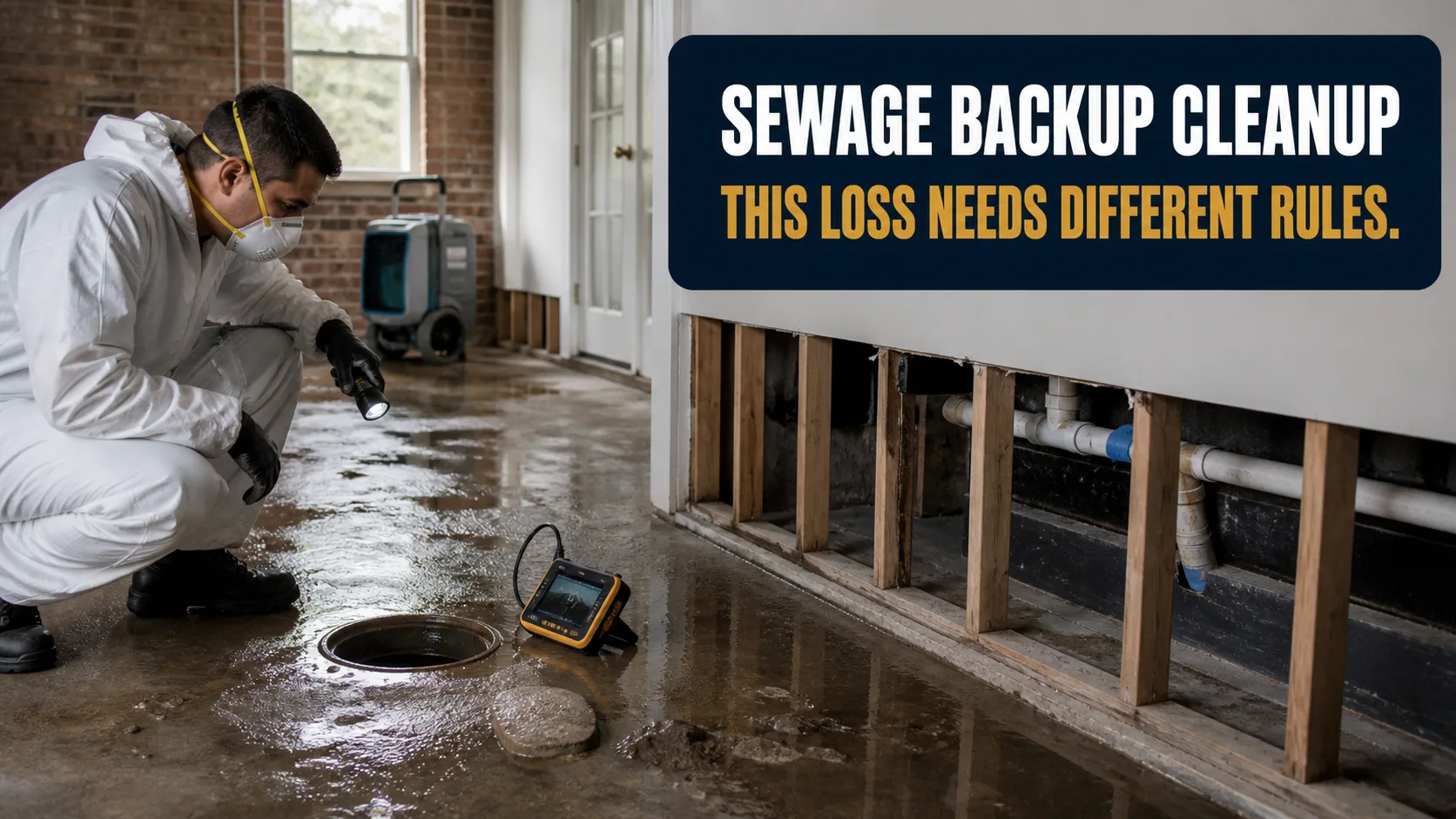
Sewage is Category 3 water, so the work is decontamination rather than drying. Proper cleanup means containment, extraction, removal of porous materials that absorbed it, cleaning and antimicrobial treatment of what stays, structural drying, and verification you can document. Small contained backups typically run a few thousand dollars and larger ones considerably more. Call **(346) 271-7004** before anyone walks through it.
Why is sewage backup treated differently from other water damage?
Because the problem is contamination, not moisture. Nearly every other water loss is a drying problem — get the water out, get the materials back to dry standard, and the house is fine. Sewage inverts that. You could dry a sewage-soaked carpet perfectly and still have a contaminated carpet, because what was in the water stayed behind when the water left.
The restoration industry sorts water into three categories, and the category is what dictates the method. This page covers the cleanup itself — the process, the decisions, and the cost. If you are in the middle of an active backup right now and need to know what to do in the next ten minutes, start with what to do during a sewer backup and come back to this afterward.
The three water categories, and why Category 3 changes the job
| Category | What it is | Examples | How porous materials are handled |
|---|---|---|---|
| 1 — Clean | Water from a sanitary source | Supply line break, overflowing tub of clean water, water heater tank | Usually dried in place if reached quickly |
| 2 — Gray | Used water with some contamination | Dishwasher or washing machine discharge, toilet overflow with urine only | Cleaned and dried, or removed if it sat too long |
| 3 — Black | Grossly contaminated, carries harmful agents | Sewage, toilet backup containing waste, rising flood water from outside | Removed and disposed of, not dried |
Two details in that table do most of the work. First, a Category 1 loss degrades into Category 2 and then Category 3 the longer it sits, which is why a clean leak found in a week is not treated like a clean leak found in an hour. Second, Category 3 removes the salvage question for anything porous. There is no drying curve that decontaminates a carpet pad.
Can I clean up a sewage backup myself?
Genuinely, no — not once it has touched anything absorbent. This is the rare case where the honest advice from a company that sells cleanup happens to line up with what a company that sells nothing would tell you.
Three specific reasons:
- Surface cleaning does not reach absorbed contamination. Disinfectant on top of a carpet, a pad, or the bottom eight inches of drywall treats the face of a material that is contaminated through its thickness.
- The standard DIY tools make it worse. A household wet/dry vac exhausts aerosolized contamination into the room and is itself contaminated afterward. Fans, run before containment exists, push it into clean parts of the house. Mopping spreads it across grout lines that will hold it.
- Exposure is a real hazard. Sewage carries bacteria, viruses, and parasites, and the routes in are skin contact, hand-to-face, and inhaled droplets. Professional crews use containment, respirators, and full protection for a reason. If you had contact with sewage and feel unwell afterward, talk to a doctor — that is a question for them, not for a restoration company.
The one exception worth naming: a small overflow on hard, sealed flooring, wiped up promptly with gloves and disinfectant and nothing porous involved, is a reasonable thing to handle yourself.
What does professional sewage backup cleanup involve?
It runs as a sequence, and skipping a step shows up later as odor, mold, or a claim that does not close cleanly.
- Containment first. Plastic barriers and negative air pressure isolate the affected zone before anything is disturbed, so the cleanup does not become the thing that spreads contamination. HVAC gets shut down if any vent, return, or duct is in the area.
- Extraction. Contaminated liquid and solids are removed with equipment built for it, into contained waste, not into a shop vac in a garage.
- Removal of porous materials. Carpet, pad, saturated insulation, particleboard, and drywall that wicked sewage upward are cut out and bagged at the source rather than carried through the house. Where the cut line falls on the wall is a judgment call made with a meter — the same decision as remove or dry the drywall, but with contamination overriding the drying math.
- Cleaning of what remains. Hard surfaces, framing, and subfloor are cleaned to remove soil and residue. Cleaning comes before disinfection, because disinfectant applied over soil does not do its job.
- Antimicrobial treatment. Applied to cleaned surfaces and to exposed framing and subfloor once the contaminated materials are gone.
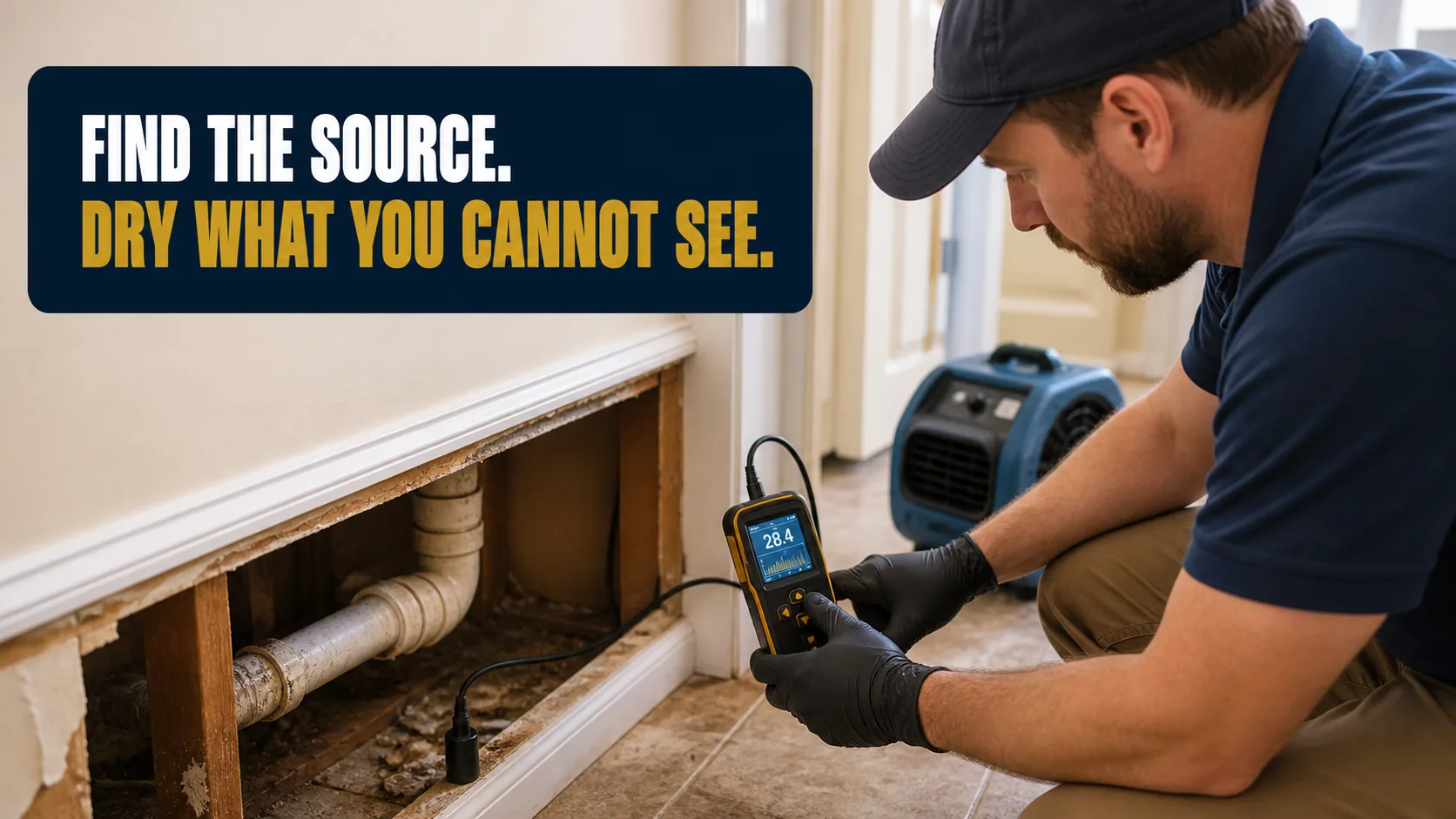
- Structural drying. Air movers and dehumidifiers run until materials reach dry standard. This part is identical to any other water loss and matters just as much — wet materials left past a day or two grow mold regardless of how well the surfaces were disinfected.
- Verification and documentation. Daily moisture readings, a record of what was removed and why, disposal records, and a final set of readings that show the job is finished. That file is what your adjuster wants and what a future buyer’s inspector may ask about.
What gets removed and what can be saved?
The rule of thumb is that porous goes, non-porous stays. Carpet and pad, upholstered furniture, mattresses, particleboard cabinetry, saturated insulation, and drywall that absorbed sewage are removed. Tile, sealed concrete, solid wood in some cases, metal, glass, and plastics can generally be cleaned and disinfected.
The gray areas are worth knowing about in advance:
- Hardwood flooring over a sewage loss is usually removed. Contamination gets into the seams and beneath, and the subfloor underneath needs cleaning it cannot get while the floor is down.
- Cabinetry depends on construction. Solid, sealed exteriors can often be cleaned; particleboard boxes and toe kicks that soaked usually cannot.
- Grout is porous even when the tile is not, which is why a tile floor may be cleanable while its grout lines need aggressive treatment or replacement.
- Personal belongings split the same way. Hard goods can be cleaned. Soft goods that absorbed sewage generally do not come back, and photographing them before disposal protects your contents claim.
What health precautions matter while this is happening?
Keep people and pets out of the affected area entirely, and treat the boundary as real. That is the single most useful precaution, and it costs nothing.
- Shoes that walked through it do not walk through the rest of the house
- HVAC off if any vent, return, or duct sits in or near the affected area, so the system does not distribute anything
- Nobody with a compromised immune system, and no small children, in the area at all
- If you must enter briefly, waterproof boots, sealed gloves, eye protection, and an N95 or better, with clothes changed and washed separately afterward
- Hand washing after any contact, and no eating or drinking anywhere near the zone
This is a hazard that professionals handle with equipment and containment for good reason. If contact happened and symptoms follow, that is a conversation for a doctor.
How much does sewage backup cleanup cost?
Cost tracks three things — how far it spread, how much porous material has to be removed, and how long it sat before work started.
| Scope | What is typically involved | Typical range |
|---|---|---|
| Contained to one bathroom, hard surfaces, caught same day | Containment, extraction, cleaning, antimicrobial, short dry | Low thousands |
| Crossed into carpeted or finished rooms | The above plus carpet, pad, baseboard, and drywall removal, multi-day drying | Several thousand to low five figures |
| Multi-room, subfloor, cabinetry, or HVAC involvement | Extensive removals, duct cleaning, longer drying, reconstruction to follow | Upper five figures and beyond |
Those are typical ranges and they vary a great deal by square footage, materials, access, and how long the sewage sat. Anyone quoting a firm number before seeing the loss is guessing. The general cost logic is the same as any water loss — what drives a mitigation number applies here too, with category acting as a multiplier all by itself.
One honest note about basements. Most Houston-area homes are slab-on-grade, so searches for basement sewage cleanup cost usually land on people whose lowest drain is a first-floor bathroom, utility room, or garage. The cost pattern is the same. True below-grade space, where it exists, runs higher because water pools deeper and stays longer.
How long does sewage cleanup take?
Three to five days for a contained single-bathroom backup: containment, removal of contaminated porous material, cleaning and antimicrobial treatment, then documented drying. One to three weeks once it crossed into carpeted living areas or the HVAC system, because removal and access have to finish before drying starts.
Readings decide the end date, not the calendar — and on a Category 3 loss the removal record decides it too. Smell is not a clearance test. Odor drops off as soon as the bulk material is out, while contamination absorbed into a subfloor or a bottom plate stays exactly where it is until somebody takes it out.
Does insurance cover sewage backup cleanup?
Usually only if you bought the endorsement. Standard Texas homeowners policies frequently exclude sewer and drain backup, and coverage comes as an optional add-on — often written as water backup and sump discharge — with its own limit that is commonly lower than your dwelling limit.
Practical steps:
- Find your declarations page and look for backup wording. It takes two minutes and it is the highest-value thing in this article for anyone who has not had a backup yet.
- If it is not there, call your agent. The endorsement is generally inexpensive and cannot be added after a loss.
- If it is there, note the sublimit. A backup endorsement capped low may not cover a large Category 3 job in full, and knowing that in advance changes decisions during the cleanup.
- Report promptly and document heavily. Category 3 claims are scrutinized, and a mitigation file with readings, photos, and disposal records does the arguing for you. More on coverage generally: does insurance cover water damage.
How do you know the cleanup actually worked?
You know by the readings and the paperwork, not by how the room looks. A finished sewage job should produce moisture readings at dry standard on every affected material, a written scope of what was removed and why, disposal documentation, and a record of the antimicrobial products used. Drying timelines vary, but the end point never does — it is a measurement.
Odor is a reasonable secondary check. A completed job should not smell. If it still does, something porous stayed in place, a cavity is still wet, or the line that caused the backup was never actually repaired.
The first-hour list, free, whether you call us or not
Print this or screenshot it. It is worth more before a backup than during one.
- Stop all water use immediately. Every flush, sink, and load of laundry feeds the backup, because they all drain to the same blocked line.
- Get people and pets out of the affected rooms, and keep them out.
- Turn off HVAC if any vent or return is in or near the area.
- Photograph from the doorway. Wide shots, then closer ones from the edge. Do not wade in for a better angle.
- Do not run fans and do not use a shop vac. Both spread contamination before containment exists.
- Call a plumber for the line and a cleanup company for the contamination, in parallel. Neither job waits on the other.
- Find your policy declarations and look for backup coverage while you wait, so you know what you are working with.
- Write down the time it started. Dated, contemporaneous notes carry weight in a claim later.
And one thing to do this week even if nothing has happened — locate your sewer cleanout, and if your home is older or has mature trees near the line, ask a plumber about a camera inspection. Root intrusion and line bellies are found cheaply and fixed expensively.
If it already happened
TruePoint Restoration handles Category 3 losses in Pearland and across the Greater Houston area — containment, removal, cleaning, drying, and the documentation your claim needs. We do not clear the sewer line itself, so call a plumber for that at the same time you call us.
Send photos from the doorway to (346) 271-7004, or email claims@truepointrestoration.com, and we will tell you honestly what you are dealing with, including the times when a small contained spill on tile is something you can handle with gloves and a disinfectant.