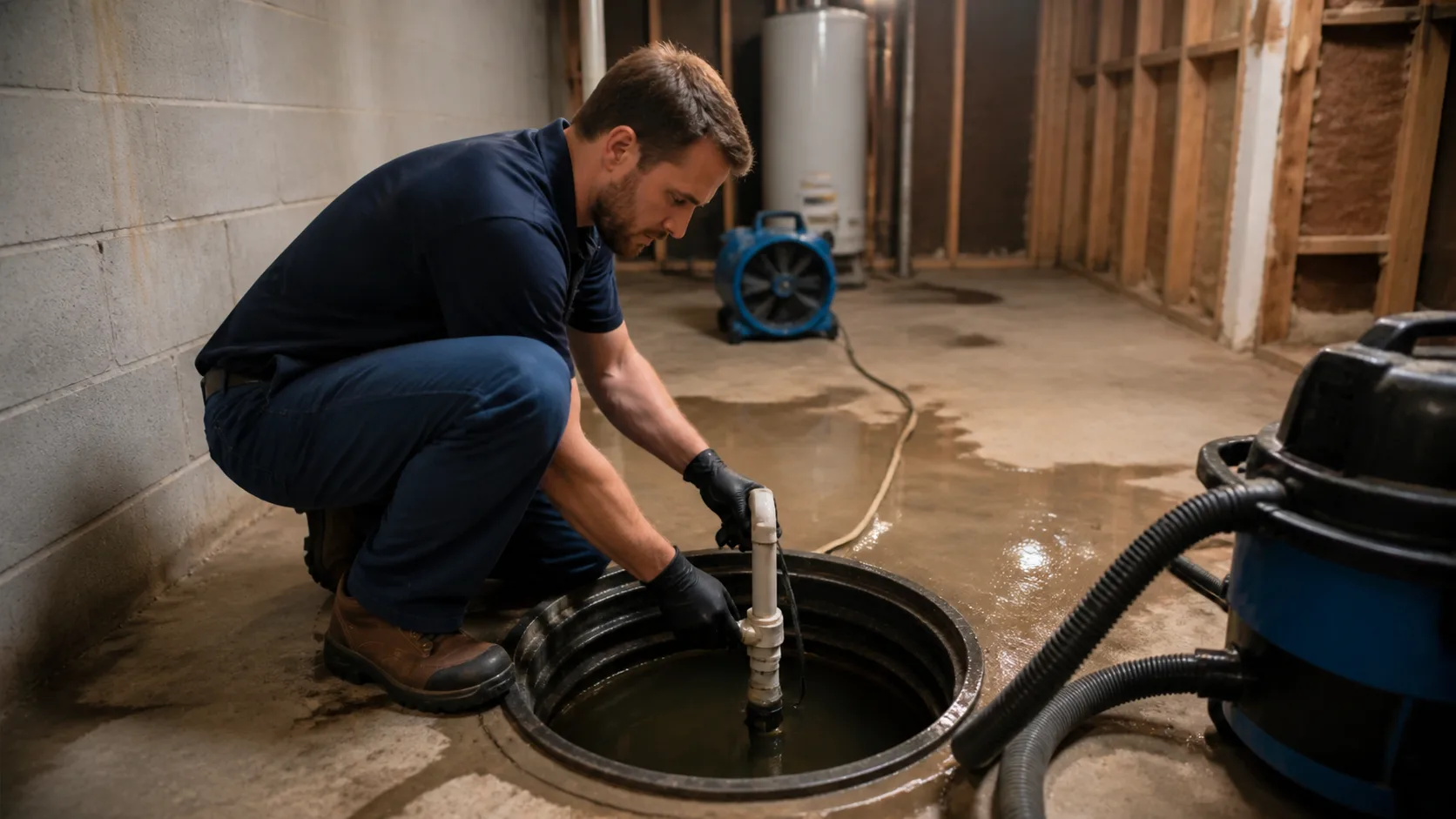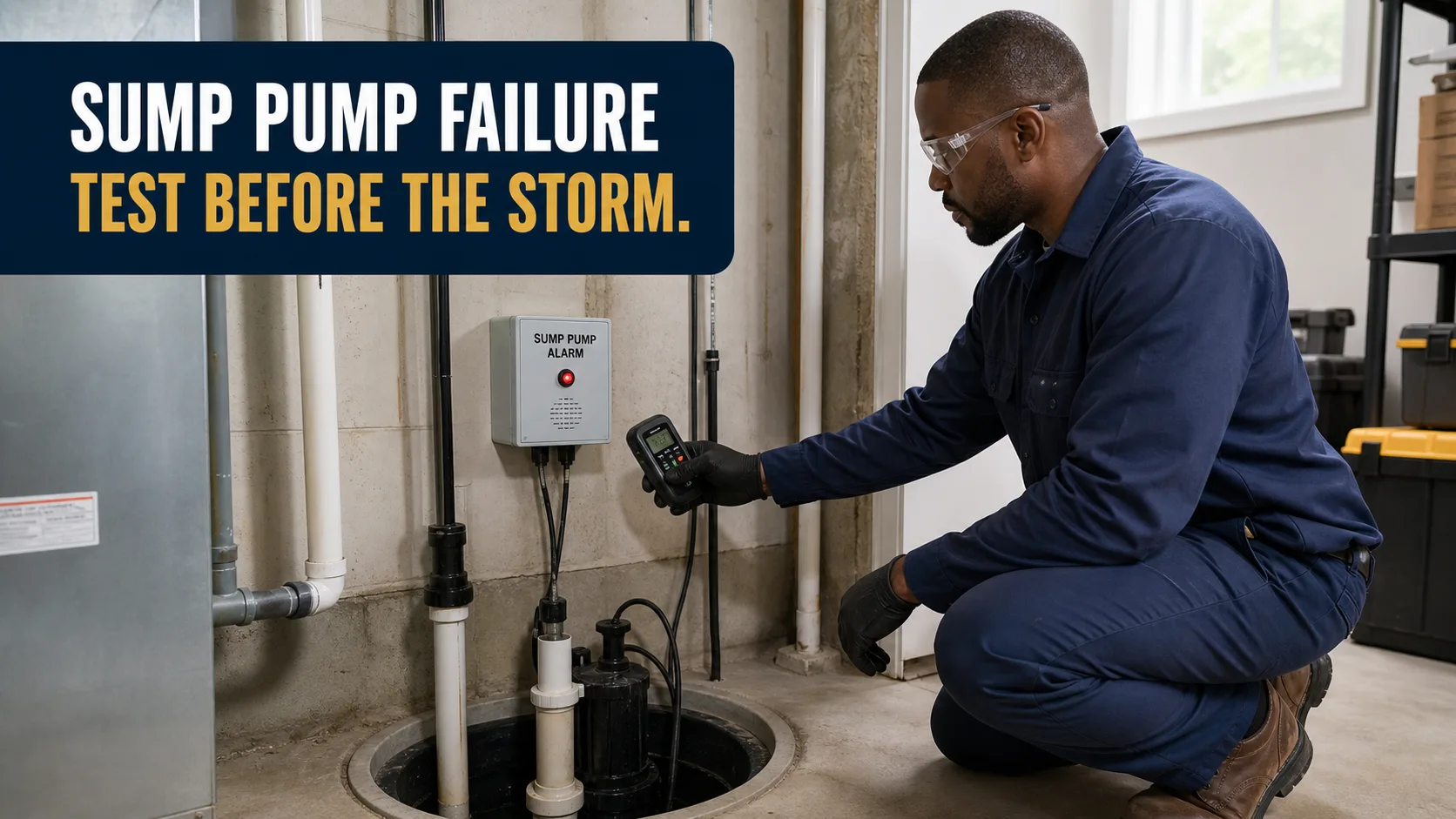
Sump pumps fail for four common reasons: the power goes out during the same storm that needed the pump, the float switch sticks, the intake clogs with silt and debris, or the pump is simply old and undersized for what it is being asked to move. Most standard homeowners policies exclude sump failure unless you carry a water backup endorsement. If a failed pump has already put water in your building, call **(346) 271-7004**.
Where sump pumps actually live in Houston
Most articles about sump pump failure are written for the Midwest, where every house has a basement and a pit in the corner of it. That is not Houston. Basements here are rare — high water table, expansive clay soil, and the simple fact that building below grade on a coastal plain is asking for trouble.
So if you have a sump pump in the Houston area, it is almost certainly protecting one of these instead:
- A crawl space under a pier-and-beam home, where standing water rots joists and feeds mold under your floor.
- An elevator pit, which is below grade by definition and where water damage means an out-of-service elevator and a significant repair bill.
- A commercial or mid-rise building — mechanical rooms, utility vaults, loading docks, and parking structures all rely on pumps.
- Newer construction with a below-grade media room, wine room, or storage space.
- A French drain or yard drainage system with a collection basin that pumps to the street.
The failure mode is identical in all of them. Water arrives, the pump does not move it, and it sits. What changes is what is sitting in the water.
Why do sump pumps fail?
Four causes account for the overwhelming majority, and none of them are exotic.
Power loss. The pump is needed during severe weather, and severe weather takes the grid down. A pump without backup power is simply off for the duration of the outage — which is the same window the water is rising. This is the failure that causes most of the damage we see, and it is the one people most often assume cannot happen to them because the pump “works fine.”
Float switch problems. The float is what tells the pump to start. It sticks, it gets tangled in the cord, it wedges against the side of a pit that is too narrow, or it fails outright. A pump with a stuck float sits in a full pit doing nothing, looking perfectly healthy.
Clogging. Silt, gravel, and construction debris settle into the pit and choke the intake screen. Crawl space and yard-drain pits in Houston take on a remarkable amount of sediment from clay soil. A partly clogged pump moves water slowly enough to lose the race without ever appearing broken.
Age and undersizing. Pumps are motors with seals and bearings. A typical residential unit lasts on the order of seven to ten years, less if it cycles hard. Undersizing is the quieter version of the same problem — a pump chosen for ordinary groundwater cannot keep up with the volume a Gulf Coast rain event delivers, so it runs continuously and cooks itself.
There is a fifth, less common one worth knowing: a failed check valve. When it goes, water in the discharge pipe falls back into the pit every time the pump shuts off, so the pump immediately restarts. Short-cycling like that will destroy a motor in a season.
Why does the pump always fail during the storm?
Because the two events share a cause. The rain that fills the pit is the same weather system that knocks out the power, and the grid does not need a hurricane to go down — an ordinary Gulf Coast thunderstorm will do it. Your pump can pass a test on a sunny Saturday and still be useless on the night that matters, because nothing you tested addressed the failure that was going to happen.
The 2021 freeze made the same point from the other direction. Extended outages meant pumps sat idle for days, and discharge lines froze solid where they ran outside — which is worth remembering alongside the rest of your freeze preparation.
Does insurance cover sump pump failure?
Usually not under the base policy, and this catches people out. Standard homeowners forms specifically exclude water that backs up through sewers or drains or overflows from a sump — and that exclusion applies regardless of why the pump stopped. Mechanical failure, power loss, and clogging all land in the same excluded bucket.
| Scenario | Base homeowners policy | What actually pays |
|---|---|---|
| Pump stopped, groundwater rose into the space | Excluded | Water backup and sump overflow endorsement |
| Power went out in a storm, pump had no backup | Excluded | Same endorsement — the reason for the outage rarely changes it |
| Pump motor burned out from age | Excluded, and the pump itself is not covered either | Endorsement covers the resulting water; the pump is out of pocket |
| Rising water from outside came in at the same time | Excluded | Separate flood policy only |
| Discharge line froze and burst inside the building | Commonly covered as sudden and accidental discharge | Homeowners policy |
The fix is a water backup and sump overflow endorsement, added to the policy for a modest premium. Two things to know about it. It normally carries its own limit, often much smaller than your dwelling coverage, so check that the number is realistic for what the pump protects. And it is not flood coverage — water rising from outside still needs a separate flood policy, which is a different exclusion entirely.
Take five minutes with your declarations page and look for that line item by name. Finding out afterward is how a lot of claims get denied. The broader coverage picture is in does insurance cover water damage.
What does a sump pump failure actually cost you?
The honest answer is that it depends far more on how long the water sat than on how much water there was. A crawl space caught the same day is extraction, drying equipment, and a few days of monitoring. The same crawl space found ten days later, in Houston summer humidity, can mean removing saturated insulation, drying subfloor and framing from below, treating mold growth, and repairing anything the moisture reached above. Costs vary widely by property and scope, but the shape of the curve is consistent: time is the expensive variable.
That asymmetry is the whole argument for backup and detection. A backup battery system and a water alarm cost a small fraction of one dried and remediated crawl space, and they address the exact scenario — nobody was home, the power was out, the water sat — that produces the expensive version.
What warns you before it fails?
The pump usually tells you. The signs are easy to notice once you know what you are listening for.
- It runs constantly, or cycles on and off every few seconds. Undersized, failed check valve, or blocked discharge.
- It runs and the water level does not drop. Clogged intake, or the discharge line is blocked.
- Grinding, rattling, or a loud hum with no water moving. Bearings, impeller, or a seized motor.
- Visible rust, corroded fittings, or a rusty waterline inside the pit above the normal level, meaning it has flooded before.
- It has not run in months during a wet stretch, which usually means the float is stuck rather than that the pit is dry.
- It is more than a decade old and has never been tested.
A musty smell from a crawl space is a late signal, not an early one — by then something has already been wet long enough for mold to establish.
What protects you, in order of value
- A battery backup system. Highest return by a wide margin, because it covers the failure that causes the most losses. It runs off a dedicated deep-cycle battery and switches over automatically. Water-powered backups are an alternative where municipal pressure is dependable.
- A water alarm in the pit or on the floor. Inexpensive, and the Wi-Fi versions will text you while you are away — which is when the expensive version of this happens.
- A second pump. For elevator pits, commercial mechanical rooms, and anything where the downtime is the real cost, a redundant pump on a separate circuit is standard practice rather than overkill.
- A check valve you have actually verified, and a discharge line that runs far enough from the foundation that the water does not simply return.
- The insurance endorsement. It will not keep you dry, but it decides who pays when nothing else worked.
The five-minute test to run this weekend
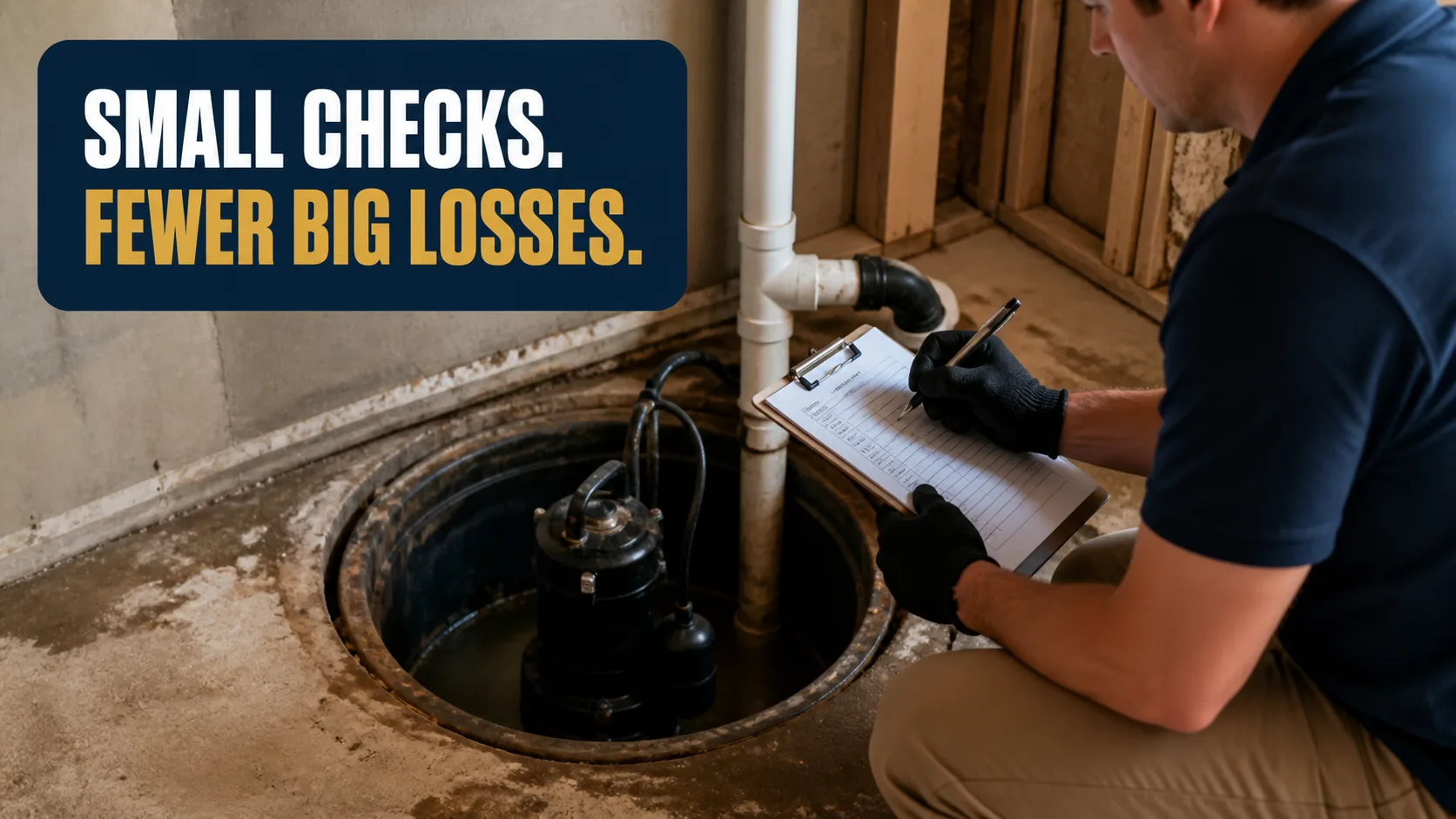
Free and worth doing before every wet season, and again after any long dry spell. Nothing here needs a technician.
- Look in the pit. Clear out silt, gravel, and anything that has fallen in. Check that the intake screen is not caked.
- Lift the float by hand. It should move freely through its full travel and not catch on the cord or the pit wall. The pump should start when it lifts.
- Pour in clean water until the float rises on its own. The pump should start without help, move water briskly, and shut off cleanly. Short-cycling means something is wrong.
- Go outside and watch the discharge. Confirm water is actually leaving, and that the outlet is clear and directed well away from the foundation.
- Test the backup. Unplug the primary pump, then repeat the water test. If nothing happens, your backup is decorative. Check the battery date while you are there.
- Write the date on the pump with a marker. In three years you will want to know.
If any step surprises you, that is the finding. A pump that fails a calm-weather test on your terms is a good outcome.
The Houston calendar for a sump pump
The pump’s year has a shape here, and it is not the Midwest’s shape.
- April and May. Run the five-minute test before the wet season. Replace the backup battery if it is more than three or four years old.
- June 1 through November 30. Hurricane season, peaking August and September. This is the stretch where the pump and the grid fail together, so the backup matters more than the pump does.
- After every named storm. Clear the pit of silt and debris, check the discharge outlet is still open and still directed away from the foundation, and confirm the backup recharged.
- August and September. Long dry spells stick floats in place. A pump that has not run in months during a wet stretch usually has a stuck float rather than a dry pit.
- December through February. Freeze events. Discharge lines that run outside freeze solid and idle pumps sit through multi-day outages — the freeze checklist covers the rest of the house at the same time.
- February and November, at the time change: test the water alarm and read the date you wrote on the pump.
Where we fit, and where we don’t
TruePoint Restoration does not install, service or replace sump pumps. We do not fit backup batteries, run discharge lines, wire dedicated circuits, or clear French drains — that work belongs to a licensed plumber and, for anything on the electrical side, a licensed electrician. A pump in standing water on a live circuit is not a homeowner job either; kill the breaker before you reach for anything, and if you cannot do that safely, do not touch it.
Two fire notes belong here, because the pump lives on the electrical side of the house. A sump pump wants its own GFCI-protected dedicated circuit, not an extension cord — a cord sized for a lamp and running a motor heats along its whole length, and in a crawl space nobody sees it. And a backup battery is a sealed lead-acid battery in an enclosed space: keep it on its charger, keep the terminals clean and covered, and replace it on schedule rather than letting it swell and vent. If the house still carries original 1960s or 70s branch wiring, as much of the southeast Houston stock does, adding a dedicated circuit is the moment to have a licensed electrician look at the panel — see electrical fire damage.
What we do is the water once it is sitting in a crawl space, a pit, or a mechanical room: extraction, containment, structural drying with logged daily moisture readings, mold remediation, and smoke and soot cleanup on the fire side of the business.
When you want a hand
If a pump has already failed and there is water in a crawl space, a pit, or a mechanical room, the useful next move is extraction and drying before the humidity turns it into a mold job. TruePoint Restoration works out of Pearland and covers Greater Houston for water extraction, structural drying, and the repairs after — residential and commercial. Call (346) 271-7004 or email claims@truepointrestoration.com. If you are not sure whether what you are looking at needs professional drying, describe it to us and we will tell you straight.