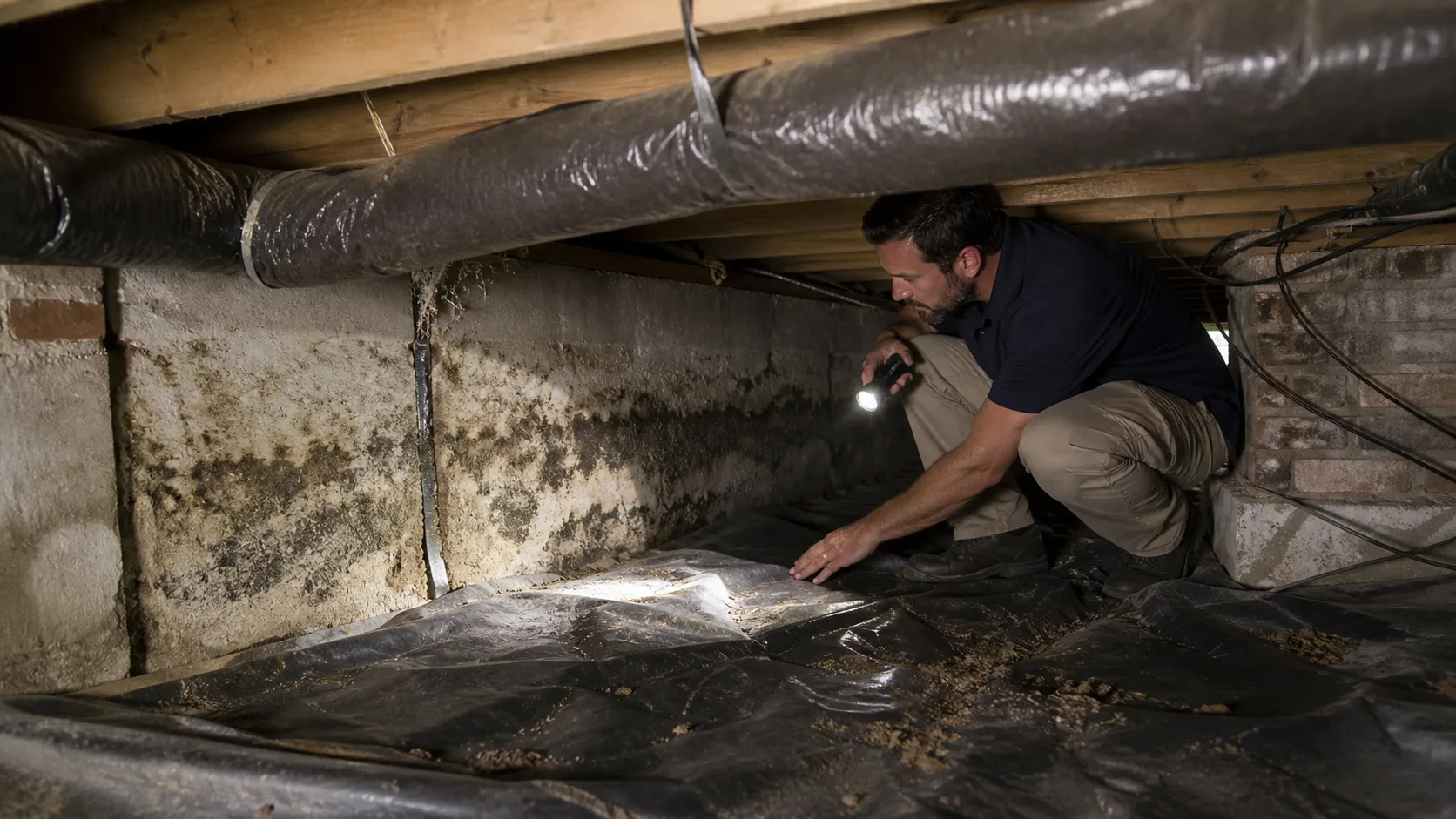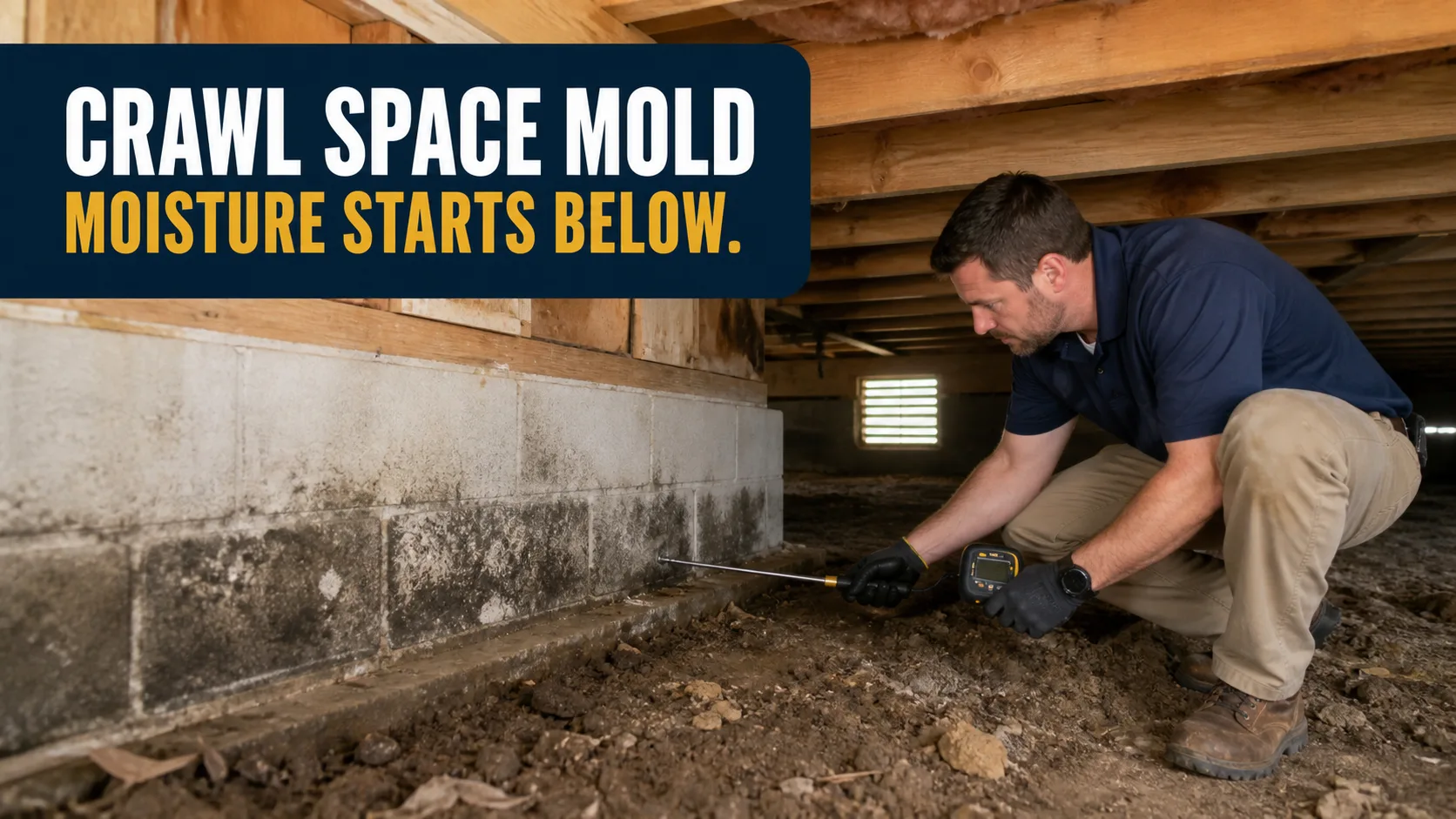
Mold in crawl space removal is two jobs, and most people only pay for the second one. First find the water — bare ground, a torn vapor barrier, a dripping supply line, or standing water after rain. Fix that, then remove contaminated insulation, clean the joists and subfloor, and seal the ground properly. Skip the moisture step and the growth is back within a year. Call **(346) 271-7004**.
Why do crawl spaces grow mold so reliably?
Because a crawl space is a dark, still, cool box sitting directly on wet ground, which is close to a purpose-built growth chamber. Mold needs spores, food, and moisture. The spores are already there. The food is the joists, the subfloor, and the paper facing on the insulation. All the ground has to do is supply the third thing, and bare Houston clay supplies it endlessly.
Not every Houston home has one — much of the metro is slab-on-grade. But pier-and-beam is everywhere in the older neighborhoods, and in any house built high for drainage.
The specific problem is that the crawl space and your living space are not really separate. Air moves upward through the floor — around plumbing penetrations, at the perimeter, through duct chases and any leaky return. Whatever the air under your house smells like tends to become what the first floor smells like. That is the mechanism behind the musty smell that will not go away in a lot of older homes.
Where the moisture actually comes from
| Source | What it looks like down there | What fixes it |
|---|---|---|
| Bare dirt, no vapor barrier | Damp soil, condensation on ducts, general high humidity | Lay a proper vapor barrier, lap and seal the seams |
| Torn or shifted barrier | Poly present but wrinkled, gapped, or pulled off the piers | Repair or replace and secure it at the perimeter and piers |
| Grading that slopes toward the house | Standing water or mud after rain, worst on one wall | Regrade, extend downspouts, add a French drain if needed |
| Plumbing supply or drain leak | Wet ground in one spot, mud that never dries, rusted supports | Plumber repairs the line, then dry and remediate |
| Sweating AC ducts or condensate line | Damp insulation directly under duct runs, drips on the barrier | Repair duct insulation, clear the condensate line |
| Humid outdoor air through open vents | Condensation on the coolest surfaces in summer | Seal and encapsulate, add controlled dehumidification |
Every row leads to the same conclusion. The growth is downstream of the water. Remediation without addressing the row you are in is a cleaning service with an expiry date.
What does mold in a crawl space look like?
It shows up first on the underside of the subfloor and on the bottom edges of the floor joists, because those are the coolest surfaces above the warmest, wettest ground. Look for fuzzy, powdery, or speckled patches in white, grey, green, black, or yellow, often spreading in irregular blooms rather than the defined edges of a water stain.
The other clues are just as reliable:
- Insulation falling down. Batts that sag or drop out of the joist bays have absorbed moisture. Wet insulation is both a symptom and a reservoir.
- A musty smell in the house, usually strongest at the floor, in closets, and near the return.
- Cupped or springy hardwood floors, which is what a wet subfloor does to the flooring above it.
- Condensation on the ductwork, beads of water on the vapor barrier, and rust on duct straps and pier hardware.
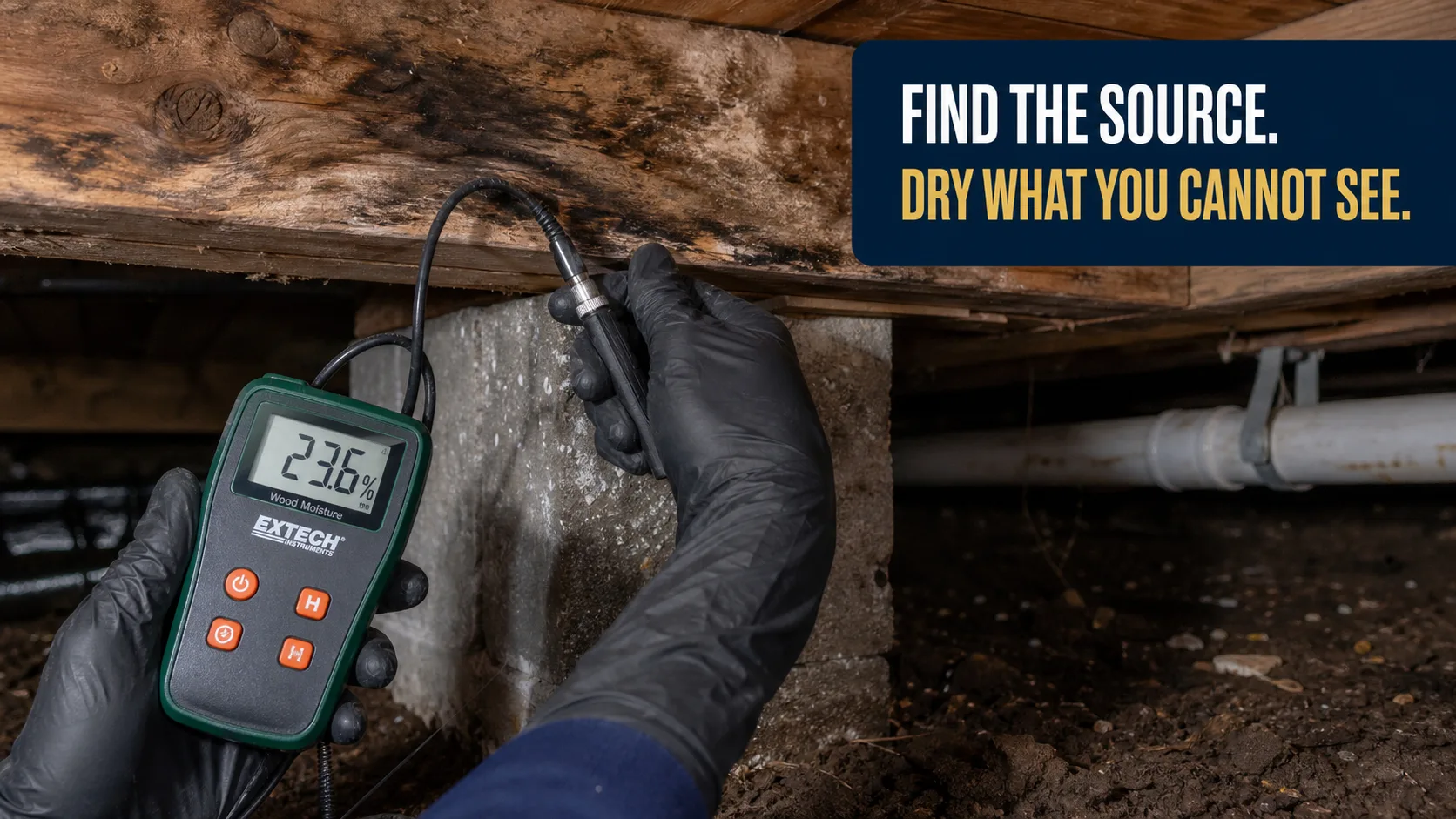
The most important thing to check is not the mold. It is the wood. Press a screwdriver into suspicious joists. Sound wood resists. Wood that gives, crumbles, or has cracked into a cube pattern is decay fungus, which is structural repair rather than remediation.
Do the colors mean anything?
Not in the way the internet suggests. Color does not identify a species and does not tell you how dangerous a growth is. Many genera produce growth in several colors depending on age, surface, and moisture, and identifying species genuinely requires lab sampling, not a photo.
Here is the honest version of the color questions people search for:
- Black mold in a crawl space. Extremely common and not automatically worse than anything else down there. The phrase gets used as a scare term. We take it apart in detail in black mold after water damage.
- White mold in a crawl space. Usually young growth or simply a different genus than the darker patches a few feet away. Worth ruling out efflorescence, the white mineral crust water leaves on masonry as it evaporates. Efflorescence brushes off as a dry powder and is a moisture signal rather than a living thing.
- Yellow mold in a crawl space. Common, tells you almost nothing on its own, but yellowish and orange-brown growth on structural wood is occasionally a decay fungus. The color is not the issue; the softness of the wood is.
The practical response to every one of these is identical. Find the water, stop it, remove what is contaminated, clean what can be saved, and control the humidity from then on. Anyone who prices a job differently because the growth was black rather than white is charging for the color.
How much mold in a crawl space is acceptable?
There is no published threshold, and any company quoting a precise acceptable percentage is inventing it. What exists instead is a judgment call.
Light, isolated surface growth on dry wood in a crawl space with a sealed ground and stable humidity is not an emergency and does not need a five-figure project. It happened when conditions were worse, and the conditions have changed. Growth that is spreading, growth on wet material, growth on insulation, and growth near your ductwork all belong in the fix-it column, because those are being actively fed.
The test is not how much you see. It is whether what you see is still getting water. Bring a cheap hygrometer down with you — a crawl space reading consistently above about 60 percent relative humidity will keep growing things, no matter how well the wood was cleaned last year.
How do you get rid of mold in a crawl space?
You do it in this order, and the order is the whole point.
- Stop the water first. Plumbing leak, drainage, grading, gutters, condensate line, torn barrier — whichever row of that table you are in. Nothing below this step is durable without it.
- Clear the space. Old wood, cardboard boxes, construction debris, and anything organic left behind by the builder comes out. It is all food.
- Set containment. The crawl access gets sealed and a HEPA-filtered air scrubber runs under negative pressure, so what gets disturbed does not migrate up into the house.
- Remove contaminated insulation. Wet or moldy batts are bagged and hauled. Insulation is porous and holds both spores and moisture, so it is replaced rather than cleaned.
- Clean the wood physically. HEPA vacuuming, then abrasive cleaning such as soda or dry ice blasting on larger areas, or wire brushing on smaller ones. The mechanical removal does the work; chemicals are the finish, not the method.
- Treat and encapsulate the wood. An antimicrobial, then usually a sealant on the joists and subfloor. This locks down residual staining that no cleaning fully removes.
- Dry the space and verify it. Air movers and a dehumidifier until moisture readings on the wood come back where they belong. Not until it looks dry.
- Seal the ground. New vapor barrier at minimum, encapsulation where the moisture keeps coming back.
Steps 1 and 8 are the ones that decide whether you do this once or twice.
Vapor barrier or full encapsulation?
A vapor barrier is the minimum and encapsulation is the durable version, and the difference is not subtle.
A vapor barrier is heavy polyethylene laid across the dirt, overlapped at the seams and run up the piers, to stop ground moisture evaporating into the space. For a crawl space with decent drainage and no leaks, it is often enough.
Encapsulation seals the crawl space as a conditioned zone. The liner is sealed at every seam and taken up the perimeter walls, the vents are closed, and a dedicated dehumidifier holds humidity at a set point. It costs more, and it is the honest answer for a crawl space that has already grown mold once, sits low, or holds water after heavy rain.
The mistake to avoid is encapsulating over an unresolved problem. Sealing a liner over ground that is still being fed by a leaking supply line or a downspout dumping at the foundation just puts a lid on it. Fix the source, then seal.
Should I close the crawl space vents in Houston?
Sealing generally wins on the Gulf Coast, though this is a genuinely debated question in building science. Open foundation vents were designed to dry a crawl space with outside air, which works well in a dry climate. In a Houston July, the outside air is frequently more humid than the crawl space air, so venting can pull moisture in, where it condenses on the coolest surfaces down there — usually your ducts and your subfloor.
That is why sealed and dehumidified crawl spaces have become the standard recommendation for this climate, and why adding more vents to a damp crawl space often makes the summer worse rather than better.
What does crawl space mold remediation cost?
Cost tracks square footage, headroom, and how much material comes out — not how alarming the growth looks. Some typical Houston-area ranges, as orientation rather than a quote:
| Scope | Typical range |
|---|---|
| Small contained area, moisture already resolved | roughly $500 to $1,500 |
| Standard remediation, cleaning plus insulation removal | roughly $1,500 to $4,000 |
| Full remediation with treatment and encapsulation of the wood | roughly $4,000 to $8,000 |
| Add vapor barrier over the ground | commonly $1,500 to $4,000 depending on area |
| Add full encapsulation with a dedicated dehumidifier | commonly $5,000 and up |
| Structural repairs for decayed joists or subfloor | quoted separately, varies widely |
Headroom is the underrated variable. A crawl space you can sit up in is a normal job; eighteen inches of clearance over uneven clay turns the same square footage into slow, physical work, and the price reflects that. Plumbing repair, regrading, and drainage sit outside the remediation number.
More on how remediation gets priced in mold remediation cost in Houston.
Does insurance cover crawl space mold?
Usually not by default, and the reason is the cause rather than the mold. Standard Texas homeowners policies exclude gradual damage, and a crawl space that has been damp for years is the definition of gradual. Ground moisture, humidity, and poor drainage are maintenance, not a sudden accidental event.
Where coverage does appear:
- A sudden covered event underneath, such as a supply line that let go or a water heater that failed, with the mold following promptly and documented from day one.
- A mold endorsement, which many Texas policies carry as an optional add-on with its own sublimit. Check your declarations page for a mold limit before you assume there is nothing there.
What almost never gets paid is the encapsulation, the drainage correction, and the vapor barrier — those are improvements to the house rather than repair of a covered loss. What Texas policies actually say about mold is in does insurance cover mold.
How long does crawl space work take?
Two to four days for cleaning and treating a moderate crawl space, plus drying time underneath. A week or more once encapsulation, drainage correction, or subfloor and joist replacement is in the scope, and longer if a plumbing repair has to happen first.
Readings decide, not the calendar. The joists and subfloor get metered until they reach dry standard, and the vapor barrier goes down after that rather than over a wet crawl space. Sealing a damp crawl space is how a moisture problem becomes an expensive moisture problem.
Why DIY treatment usually falls short here
The cleaning is not the hard part. The rest of it is.
Bleach is the usual first attempt and a poor choice on framing lumber — it is mostly water, so it soaks in and adds the one thing you are trying to remove, while the chlorine sits on the surface and evaporates. Spraying a joist without physically removing the growth leaves dead material in place, and dead material on damp wood is a head start for the next colony.
Then there is containment. Pulling down wet insulation in an unsealed crawl space moves a lot of material into air that travels up into your house through every floor penetration.
And none of it touches the ground, which evaporates water into the crawl space every day. That is why mold after water damage anywhere in a house always starts with the moisture rather than the mold.
A free crawl space check you can do this month
You do not need to hire anyone to learn most of this. Take a headlamp, a flat screwdriver, a cheap hygrometer, and your phone, and work through the list:
- Look at the ground. Bare dirt, or plastic? If there is plastic, is it continuous, lapped at the seams, and run up the piers, or is it a few torn sheets that have shifted?
- Find the wettest spot and trace it. Wet in one corner points to grading or a downspout. Wet under a bathroom points to plumbing. Wet everywhere points to the ground.
- Leave the hygrometer down there for a day and read it. Consistently above roughly 60 percent means the space will keep growing things.
- Press the screwdriver into any suspicious joist, especially near the perimeter and under bathrooms. Firm is fine. Soft or crumbly is a structural conversation.
- Check the insulation and ducts. Sagging, dropped, or dark batts have been wet; look for torn duct insulation, condensation, and where the condensate line goes.
- Photograph everything, then walk outside and look at the grade, the downspouts, and where water goes in a storm. Half the crawl space answers are found above ground.
Anyone giving you a quote should be able to speak to those photos specifically. If someone will not tell you where the water is coming from, they are quoting a cleaning. And if anyone in your home has asthma, allergies, or a compromised immune system, they should not be the one going under the house — health questions belong with your doctor rather than a restoration company.
If you want a second read on what you found
Send us the photos. Sometimes the answer is that the wood is sound, the growth is old, and what you need is a vapor barrier and a downspout extension. Sometimes it is a real remediation. You should know which one before anyone gives you a number.
We are not a plumber, a foundation contractor, or a grading company. We do not repair the supply line under your floor, correct a foundation drainage problem, or regrade your yard, and we are not a public adjuster. On a licensed-size project the consultant who writes the protocol and verifies the result has to be independent of the remediator.
TruePoint Restoration serves Greater Houston from Pearland. Call (346) 271-7004 or email claims@truepointrestoration.com with your crawl space photos, and we will tell you what we see.