Service Areas · August 15, 2026

Water Damage Mitigation in Richmond & Rosenberg, TX

Local water damage mitigation in Richmond and Rosenberg, TX. Same-day extraction, structural drying, and insurance documentation for Fort Bend county homes near the Brazos River.

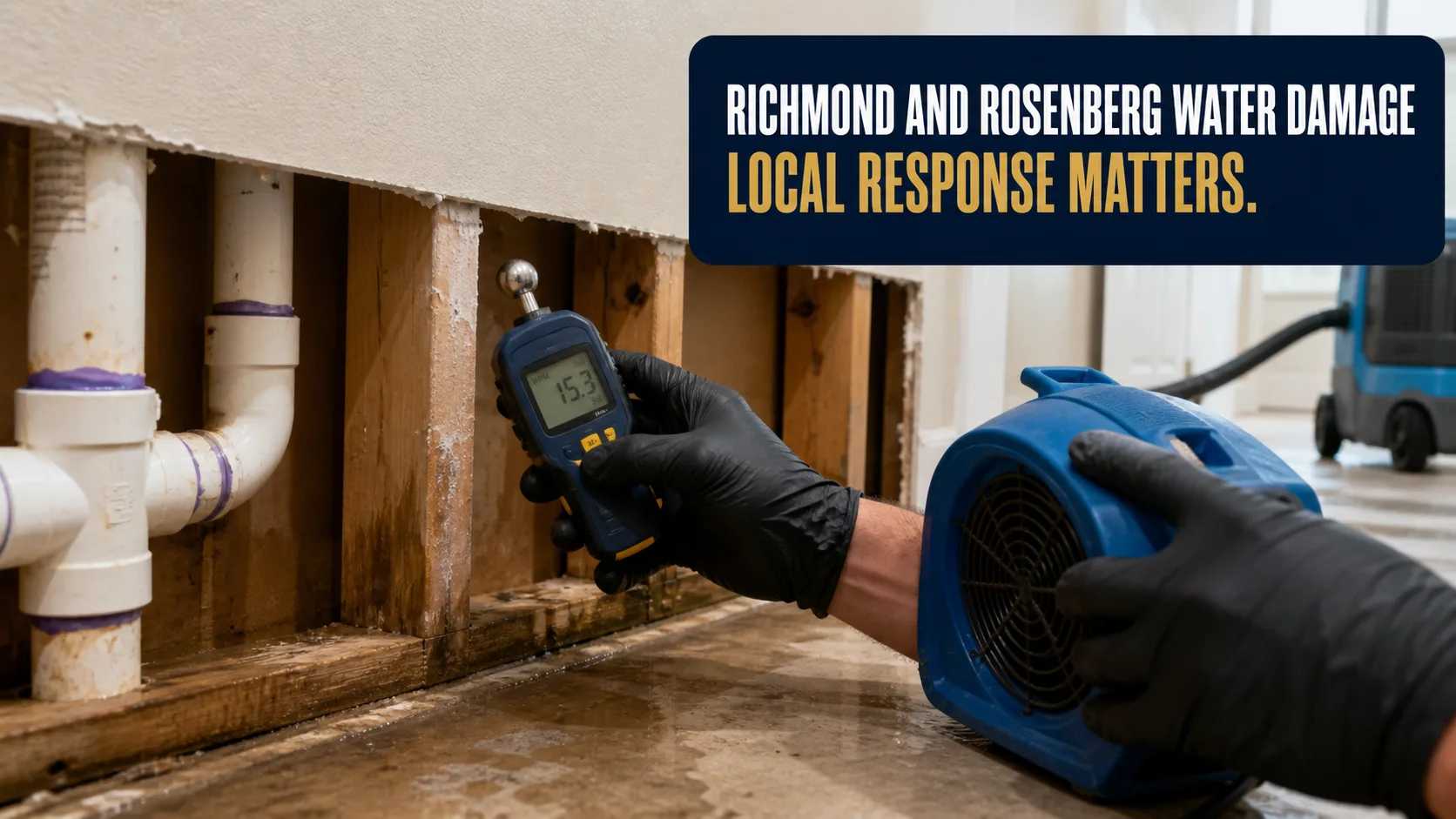
A technician in black gloves uses a moisture meter and a blue air mover to dry a water-damaged wall with exposed pipes and wooden studs. Caption on image: RICHMOND AND ROSENBERG WATER DAMAGE LOCAL RESPONSE MATTERS.
The short answer

TruePoint Restoration serves Richmond and Rosenberg across Fort Bend county — from the historic districts to newer communities like Aliana and Long Meadow Farms. Same-day emergency extraction, structural drying, and insurance-grade documentation from a local, owner-operated crew. Their Brazos River setting adds flood exposure, while a mix of old and new homes brings both aging-plumbing and modern-connector failures. Call or text **(346) 271-7004** with your location and a photo.
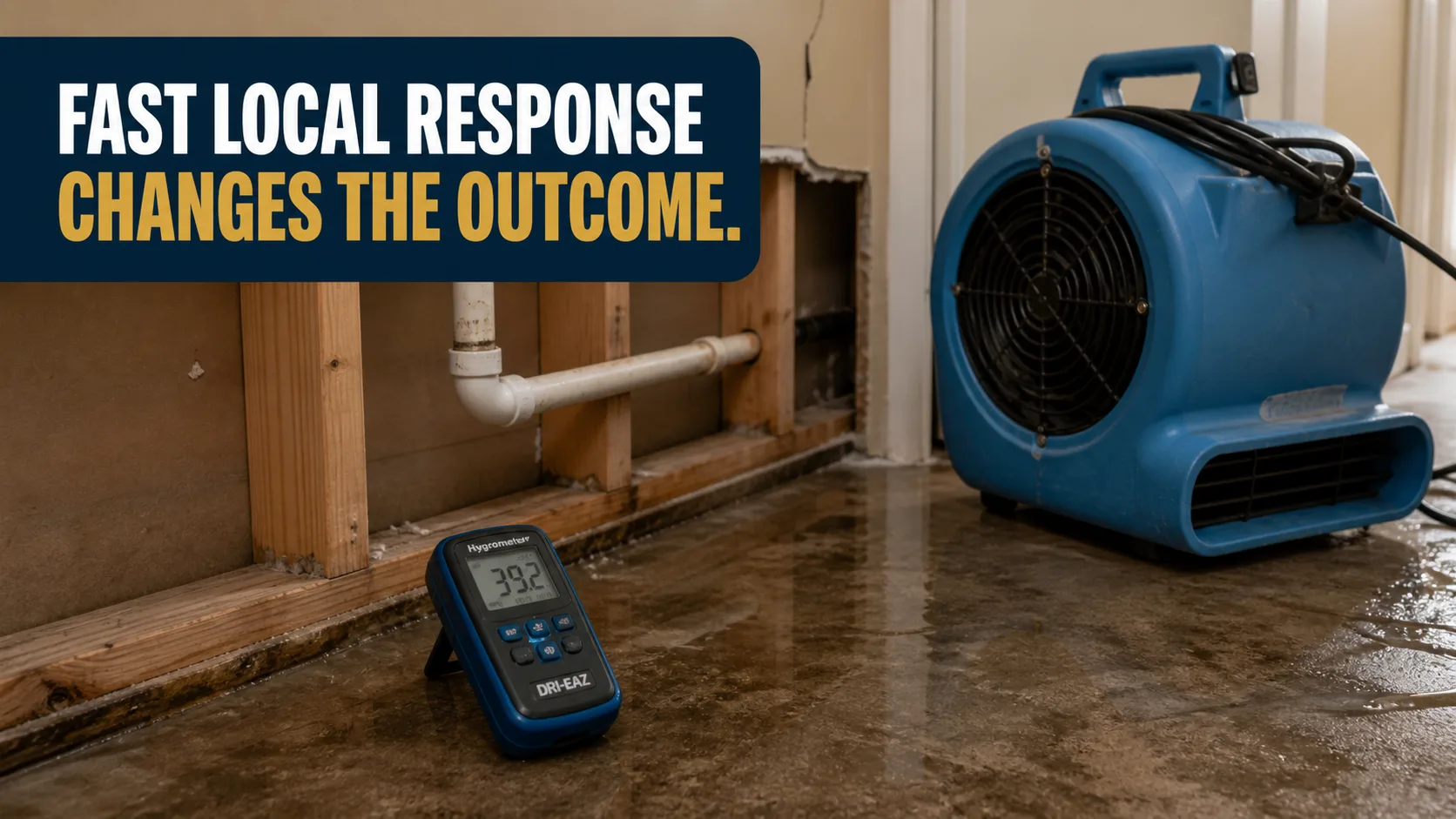
A blue air mover and a hygrometer sit on a wet concrete floor next to a wall with exposed wooden studs and plumbing. Caption on image: FAST LOCAL RESPONSE CHANGES THE OUTCOME.

Local to Richmond & Rosenberg

These Fort Bend communities span historic homes and fast-growing master-planned neighborhoods, and a local crew that knows both gets you dried out faster. TruePoint Restoration is local and owner-operated — local number, local response, insurance-grade documentation.

Richmond is the Fort Bend County seat and Rosenberg sits immediately southwest of it, with the Brazos River running between and around both. The river set record crests here in 2016 and again during Harvey, and the two downtowns — Morton Street in Richmond, Third Street in Rosenberg — are older masonry commercial blocks where buildings share walls.

What causes water damage in Richmond & Rosenberg homes

  • Brazos River flooding. Riverside areas have flooding history in major events — a flood-insurance matter distinct from interior leaks.
  • Aging plumbing. In older homes, supply lines and slab plumbing develop leaks, and seized valves make them worse.
  • Appliance and connector failures in the newer master-planned homes.
  • Attic HVAC condensate leaks dropping water through ceilings all summer.

Shared walls make your neighbor’s loss your loss

A party wall is one assembly serving two owners. Water in the building next door travels through it, and so does smoke, and so does the smell afterward. In these downtown blocks the wall is often unreinforced masonry with plaster on both faces, under a common roof structure.

That produces a specific set of problems. Access needs two owners cooperating, and one of them may be an absentee landlord. Drying one side of a shared wall while the other side stays wet does not work — the moisture simply migrates back. And the loss on your side may be recoverable from the neighbor’s carrier, which is what subrogation is for, but only if the cause and the path were documented before anyone started cleaning.

Old commercial roofs on these blocks are the other shared component. A low-slope commercial roof leak travels laterally above the ceiling and comes down a long way from where it entered, which is why the tenant who reports it is frequently not the tenant under the failure.

The Brazos, and how river flooding differs

River flooding is slow. Unlike a flash event, the Brazos gives days of warning as the crest moves downstream, and that changes what is worth doing with the time: contents go up and out, vehicles move, and photographs get taken while the building is still dry.

It also means the water sits. An inundation standing for two or three days saturates deeper into materials than a flash flood that drains in hours, so the removal line goes higher up the wall and the drying runs longer. And it is river water, which is contaminated, so porous materials in its path are removed rather than dried.

Older residential stock

The older Richmond and Rosenberg neighborhoods include pier-and-beam bungalows as well as slab houses, and the pier-and-beam ones let water through the floor into a crawl space where it sits unseen. The newer master-planned growth north toward the Grand Parkway is a completely different building and fails like every other new subdivision — attic air handlers, second-floor laundries, appliance connectors.

What we do

  1. Map the water with moisture meters and thermal imaging.
  2. Extract and dry with commercial equipment to a verified dry standard.
  3. Prevent mold by beating the 24-to-48-hour window.
  4. Document for insurance as adjusters expect.

What these jobs cost

Commercial and residential price differently here, and the downtown buildings are the more variable of the two.

  • Occupancy and hours. Work inside an operating shop or restaurant means after-hours labor and containment that lets the business keep trading.
  • Shared assemblies. Drying a party wall properly may require access on both sides, and that is a scheduling cost before it is a labor cost.
  • How long river water stood. Days rather than hours moves the removal line up the wall.

Residential single-room losses run low thousands. A downtown commercial water loss across two tenancies, or a river inundation, runs to five figures and up.

Fort Bend, flood, and the commercial policy gap

Fort Bend County is inland, so wind and hail generally stays on the homeowners or commercial property policy rather than in a separate coastal windstorm policy. Flood is separate, and along the Brazos it is the policy that decides everything.

Business owners have a second gap worth checking now. Business interruption and extra expense are frequently either absent or set far too low, and they are what pays the rent while the building dries. A commercial flood policy also carries separate building and contents limits.

Tonight, free

  1. If you own a downtown building, find out who owns the one attached to yours and get a phone number.
  2. Photograph the interior and exterior of the property, dated, including the roof from ground level.
  3. Confirm your flood policy exists, and for a business, confirm business interruption is on it.
  4. Note your elevation relative to the last recorded crest. The county floodplain office can tell you.

What we handle in Richmond and Rosenberg

TruePoint Restoration is a mitigation contractor — not roofers, plumbers, electricians, HVAC, general contractors, or public adjusters.

We do extraction, containment, contaminated-material removal, structural drying with logged readings, smoke and soot work, and documentation for residential and commercial claims alike. Richmond, Rosenberg, and east toward Sugar Land: call or text (346) 271-7004.

If you have water damage right now

Stop the source if you safely can, cut power near standing water, lift belongings, photograph everything, then call or text (346) 271-7004. Honest answer, every time.

Serving Richmond, Rosenberg, and the surrounding Greater Houston metro. See all our service areas.
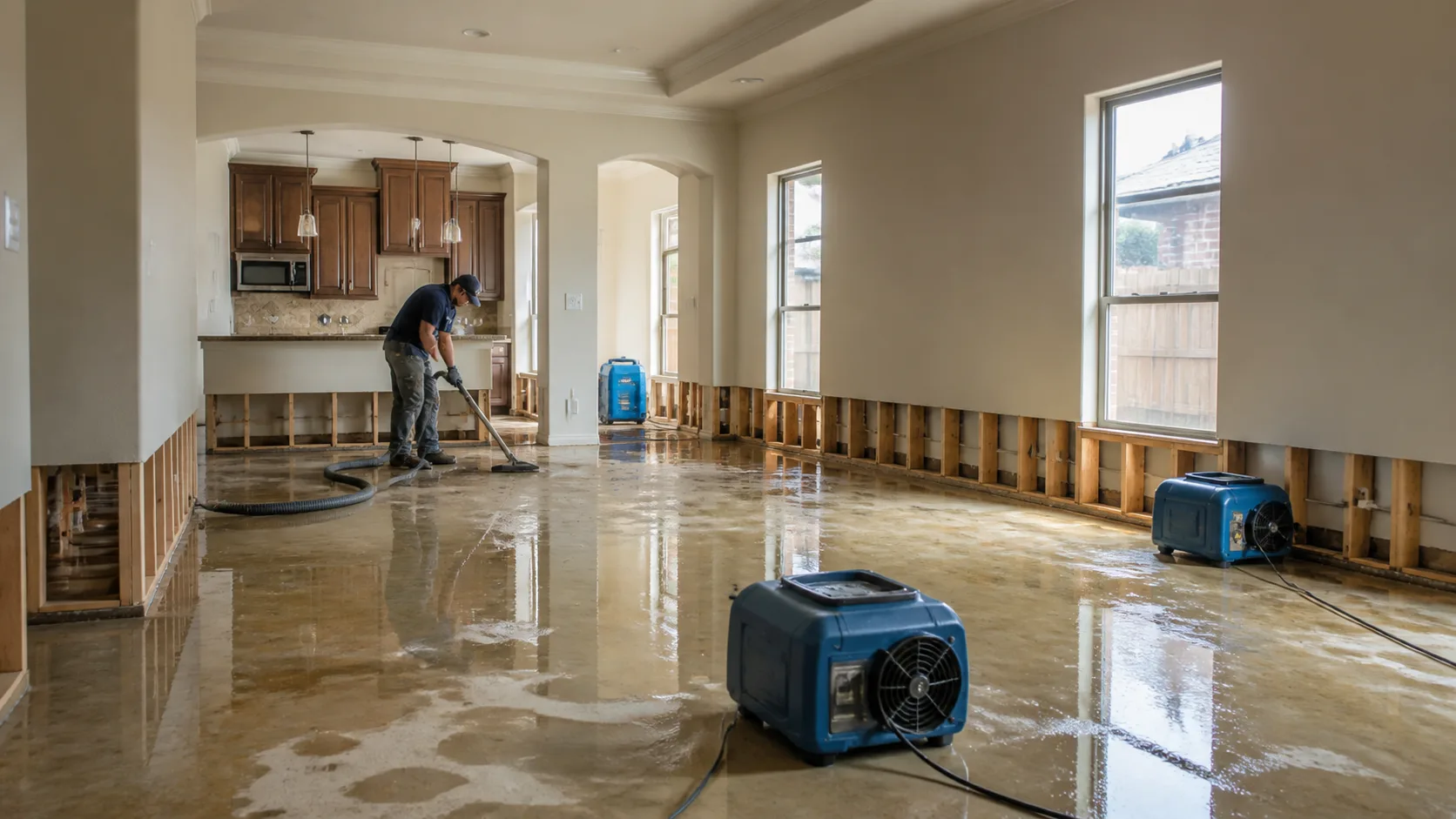
A technician uses a wet vacuum to remove standing water from a flooded room with exposed wall studs and multiple blue air movers.
Questions, answered

Richmond & Rosenberg Water Damage Questions

Who does water damage mitigation in Richmond and Rosenberg, TX?
TruePoint Restoration serves Richmond and Rosenberg across Fort Bend county — from the historic districts to newer master-planned communities like Aliana and Long Meadow Farms. Local and owner-operated, we handle emergency extraction, structural drying, and insurance-grade documentation. Call or text (346) 271-7004 with your location and a photo for an honest arrival window.
Do Richmond and Rosenberg flood?
Areas near the Brazos River have flooding history, and major rain events have pushed the Brazos over its banks into Fort Bend neighborhoods. Flood insurance matters near the river. But most Richmond and Rosenberg water-damage calls are interior failures — attic HVAC leaks, water heaters, and burst pipes. Outside flooding needs a separate flood policy; sudden interior failures are usually covered by homeowners.
How fast can you respond in Richmond or Rosenberg?
Same day, usually within hours. Because we're local to the Houston metro, you're not waiting on an out-of-area crew — and with mold able to start within 24 to 48 hours, fast arrival matters. Call (346) 271-7004, text a photo, and we'll give you an honest arrival window.
These areas have both old and new homes — does that change the risk?
It does. Richmond and Rosenberg's historic homes tend toward aging plumbing, original water heaters, and dated valves; the newer master-planned communities fail through appliance connectors and builder-grade fittings. Both end up as the same emergency — water in the walls and floors — but knowing your home's age helps predict where it'll come from.
Do you document Richmond and Rosenberg water damage for insurance?
Yes — our team has hands-on mitigation work. We document losses with moisture readings, affected materials, and drying logs in the format Texas adjusters expect, which is often what separates a smooth claim from a disputed one — and near the Brazos we help keep homeowners and flood coverage straight.
Who does fire damage restoration and smoke odor removal in Richmond and Rosenberg?
TruePoint Restoration covers fire and smoke losses across Richmond, Rosenberg, and the surrounding Fort Bend County communities, including smoke odor removal in homes that never took flame. The historic districts and the newer Aliana and Long Meadow Farms neighborhoods need different handling, because old wood and shiplap hold odor differently than modern drywall. Send photos and your address to (346) 271-7004 for an honest scope.
How is smoke odor actually removed from a house?
By removing the source, not by covering it. That means taking out the material holding the residue, HEPA vacuuming and cleaning every surface the smoke reached, running air scrubbers with carbon filtration, treating what stays, and sealing porous surfaces that still carry odor before anything is repainted. Ozone, foggers, and scented treatments applied over live residue mask the smell for a few weeks and then it comes back.
It has been months and my house still smells like smoke. Where is it hiding?
Four places, almost every time: attic insulation, the inside of the ductwork, the backs and undersides of cabinets and closets, and the carpet pad or subfloor. All four are porous, all four get skipped in a fast cleanup, and all four keep releasing odor whenever the house heats up. A smell that returns after cleaning is evidence residue is still in one of them, not evidence the deodorizing failed.
A fire in the building next door left soot on my downtown Richmond property. What now?
Document it before you clean it. Older buildings in downtown Richmond and Rosenberg share walls and sit close together, so a neighboring fire puts soot into your attic and ductwork and against any shared masonry, and heat can damage what flame never touched. Photograph the residue where it landed, keep samples of anything you remove, and have the residue type identified — that record is what a third-party claim is built on.
My Rosenberg property is on a well. What happens when the power goes out?
You lose pressure entirely, and there is no street meter to open as a backup. The bigger problem is the restart: repressurizing a whole house at once is when a marginal fitting, an old hose bib, or a tired water heater connection tends to let go, and on acreage that can run for hours before anyone hears it. Kill the pump breaker before an announced outage, then walk the visible connections before you switch it back on.
How do you dry an old pier-and-beam bungalow in the historic district?
Carefully, and slower than a modern house. Old-growth pine flooring, original subfloor, and lath-backed finishes react badly to aggressive drying — push too hard and boards cup, crack, or split at the seams instead of coming back. The approach is controlled dehumidification, floor drying mats where they suit the material, working the crawlspace as well as the rooms, and watching moisture content rather than the calendar.
The road was closed after the Brazos came up. When can you start?
As soon as access opens and the property is safe to enter, which after a river event is a question of the water going down rather than scheduling. In the meantime, photograph everything before you move it, get soaked contents out of standing water and up off the floor, and open the house if the weather allows. Documenting the house on its worst day is exactly what an adjuster will want later.
Water or fire damage right now?

Talk to someone who documents it properly.

Certified water and fire damage mitigation across Pearland, Manvel, Friendswood and the Greater Houston area. Text a photo of what you are seeing and we will tell you whether it needs professional drying.

Call or text (346) 271-7004