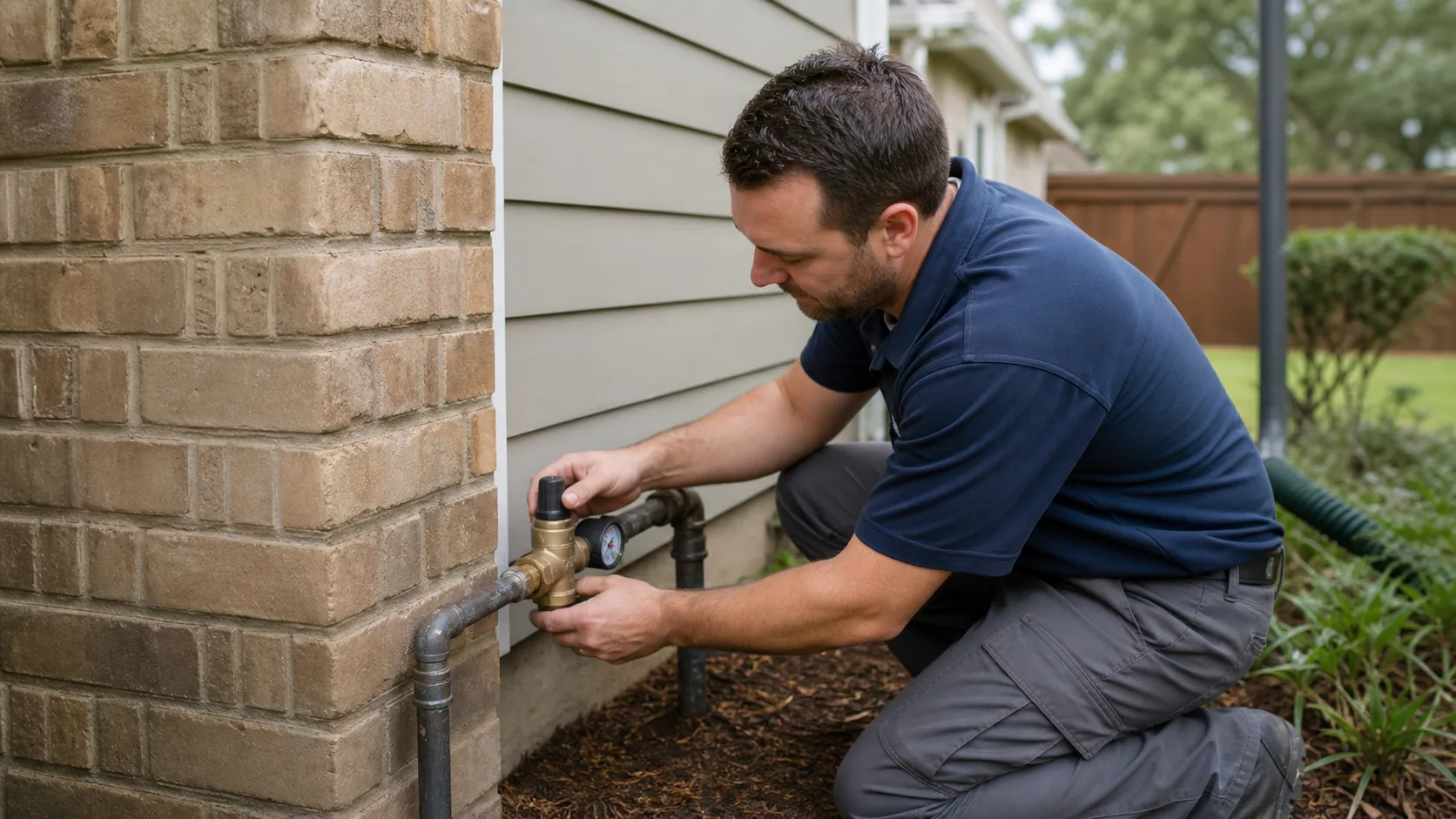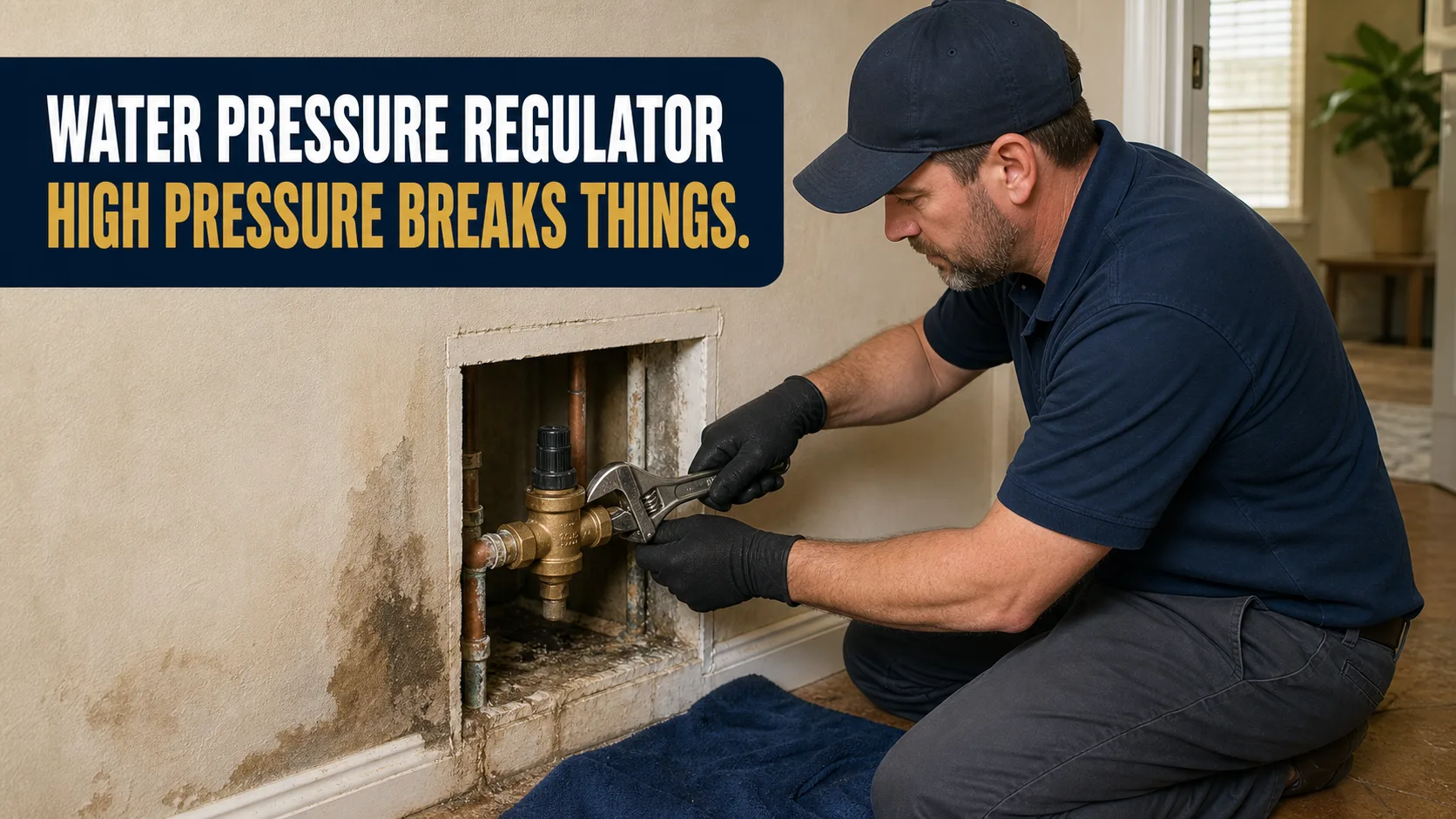
A water pressure regulator — also called a pressure reducing valve, or PRV — sits where the city main enters your house and drops it to something your plumbing can live with. Most homes are happiest between 50 and 70 psi; above roughly 80 psi you are working supply lines, connectors and appliance valves harder than they were built for. Test yours with a hose-bib gauge. If a line already let go, call **(346) 271-7004**.
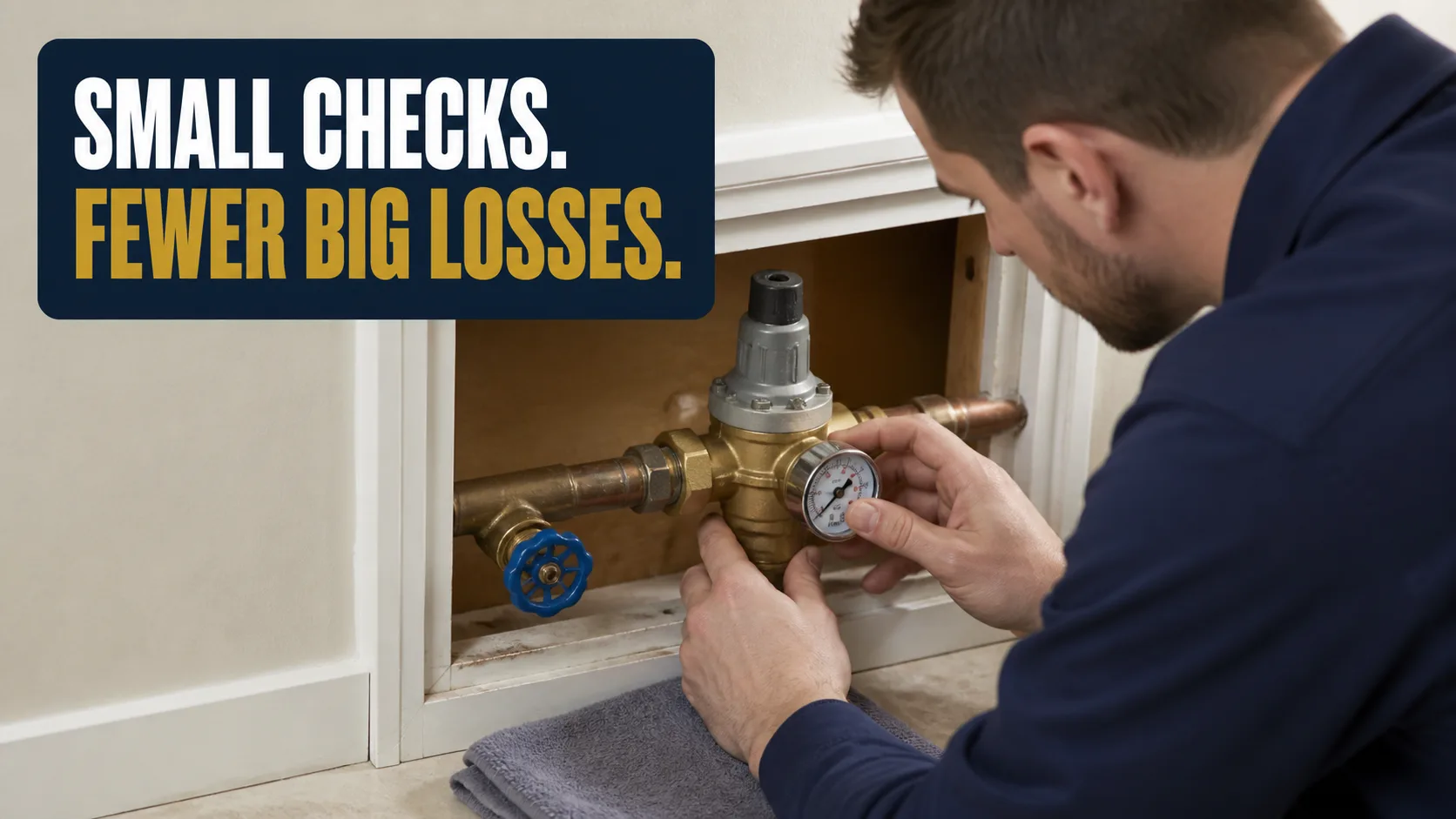
What does a water pressure regulator actually do?
It takes whatever pressure the city sends down your street and knocks it down to a level your house can live with, permanently. The regulator — plumbing supply houses call it a pressure reducing valve, or PRV — is a bell-shaped brass valve installed on the main water line right where it enters the property, usually a foot or two downstream of the main shutoff.
Municipal mains have to push water uphill, across neighborhoods, and up to second floors, so they are often run at pressures well above what a dishwasher inlet valve or a toilet fill valve was designed for. The regulator is the one part standing between that and everything inside your walls.
And “everything” is the right word. Downstream of that valve sits every toilet supply line, every faucet, the washing machine hoses, the ice maker line, the dishwasher, the water heater, and every rubber washer and plastic nut in the house. They all carry the pressure the regulator sets, twenty-four hours a day, whether you are home or not.
What water pressure is safe for a house?
Most residential plumbing is happiest between 50 and 70 psi, and plumbing codes generally treat 80 psi as the ceiling for static pressure in a home. That upper limit is not arbitrary — it is roughly where standard fixtures, connectors and appliance valves stop being comfortably inside their rating.
| Static reading | What it usually means | What to do |
|---|---|---|
| Under 40 psi | Weak fixtures. Often a regulator stuck low, a partly closed valve, or a restriction | Investigate. Not a burst risk, but usually a symptom of something |
| 40–50 psi | Low-normal. Fine for fixtures, marginal for some appliances | Leave it unless showers and fill times annoy you |
| 50–70 psi | The target range for most homes | Nothing. Retest in a year |
| 70–80 psi | Upper end. Allowed, but no margin left | Dial down to the low 60s if you have a regulator |
| Above 80 psi | Past the limit most codes allow. Every hose, connector and appliance valve is carrying more than its rating | Install a regulator, or repair the one you have |
| Swings 20+ psi through the day, or climbs overnight | Failing regulator, or a closed system with no expansion tank | Replace or repair, and ask about an expansion tank |
The reason this matters more than it sounds: pressure is not a dramatic failure mode. Nothing bursts the afternoon somebody sets it wrong. It quietly consumes the service life of every weak point in the house until one of them goes — and the one that goes is usually a washing machine supply hose or an appliance connector, at full line pressure, unattended.
How do you test your water pressure?
With a hose-bib pressure gauge, in about five minutes, for less than the cost of a pizza. This is the single most useful thing on this page.
- Buy the gauge. Any hardware store carries a water pressure test gauge with a female garden hose thread. Get one with a peak-recording needle if you can — the red “lazy hand” stays at the highest pressure the gauge has seen, which is how you catch overnight spikes.
- Shut down water use inside. No dishwasher, no laundry, no ice maker cycling, no irrigation, nobody in the shower. You want static pressure, not pressure with something running.
- Pick the right hose bib. Use the one closest to where the main line enters the house, typically the front one. A bib fed off an irrigation line downstream of a separate valve will give you a misleading number.
- Thread it on hand tight and open the bib all the way. The number that settles is your static pressure. Write it down.
- Leave it on overnight. In the morning, read both the live pressure and the peak needle. A house that sits at 65 psi all day and hits 110 psi at 3 a.m. has a thermal expansion problem, and you would never know it from the daytime reading.
- Optional, but informative: open a nearby fixture and read the gauge again. That is your working pressure. A large drop between static and working suggests a restriction somewhere rather than a regulator problem.
Two readings, five minutes, and you now know something about your house that most homeowners never learn until a plumber tells them at the worst possible moment.
Where is my water pressure regulator?
Look within a few feet of where the main water line enters the house, immediately after the main shutoff valve. You are hunting for a brass, bell-shaped or cone-shaped body, a few inches across, with a threaded adjustment screw sticking out of the top and a lock nut around it.
Common locations in Houston-area homes:
- Against the front exterior wall, near the main shutoff and the front hose bib, sometimes inside a small in-ground box
- On the garage wall where the supply line comes up
- In the meter box near the street, next to or just downstream of the meter
- In a crawlspace or utility closet in older or raised homes
If you look everywhere and find nothing, that is a real possibility — plenty of houses were built without one, particularly where street pressure was modest at the time. That does not mean street pressure is still modest today. Test first. If you are above 80 psi with no regulator on the line, installing one is the whole fix.
How to adjust a water pressure regulator
Never adjust blind. Get a gauge reading first, then:
- Put the gauge on the hose bib and leave it there so you can see the effect of each turn.
- Loosen the lock nut — the hex nut around the base of the adjustment screw — with a wrench. The screw will not hold a new setting until this is loose, and it will not stay put afterward unless you retighten it.
- Turn in small increments. On most regulators, clockwise raises pressure and counterclockwise lowers it. Quarter to half a turn at a time, no more.
- Bleed after each turn. Open a nearby faucet for a second or two so the pressure downstream equalizes, then read the gauge. Without this step the gauge lags and you will overshoot.
- Aim for the high 50s to low 60s psi. That leaves headroom under the 80 psi ceiling for the daily swings every house has.
- Retighten the lock nut and retest the next morning, peak needle included.
If the gauge barely moves no matter how far you turn the screw, or the pressure will not hold the setting for a day, stop adjusting. The diaphragm inside has failed and no amount of turning will bring it back.
How do you know the regulator has failed?
The gauge is the honest answer, but the house usually complains first. Watch for:
- A static reading over 80 psi, or wild swings between morning and night
- Water hammer — banging or thumping in the walls when a valve or an appliance shuts off
- Screeching, whistling or vibrating pipes when a fixture runs
- Toilets that refill on their own or fill valves that cycle in bursts
- The water heater’s relief valve weeping or discharging into the drain pan (see water heater lifespan and replacement)
- Repeat failures at the same fittings — a faucet you keep re-seating, a connector that keeps weeping, flappers that keep going bad
- No response to adjustment
Replacement — what to actually ask for
Regulators are commonly given a service life in the ten to fifteen year range, varying with water chemistry and how hard the valve works. Replacement means cutting into the main supply line, which puts it firmly in licensed plumber territory in most Houston-area jurisdictions. When you get quotes, ask about three things:
- A thermal expansion tank, if the house does not already have one
- A shutoff valve on each side of the regulator, which makes the next replacement a much smaller job
- The preset pressure on the new valve, and whether the plumber will verify it with a gauge before leaving
What this costs against what high pressure costs
A hose-bib pressure gauge is roughly $10 to $15 and it is the whole diagnostic. Adjusting an existing regulator is free if the valve still responds. Replacing one, with the cutting into the main that requires, generally runs a few hundred to around a thousand dollars installed in the Houston market, depending on access and whether shutoff valves and an expansion tank go in at the same time. An expansion tank is usually a couple of hundred more.
The failure side is every pressurized connection in the house at once. A supply line running at 110 psi is being asked to hold a load it was not rated for, twenty-four hours a day, and the parts that give way — washer hoses, toilet supplies, icemaker lines, water heater flex connectors — release at full pressure into rooms nobody is standing in. Mitigation on a single-room release commonly lands in the low four figures; a laundry or a bathroom over living space is a five-figure loss once ceilings and flooring are counted.
A $12 gauge is the cheapest diagnostic tool in home ownership, and it takes two minutes to use.
Does your carrier care about your water pressure?
Not directly, and no carrier is going to credit you for a gauge reading. Where it matters is the argument after a failure.
A supply line that bursts is a sudden and accidental discharge, and that is generally covered. A fitting that has been weeping for months because the system runs at 100 psi is gradual damage, excluded on almost every homeowners form in Texas. Chronic high pressure also produces the pattern carriers push back on hardest — repeat failures at the same fittings, which reads as deferred maintenance rather than bad luck.
So keep the record. Photograph the gauge reading each year with the date stamp on, keep the plumber’s invoice for a regulator or expansion tank, and keep the failed part after any release. If the part let go inside its warranty, that documentation gives your carrier a subrogation target and your deductible can come back with the recovery — see subrogation, explained and does insurance cover water damage.
The part homeowners never hear about — thermal expansion
Here is the wrinkle that surprises people. Once you have a regulator (or a check valve at the meter), your plumbing becomes a closed system. Water can come in but it cannot push back out toward the street.
Water expands when it is heated. In an open system, that expansion pushes harmlessly back into the main. In a closed system it has nowhere to go, so every time the water heater fires, pressure in the house spikes — sometimes far above the number you measured at noon. That is the mechanism behind the overnight peak readings, the dripping relief valve, and a lot of connector failures that look mysterious.
The fix is a thermal expansion tank installed near the water heater. If you are replacing a regulator anyway, this is the moment to handle it.
Why a restoration company is telling you about a plumbing valve
Because we get the call at the other end of this. The failures we are hired to dry out are overwhelmingly the small connections, not the big pipes: a washing machine connector, an ice maker line, a toilet supply, a supply line inside a wall, a fitting on a water heater. Every one of those parts has a pressure rating, and every one of them lives its whole life at whatever number your regulator is set to.
Two things determine when they fail: the load and the clock. Pressure is the load, and it is the one you can change today for the price of a gauge. The clock is age, which you manage with connector warranty windows and a hose replacement schedule. Handle both and you have removed most of the residential water losses that exist.
If one has already happened, that is a different page: what to do when a pipe bursts.
Take this with you — the annual five-minute check
No sign-up, no email. Copy this into whatever reminder system you use and run it once a year, ideally the same weekend you change the smoke detector batteries.
- Shut down all water use inside the house.
- Thread the gauge onto the front hose bib, open it fully, and record the static pressure.
- Leave the gauge on overnight and record the peak in the morning.
- Static above 80 psi, or a peak far above static, means a call to a plumber about the regulator and an expansion tank.
- While you are outside, locate and exercise the main shutoff so it turns freely.
- Check the washer hoses and their install dates, and exercise the laundry valves.
- Look under the water heater and in the drain pan for anything damp.
That list is the cheapest water damage prevention available to a homeowner. A gauge, an annual reminder, and one phone call if the number comes back wrong.
If the number already came back wrong the hard way — a burst supply line, a soaked wall, water where it should not be — we handle mitigation and drying across the Greater Houston area from Pearland. Call (346) 271-7004 or email claims@truepointrestoration.com, and we will talk through what is wet, what can be dried in place, and what the next few days look like.