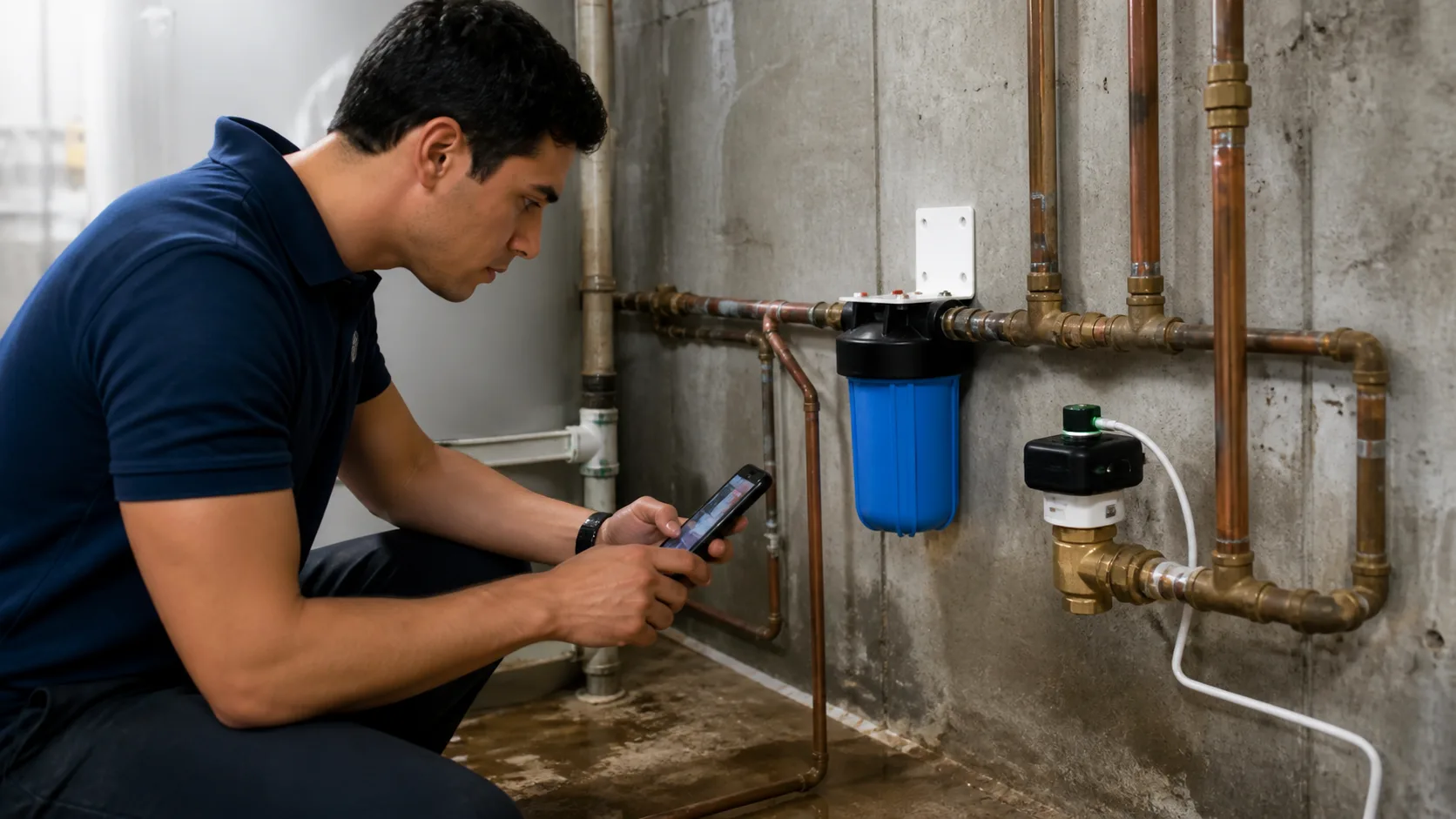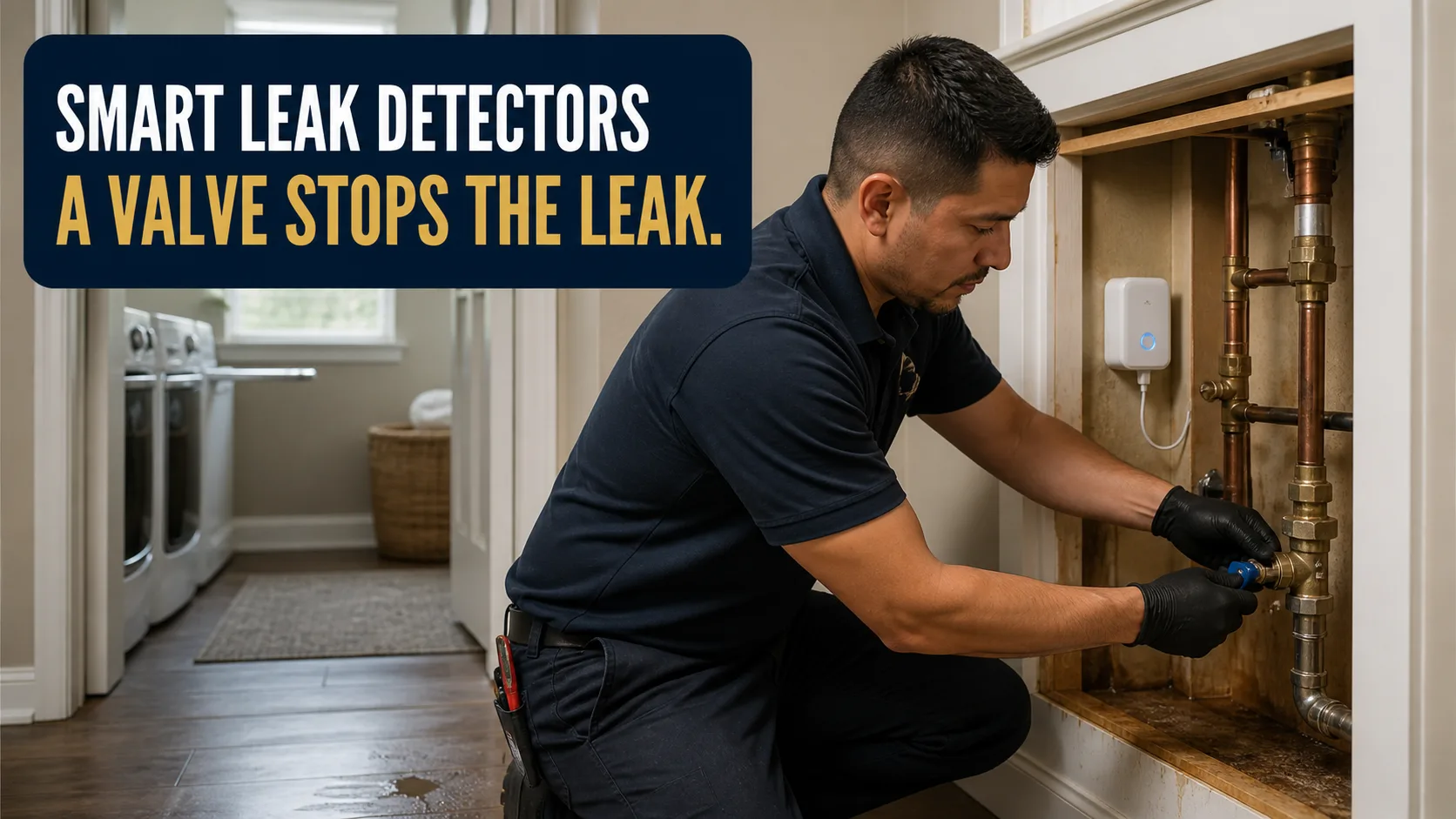
A smart water leak detector is a sensor that texts your phone when it gets wet. That is genuinely useful, because most expensive losses are slow leaks nobody found for days — but a sensor cannot close a valve. If nobody is home to act on the alert, add an automatic shutoff valve. Put the first sensor under the water heater. If one has gone off and you have water, call **(346) 271-7004**.
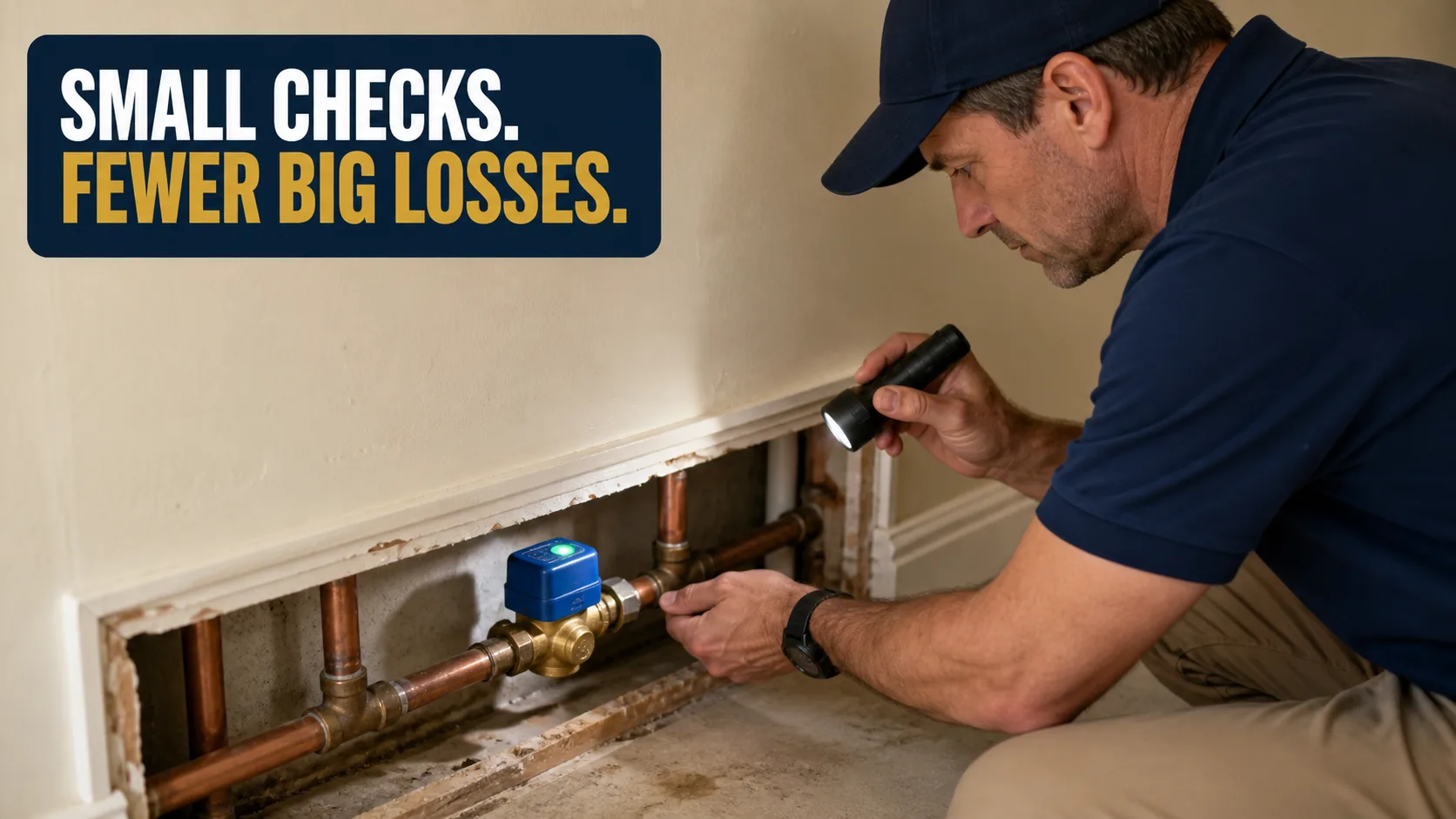
What does a smart water leak detector actually do?
It notices water and tells you about it. That is the whole job, and it is worth being precise about it, because the marketing around this category tends to blur two very different products into one word.
A point leak sensor is a small puck or a puck with a probe cable. It sits on the floor. When water bridges the contacts, it sounds a local alarm and sends a notification to your phone through WiFi or a hub. Many models also read temperature and humidity, and some flag freezing conditions.
A whole-home flow monitor clamps onto or installs into your main line and watches how water moves through it. Instead of waiting for a puddle, it looks for patterns that should not exist — a continuous small flow at 4 a.m., a volume larger than any fixture in the house should produce.
An automatic shutoff valve is a motorized valve on the main that closes when triggered.
Only the third one stops water. The first two produce information. That distinction is the entire point of this page.
Detector or shutoff valve — which one do you actually need?
You want a detector if the question is “how long did this run before someone noticed.” You want a shutoff valve if the honest answer to “will someone be home to act on the alert” is sometimes no.
| Device | What it does | What it stops | Who installs it |
|---|---|---|---|
| Point leak sensor | Detects water touching the sensor or probe, sounds locally, alerts the app | Nothing on its own | You, in under a minute |
| Whole-home flow monitor | Watches flow through the main, flags abnormal usage patterns | Nothing, on monitor-only models | Plumber |
| Automatic shutoff valve | Closes the main line when triggered by a sensor, a flow rule, or the app | The water | Plumber |
| Valve actuator retrofit | Motor that turns an existing quarter-turn ball valve | The water | Handy homeowner or plumber |
The practical answer for most houses is layered. Cheap sensors everywhere water can appear, because they cost almost nothing and cover the specific spots that fail. Then a shutoff valve if the house is ever empty for more than a workday, if the laundry or a bathroom sits over living space, or if you travel.
Where should the sensors go?
On the floor, at the lowest point, wherever a slow leak would pool first. Sensors on shelves and cabinet lips catch nothing. In rough priority order:
- Beside the water heater, on the floor and in the drain pan if there is one. Tank failures are common, they release a lot of water, and heaters are frequently in garages and closets where nobody looks. See water heater lifespan and replacement and water heater connector leaks.
- Behind or beside the washing machine. Supply hoses fail at full line pressure. If you do nothing else on this list, do the water heater and the laundry, and put the hoses on a replacement schedule.
- Under every sink, kitchen and bath. Angle stops, trap joints and supply lines all weep here, usually slowly, usually behind whatever is stored under the sink.
- At the dishwasher toe kick. A dishwasher leak often shows up as a damp cabinet base long before it reaches open floor.
- Near the refrigerator ice maker line, particularly on plastic tubing behind a fridge that has been slid in and out a few times.
- In the air handler drain pan, and near the indoor unit. Clogged condensate lines are one of the most common summer calls in Houston — details in HVAC drain line maintenance.
- Anywhere upstairs that sits over a room you care about, plus the ceiling below if there is an accessible attic pan.
If you can only buy a handful, weight them toward things that are plumbed and pressurized and toward anything above living space. A pressurized failure over a ceiling is the difference between a mop and a rebuild.
What do they cost, roughly?
Point sensors are cheap enough that price is rarely the deciding factor — typically in the tens of dollars each, and less per unit in multipacks. That is why the sensible strategy is buying several rather than agonizing over one.
Whole-home flow monitors with automatic shutoff are a different tier, typically in the hundreds before installation, plus a plumber’s labor to fit the valve on the main. Some brands attach a subscription for extended monitoring or alerts.
Those bands are typical and they move. Brands, promotions, regional labor rates and what the plumber finds at your main all shift the real number, so treat any figure you read anywhere — including here — as a starting point and check current pricing before you budget.
Will my insurance company give me a discount?
Often, but not automatically, and the size of the credit varies a lot. Many carriers offer a premium reduction for monitored leak detection, and the credit is usually larger for systems that include automatic shutoff than for standalone sensors.
Before buying, call your agent and ask two specific questions:
- Does the carrier credit the type of device you are considering, and does it need to be professionally installed or actively monitored?
- Does the credit require you to register the device with them, and what documentation do they want?
That five-minute call sometimes changes which product makes sense. A shutoff system that earns a recurring credit reads very differently on paper than one that does not.
How to evaluate a detector without believing the marketing
Ignore the review roundups and check these instead. They are the specifications that determine whether the thing works when it finally matters.
- Local alarm, not just an app alert. If the network is down or your phone is on silent, a loud sensor in the house is still doing something.
- Battery life and low-battery alerting. A dead sensor is indistinguishable from a dry house. You want the device to tell you it is dying.
- Probe cable option. Puck-only sensors cannot reach behind a fridge or into a tight pan. A cable probe can.
- Freeze and temperature sensing, which turns one device into two for the Houston-specific case below.
- Whether it can trigger a shutoff valve, now or later. Buying into an ecosystem that can add a valve is worth more than a marginally better standalone sensor.
- What happens when the internet drops, and whether the hub has cellular or battery backup.
- Whether it needs a subscription for the alerts you actually care about.
Well-known options in this space range from simple battery sensors sold in multipacks, to combined leak-and-freeze sensors, to whole-home systems that pair flow monitoring with a motorized valve on the main. TruePoint does not sell or install any of them, and we have no stake in which one you pick. Check current manufacturer specifications directly, because features and requirements change between product generations.
The limitation nobody puts on the box
A sensor is a notification. It reduces discovery time, which is genuinely the variable that separates a mop and a fan from a gutted kitchen. But it does not reduce flow rate, and it does not act on your behalf.
The failure mode we still see in houses that have detectors is straightforward. The alert fires. Nobody is home. Nobody sees it for six hours, or the phone was in a meeting, or the notification was one of forty that day. A supply line running at full pressure for six hours puts water into places a mop will never reach — under cabinets, into wall cavities, down into the subfloor and along the framing. In Gulf Coast humidity, what gets wet stays wet, and that is where mold risk starts.
That is the whole argument for the valve. A sensor makes the timeline shorter. A valve makes it finite.
The other honest limitation is coverage. A floor sensor only knows about water that touched it. A slab leak, a supply line failing inside a wall, or a slow roof leak can run a long time without ever producing a puddle where you happened to put a puck. That is what a flow monitor, an annual pressure check and an occasional look at the meter dial are for.
The Houston freeze case
Houston does not freeze often, which is exactly why a freeze here does so much damage at once. Homes are built with exposed hose bibs, attic pipe runs, and supply lines in uninsulated exterior walls. When a hard freeze arrives, failures are not distributed across the year, they all happen in the same 48 hours, and every plumber and mitigation crew in the region is booked at the same time.
A combined leak-and-freeze sensor in the attic or garage gives you a temperature warning while you can still drip faucets, open cabinet doors, and shut off exterior bibs. And if something does burst, the leak alert reaches you at the moment of failure rather than when the ceiling gives way. If that is where you already are, the steps are here — what to do when a pipe bursts.
The alarms on the same shelf
You are already buying sensors and putting dates on things. The fire-side alarms belong in the same afternoon, and they run on dates rather than on batteries.
- Smoke alarms expire ten years from the manufacture date printed on the back. You replace the unit, not the battery. Turn each one over and read the date — most houses have at least one that is past due and nobody has ever looked.
- Placement: one inside every bedroom, one outside each sleeping area, one on every floor, interconnected so they all sound together.
- Carbon monoxide alarms run five to seven years, and every house with a gas appliance or an attached garage needs one on each level.
- Test everything monthly on the same day you glance at the leak sensor batteries.
Two Houston-specific fire items while you are walking the house. Clear the dryer duct the full run to the exterior hood, because lint burns and a blocked duct is the most common laundry-room fire. And if the house dates to the 1960s or 70s, as much of the southeast Houston stock does, and still carries original branch wiring, have a licensed electrician look at the panel — that is electrical fire territory and not a homeowner job.
Take this with you — the ten-minute install plan
Free, no sign-up. Buy a multipack of sensors and one afternoon’s attention, and place them in this order. Stop wherever your budget stops; the list is ranked so that the first few matter most.
- Floor beside the water heater, and inside the drain pan.
- Floor behind or beside the washing machine.
- Under the kitchen sink, at the back where the angle stops are.
- Under each bathroom vanity.
- Dishwasher toe kick.
- Behind the refrigerator, near the ice maker line.
- Air handler drain pan.
- Any upstairs bathroom or laundry that sits over living space.
- Test each one with a wet finger after pairing, and confirm the alert reaches your phone.
- Note the battery type and set an annual reminder.
- Walk to your main shutoff and make sure it turns, so the alert has something to act on.
That last item is the one people skip, and it is the one that makes all the rest useful. An alert is only as good as your ability to close the water in the next sixty seconds.
If a sensor has already gone off, or you found the water the old-fashioned way, we handle mitigation and structural drying across the Greater Houston area from Pearland. Call (346) 271-7004 or email claims@truepointrestoration.com and we will walk through what is wet, what can be dried in place, and what to document before anything gets moved.