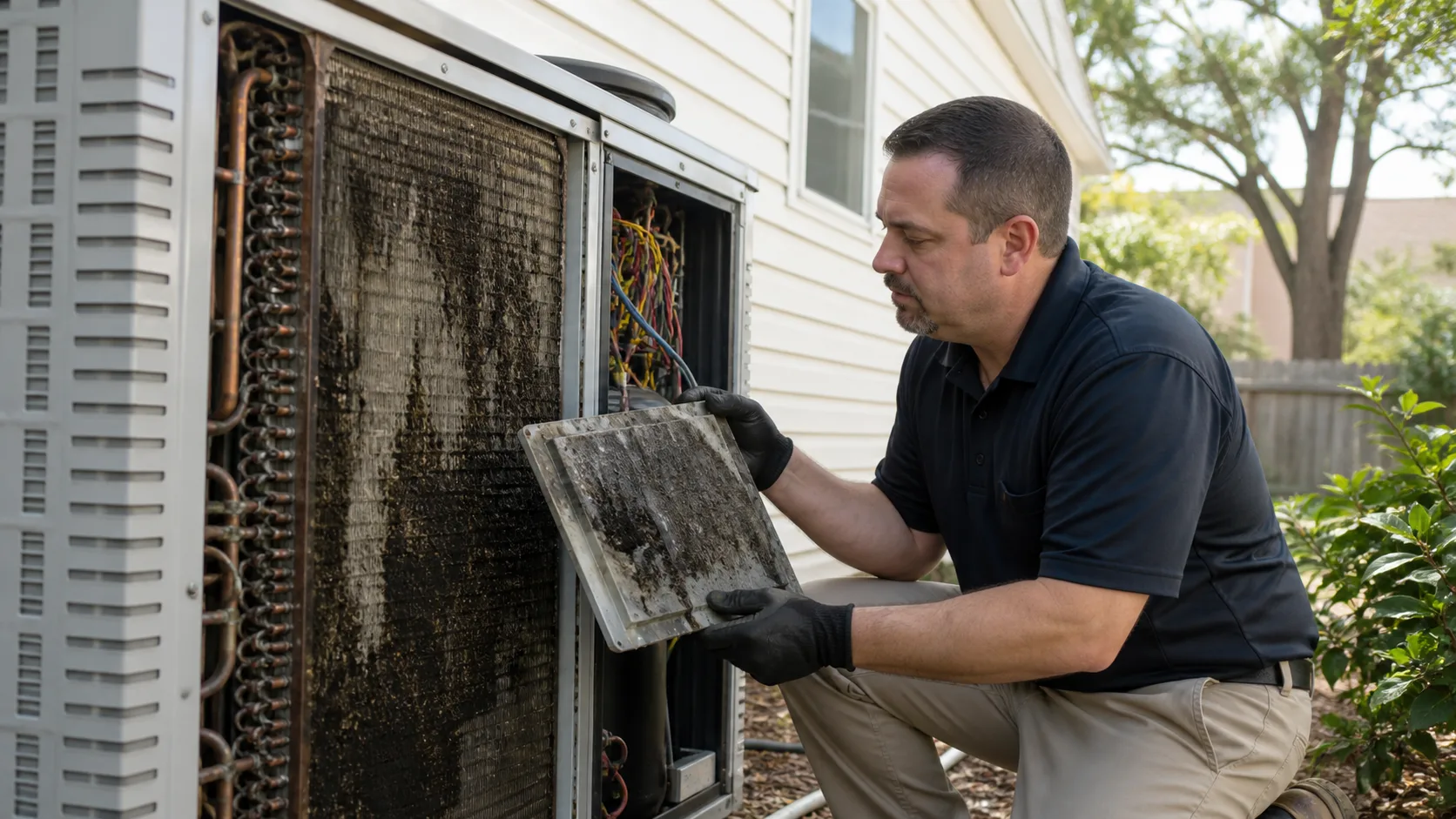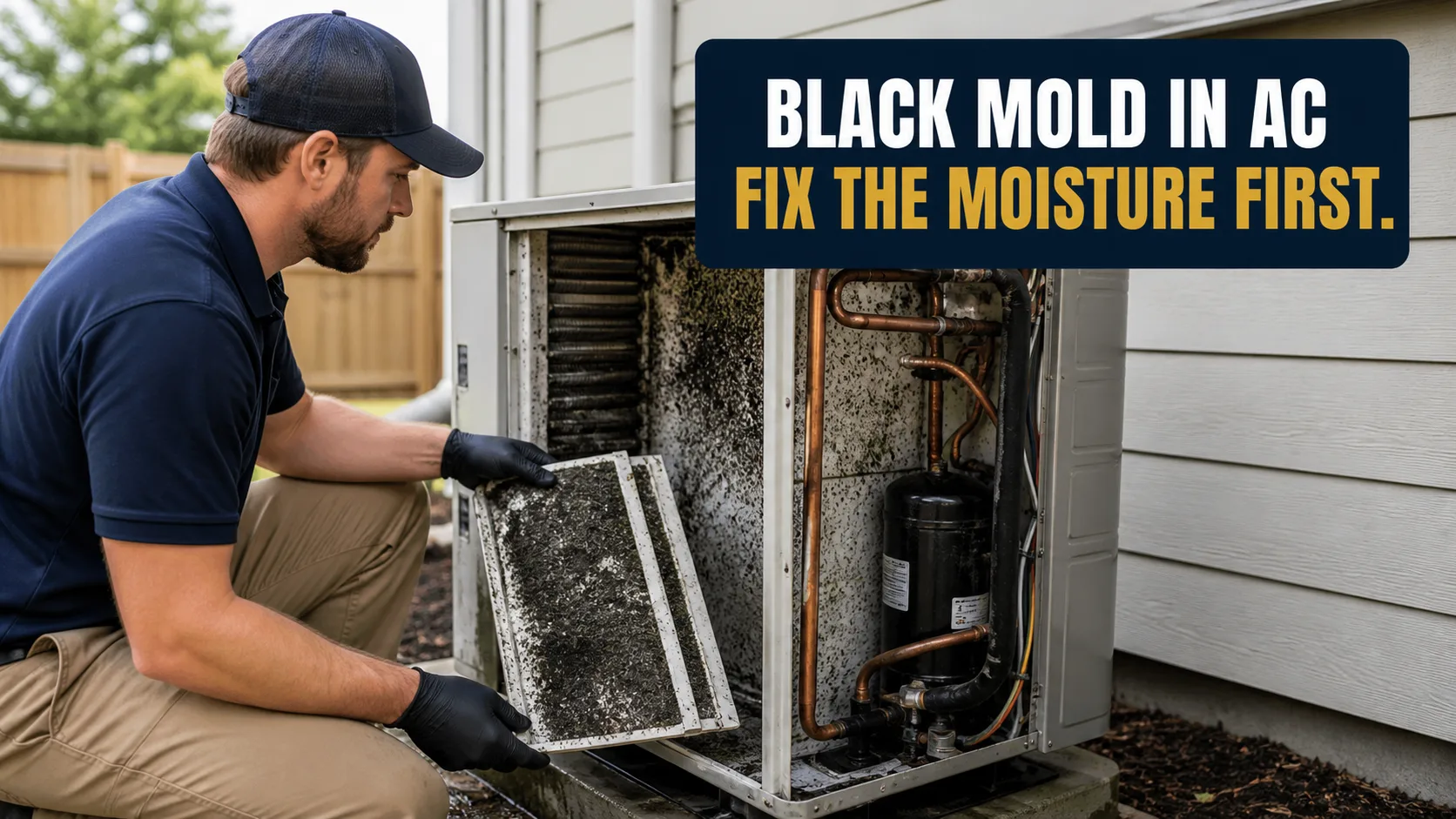
Start with the water, not the mold. An AC system that grows mold has a drainage or humidity problem — a slow drain line, a standing drain pan, a dirty coil, or ductwork sweating in a hot attic. Clear and correct that, then clean the hard components and replace the porous ones. Color tells you nothing about species or risk. If you want a look at it, call **(346) 271-7004**.
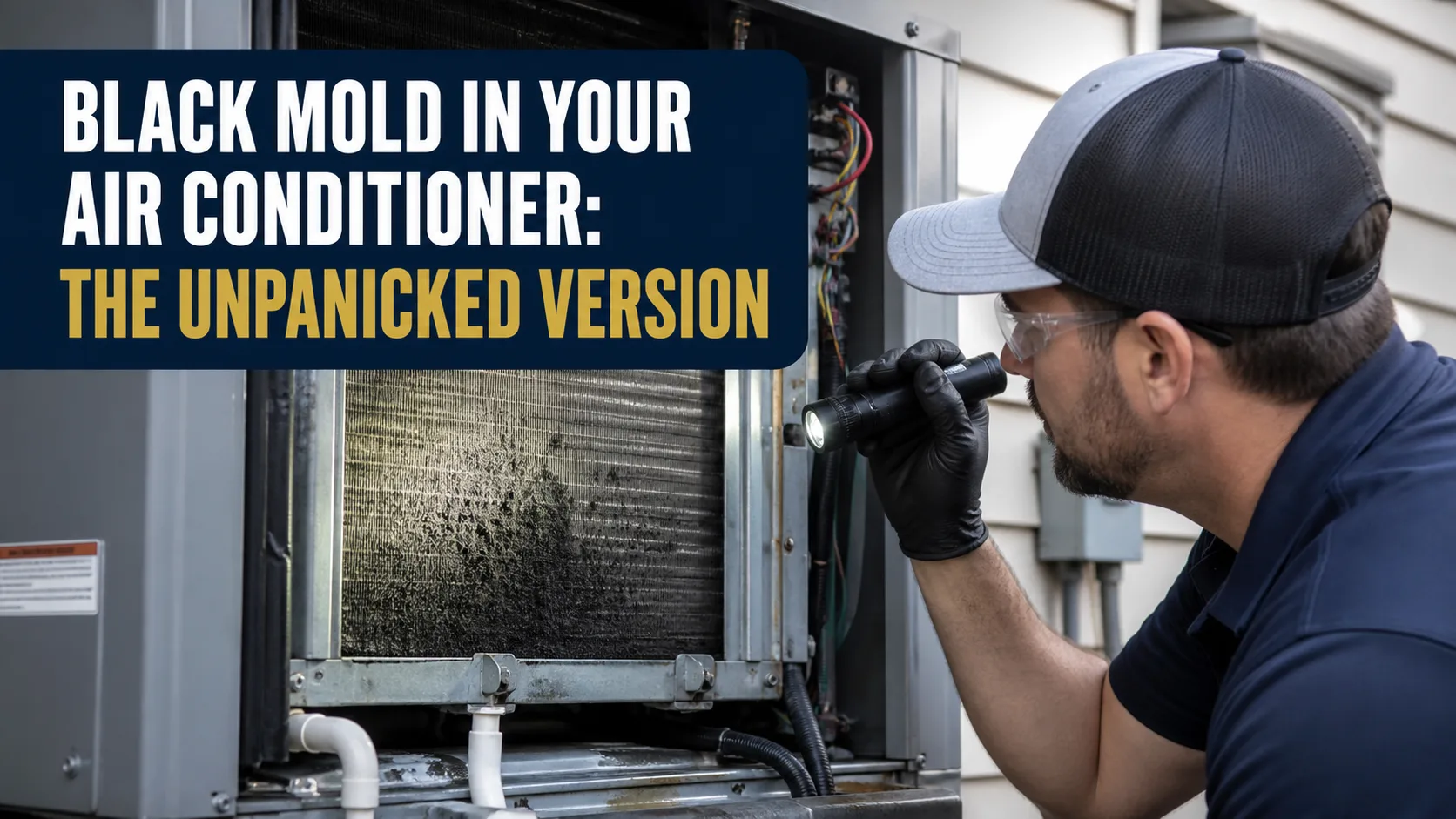
What does black mold actually mean?
Not much, diagnostically. Color does not identify a species and does not tell you how dangerous a growth is. A lot of molds appear dark, plenty of dark staining is not mold at all, and identifying a species genuinely requires lab sampling rather than a phone photo and a search result.
The phrase gets used as a marketing lever, which pushes people toward either panic or dismissal when what is needed is a look at the equipment. The full breakdown of what the term does and does not tell you is in black mold after water damage. This page is about the case people search for most in Houston — growth inside the air conditioning system.
What matters about mold in an AC system has nothing to do with color. It is that the system moves air. An air handler cycles your home’s entire air volume repeatedly every hour, so growth on a coil or inside a duct does not stay where it started. That is why a small patch in an air handler gets treated more seriously than the same patch on a garage wall.
Why do Houston air conditioners grow mold?
Because a running air conditioner is, by design, a condensation machine, and here it runs for most of the year. The evaporator coil sits below the dew point of the air passing over it. Water condenses on the fins, runs off into a pan, and drains away through a small line. That is the system working correctly.
Now put that assembly in a Houston attic in August at 130 degrees, feed it air at 75 percent relative humidity, and run it eight months a year. The coil is wet nearly all the time. The pan holds water. The line is a narrow PVC pipe carrying a constant trickle of water past accumulated dust. The conditions that grow mold are not a failure of the system. They are the normal operating state of it.
What tips it from normal into a problem is usually one of these:
- A slow or clogged condensate line. Water backs up and the pan stops draining, which turns a wet surface into a standing pool. This is the single most common one, and it is also the most preventable — see HVAC drain line maintenance.
- A dirty coil or a neglected filter. Dust on a wet fin is food sitting in water. A filter left in past its schedule loads up, restricts airflow, and gets damp itself.
- Short cycling. An oversized system satisfies the thermostat quickly and shuts off before the coil ever dries. The coil stays permanently wet between cycles.
- Duct sweating in the attic. Torn or compressed duct insulation lets cold air chill the outer jacket in hot attic air, and it condenses on the outside. Sustained, that wets the insulation and whatever sits beneath it.
- A pan that has rusted through or sits out of level. Water pools in one corner and never leaves, or it finds its way into the ceiling instead. That is how you end up with an HVAC drain pan overflow.
Where mold shows up in an AC system
| Component | Why it grows there | Typical response |
|---|---|---|
| Evaporator coil | Permanently wet surface with dust collecting on the fins | Professional coil cleaning; replacement is rare |
| Primary drain pan | Standing water when the line drains slowly | Clean and disinfect; replace if rusted or out of level |
| Secondary or emergency pan | Should be dry; if wet, the primary system is failing | Clear the cause, clean the pan, check the float switch |
| Condensate line | Biofilm builds in a narrow pipe carrying constant water | Flush and treat on a schedule |
| Blower wheel and housing | Damp air plus dust cakes onto the blades | Remove the wheel and clean it properly |
| Flexible duct interior | Porous liner, cold surface, humid air | Usually replaced rather than cleaned |
| Sheet metal duct interior | Non-porous but collects dust and condensation | Can be cleaned |
| Duct insulation, exterior | Sweats when the jacket is torn or compressed | Repair or replace the affected sections |
The pattern in that table is worth noticing. Hard, non-porous components get cleaned. Porous ones get replaced. That single distinction resolves most of the clean-versus-replace argument before anyone quotes anything.
How do you know if there is mold in your AC?
The smell usually arrives first. A musty, earthy odor in the first thirty to sixty seconds after the system starts, fading once air has been moving for a while, is the classic pattern — the blower is pushing air across something damp before that surface has dried. If the smell is constant throughout the house rather than tied to the AC cycling, the source may be elsewhere, and the musty smell that will not go away covers those cases.
After the smell, look at the equipment. With the system off at the breaker, pull the air handler access panel and check:
- The drain pan. Any standing water means the line is not draining properly. Slime or dark film in the pan is exactly what it looks like.
- The evaporator coil. Look at the fins from the return side with a flashlight. A slimy or furred coating on the fins is different from ordinary dust.
- The blower wheel. Dark, caked buildup on the blades is common and is a real reduction in airflow as well as a growth surface.
- The filter. Damp, discolored, or clearly overdue.
- The supply registers. Streaking on the ceiling around a vent, or visible growth on the register itself, points into the duct.
- The attic around the unit. Wet insulation under duct runs, a full secondary pan, or staining on the ceiling below all say water has been escaping. If the secondary pan is doing work, read HVAC secondary drain leak.
Is black mold in the air conditioner dangerous?
The honest answer is that the color does not determine the answer, and neither does a website. What can be said clearly: any mold growing indoors on wet materials should be removed, and an AC system is a worse place for it than most because the system distributes air.
People with asthma, allergies, or compromised immune systems can react to indoor mold. If someone in your home has a health concern they connect to the house, that conversation belongs with their doctor, who can actually assess them. A restoration company can tell you what is growing in your air handler and what it takes to remove it. That is the useful division of labor.
What we would push back on is the framing that turns a dirty drain pan into a crisis. A pan with standing water and a slimy coil is a common, fixable maintenance situation, not a catastrophe. Treat it seriously, get it cleaned, fix the drainage, and move on.
Clean or replace?
| Situation | Typical call |
|---|---|
| Growth on the drain pan, pan sound and level | Clean and disinfect |
| Drain pan rusted through, cracked, or sitting out of level | Replace the pan |
| Slime or growth on the evaporator coil | Professional cleaning with a proper coil cleaner |
| Coil damaged, badly corroded, or beyond cleaning | Replace the coil; evaluate the whole system’s age |
| Caked buildup on the blower wheel | Remove and clean the wheel |
| Growth on the interior liner of flex duct | Replace the affected runs |
| Growth inside sheet metal duct | Clean; reline only if the insulation is contaminated |
| Wet or moldy duct insulation on the exterior | Replace the affected sections |
Where the line falls is mostly about porosity. Metal, plastic, and coil surfaces can be cleaned to a genuinely clean state. Fibrous liners, insulation, and filter media cannot, so trying to clean them is money spent on a partial result.
Be cautious with anyone who arrives, uses the phrase black mold, and quotes a full duct replacement on the first visit without opening the air handler. That is a real job in some houses and an unnecessary one in many others, and the difference is visible in ten minutes with a flashlight.
What proper AC mold cleaning involves
The sequence matters as much as the products.
- Fix the water problem. Clear the condensate line, correct the pan, repair sweating duct insulation, address short cycling if that is what is keeping the coil wet. Cleaning a system that will be soaked again next week is a temporary result.
- Shut the system down and contain the work. Power off at the breaker, registers sealed if duct work is involved, and a HEPA-filtered air scrubber running if there is meaningful growth to disturb.
- Clean the hard components physically. Coil cleaner applied and rinsed properly, the blower wheel pulled and cleaned, the pan scrubbed out, the cabinet interior wiped down and HEPA vacuumed. Physical removal is what does the work.
- Replace the porous ones. Filter, contaminated flex duct, wet insulation.
- Apply an antimicrobial labeled for HVAC use, after cleaning rather than instead of it. Skip the bleach — it corrodes aluminum fins and metal pans, and it is mostly water.
- Restore drainage and verify. Line flushed and treated, pan draining and level, float switch working, and a check that the coil is actually drying between cycles.
- Deal with anything the water damaged on the way out. Ceilings, insulation, and drywall below a leaking air handler are a separate scope, and often the larger one.
What does AC mold cleaning cost?
The range is wide because the scope is, and anyone quoting from a phone photo is guessing.
- Coil and pan cleaning only, on a system caught early, is closest to a service-call number.
- Blower wheel removal and cleaning costs more, because the wheel has to come out and go back in balanced.
- Duct cleaning is priced per system and per run count, and it is only worth doing once the source in the air handler is fixed.
- Replacing porous components — lined plenum, flex duct with contaminated insulation, a rusted-through pan — moves this to an HVAC contractor’s replacement pricing rather than a cleaning price.
- Whether the affected material crosses 25 contiguous square feet, because above that threshold Texas mold rules apply and a licensed assessor and remediator are required, working independently of each other.
Duct insulation and flex duct are porous. They are replaced rather than cleaned, and that is usually what separates a few-hundred-dollar visit from a four-figure one.
How long does it take?
A coil, pan and blower cleaning is usually a single visit. Adding duct decontamination puts it at one to two days. Replacing contaminated flex duct or a lined plenum runs longer and belongs to an HVAC contractor’s schedule rather than ours.
If the affected area crosses the licensing threshold, expect one to three weeks end to end, because a protocol, containment, remediation and independent post-remediation verification each take their own time.
Readings and inspection decide the end, not the calendar — and not the smell. Odor drops off as soon as the visible growth is gone, while anything left inside a lined duct keeps feeding the system every time it cycles.
Does homeowners insurance cover black mold in the AC?
Sometimes, usually with limits, and the framing matters more than most people realize. Many Texas policies cap mold coverage or require a specific endorsement, and coverage generally applies only where the mold results from a covered sudden event that was handled promptly.
The practical difference plays out like this. A condensate line that has been gradually clogging for two summers until the coil turned into a science project reads as maintenance to an adjuster, and maintenance is excluded. A drain pan that overflowed and dropped water through a bedroom ceiling last Tuesday is a sudden event, and the ceiling damage is the claim. In the second case, how quickly and how thoroughly the water was dried is a large part of what protects the coverage.
Two things help regardless of which situation you are in. Document with photographs before anything is cleaned or torn out, and describe what happened rather than leading with the word mold. There is more on how remediation gets priced and what falls inside or outside a claim in mold remediation cost in Houston.
The free maintenance habit that prevents most of this
Almost every AC mold job we see traces back to drainage. Here is the routine that prevents the majority of them, and it costs nothing but ten minutes a month during cooling season.
- Find your condensate line access. It is the capped PVC tee near the air handler, usually a few inches above the unit.
- Once a month, pour about a cup of distilled white vinegar into it. Cap it back up. This keeps biofilm from establishing in the line. Do this at the start of the cooling season and monthly through the summer.
- Check the secondary pan every month while you are there. It should be bone dry. Water in it means the primary system is failing and you have a warning rather than a leak, for now.
- Confirm the float switch works by lifting it gently with the system running. The unit should shut off. If it does not, you have no backstop against a ceiling leak.
- Change the filter on schedule — every one to three months for a standard pleated filter in Houston, and more often with pets or during heavy pollen periods.
- Look at the drain line outlet outside. During a humid day with the system running, it should be dripping steadily. A dry outlet on a hot day means water is going somewhere else.
- Once a season, look at your attic ducts for torn insulation jacket, crushed runs, and any damp insulation underneath.
If you do only the first two of those, you will avoid most of the calls we get about AC-related mold and water damage. It is a genuinely high-return ten minutes.
If you want someone to look at it
If you have a musty smell you cannot place, a pan with water in it, or ceiling staining under an attic air handler, we are happy to take a look and tell you plainly whether this is a maintenance job for your HVAC company or a remediation job. Frequently it is the former, and you should hear that.
We are not an HVAC contractor. We do not replace coils, drain pans, plenums, or flex duct, and we do not service the system afterward — that is your HVAC company’s work. On a licensed-size mold project, the consultant who writes the protocol and clears the job has to be independent of the company doing the removal.
TruePoint Restoration works throughout Greater Houston from Pearland. Call (346) 271-7004 or email claims@truepointrestoration.com with photos of your air handler and drain pan, and we will tell you what we see.