Service Areas · August 15, 2026

Water Damage Mitigation in Friendswood, TX

Local water damage mitigation in Friendswood, TX. Same-day extraction, structural drying, and insurance documentation for Galveston and Harris county homes along Clear Creek and Mary's Creek.

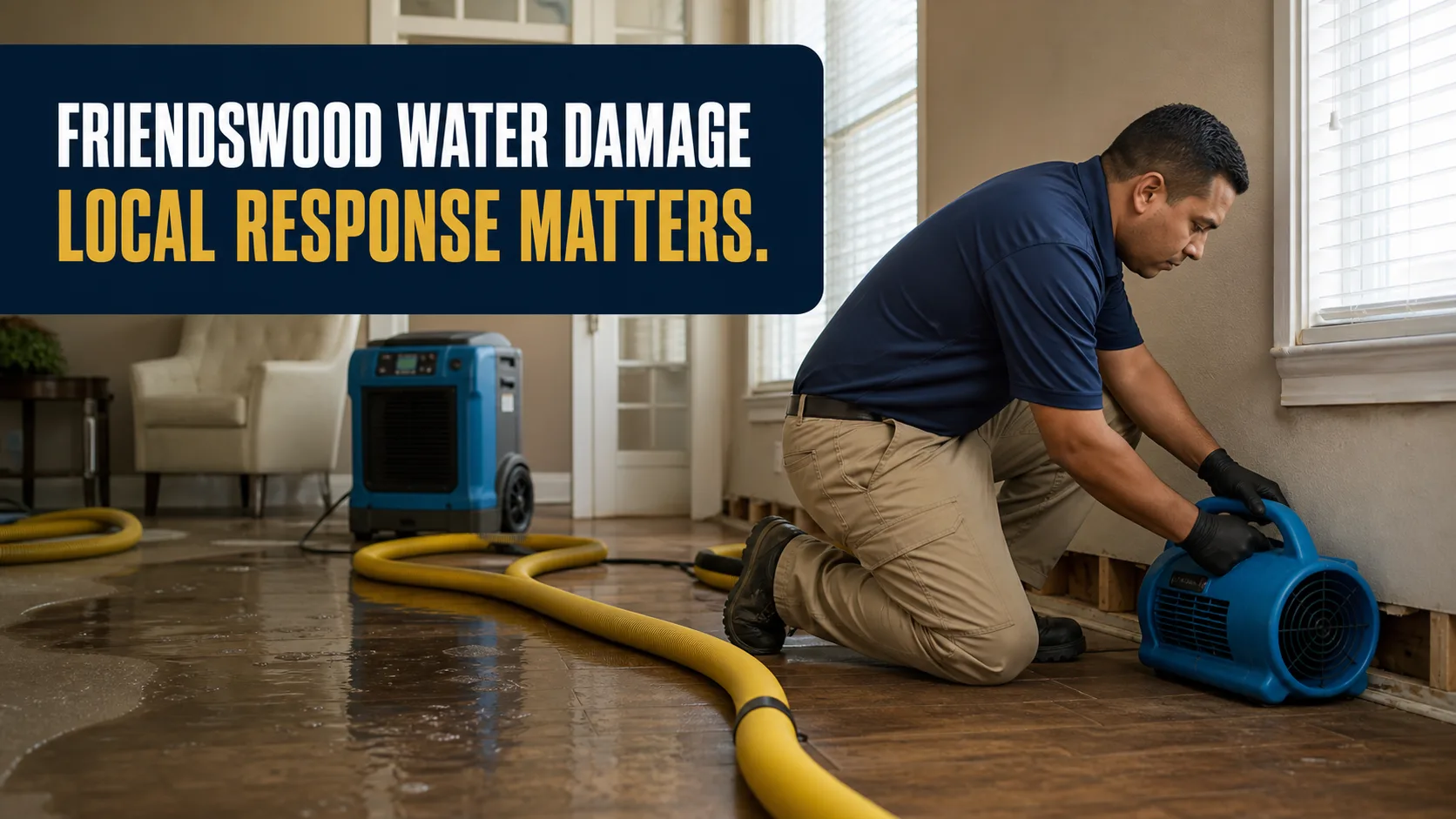
A technician in a blue polo shirt and black gloves kneels on a wet wooden floor, positioning a blue air mover next to a wall with removed baseboards, while a large blue dehumidifier and yellow hoses are visible in the background. Caption on image: FRIENDSWOOD WATER DAMAGE LOCAL RESPONSE MATTERS.
The short answer

TruePoint Restoration serves Friendswood across Galveston and Harris county — same-day emergency extraction, structural drying, and insurance-grade documentation from a local, owner-operated crew. Friendswood has a long, hard flooding history along Clear Creek and Mary's Creek, so the homeowners-vs-flood coverage line matters here more than most places. Call or text **(346) 271-7004** with your location and a photo of the damage.

A technician wearing a blue polo shirt and black gloves kneels on a wood floor, holding a moisture meter and writing on a clipboard, with two blue air movers drying a water-damaged wall and baseboard. Caption on image: FAST LOCAL RESPONSE CHANGES THE OUTCOME.

Local to Friendswood

Few Houston-area communities know water like Friendswood does. Between its creek flooding history and everyday interior failures, homes here need fast response and someone who understands how homeowners and flood coverage intersect. TruePoint Restoration is local and owner-operated, with a team that documents your loss the way adjusters need.

Friendswood straddles a county line. Most of the city sits in Galveston County with its northern edge in Harris, and Clear Creek runs through the middle of it. That creek is why Friendswood carries one of the region’s heaviest concentrations of repeat-loss properties, why FEMA and the city have bought out and demolished homes along it rather than let them flood a fourth time, and why the flood conversation here is not theoretical.

What causes water damage in Friendswood homes

  • Creek flooding. Friendswood’s Clear Creek and Mary’s Creek location gives it repeated flooding history — Harvey hit hard here. Outside flooding is a flood-policy matter, and storm floodwater is treated as contaminated.
  • Sewer backups. Heavy rain can surcharge systems and cause sewer backups — contaminated water needing professional handling.
  • Attic HVAC condensate leaks dropping water through ceilings all summer.
  • Water heater and supply-line failures in attics and closets.

Repeat loss, buyouts, and what that means for your address

A repeat-loss property is one that has claimed on flood insurance more than once, and along Clear Creek there are streets where that describes most of the block.

The flood history attaches to the property, not to you. Anyone buying a Friendswood house near the creek can and should ask for the claims record, and a documented mitigation file from a previous loss is the difference between an honest disclosure and an ugly surprise at inspection.

And if you have flooded before, your next claim is examined against the last one. Adjusters look hard at whether the previous loss was fully dried and fully documented. If it was not, the current claim gets argued as pre-existing damage — the most common route to a denied water damage claim on this side of the county.

Slab-on-grade on Friendswood clay

The soil under most of this city is expansive clay. It swells when wet, shrinks when dry, and moves the slab a little every season. That movement is why Friendswood sees more than its share of slab leaks — the pipe is rigid, the ground under it is not, and the joint eventually gives.

A slab leak announces itself quietly: a warm patch on the floor, a water bill that stepped up and stayed up, the sound of running water with everything off. By the time it shows at the baseboard it has been under the slab for weeks, and the remove-or-dry decision on the bottom twelve inches has usually been made for you.

Slab movement also breaks the seal between the bottom plate and the slab. That is how creek water reaches the inside of a wall in houses that were never actually underwater.

What we do

  1. Map the water with moisture meters and thermal imaging.
  2. Extract and dry with commercial equipment to a verified dry standard.
  3. Prevent mold by beating the 24-to-48-hour window.
  4. Document for insurance — and help you keep homeowners vs. flood straight.

What it costs, and what the creek adds

  • Flood versus plumbing. Creek water arrives contaminated, so porous material is removed rather than dried. That turns a drying job into a demolition-and-disposal job and moves the number substantially.
  • How high it got. Two inches and twenty inches are different scopes. Two inches is flooring and baseboard. Twenty is drywall, insulation, cabinet boxes and every electrical device below the line.
  • Whether it reached the slab plate. Water trapped between the flooring and the slab has to be reached, which means the flooring comes up regardless of how it looks from above.

A clean supply-line loss in one room is a low-thousands job. A creek event through the living area of a slab home is five figures before anyone rebuilds.

The two-policy reality in Galveston County

Friendswood’s Galveston County address puts most of the city in coastal windstorm territory, where wind and hail is frequently carved out of the homeowners policy and written separately. Flood is a third policy, always separate, and the creek is flood.

A hurricane that strips shingles and then puts creek water through the front door is potentially three claims paying for three different kinds of damage. The only thing that stops them arguing with each other is a photographic record showing what arrived from where. What homeowners actually covers is worth reading first.

Free, and worth doing tonight

  1. Find your declarations pages and confirm you hold wind and flood, not just homeowners.
  2. Locate your elevation certificate. If you do not have one, your agent or the city can tell you how to get one.
  3. Photograph every room, and the outside grade on all four sides, with the date stamp on.

What we handle, and what we do not

TruePoint Restoration is a mitigation contractor, not a plumber, a slab tunneling company, an electrician, a rebuild contractor, or a public adjuster. We will tell you which of those you need.

Our work is the water and the proof: mapping, extraction, containment, removal of contaminated material, drying to a documented standard, and a file built for a Texas adjuster. Friendswood, and neighboring League City and Pearland: call or text (346) 271-7004.

If you have water damage right now

Stay out of standing water near outlets, stop the source if you safely can, photograph everything before you remove anything, then call or text (346) 271-7004. Honest answer, every time.

Serving Friendswood and the surrounding Greater Houston metro. See all our service areas.
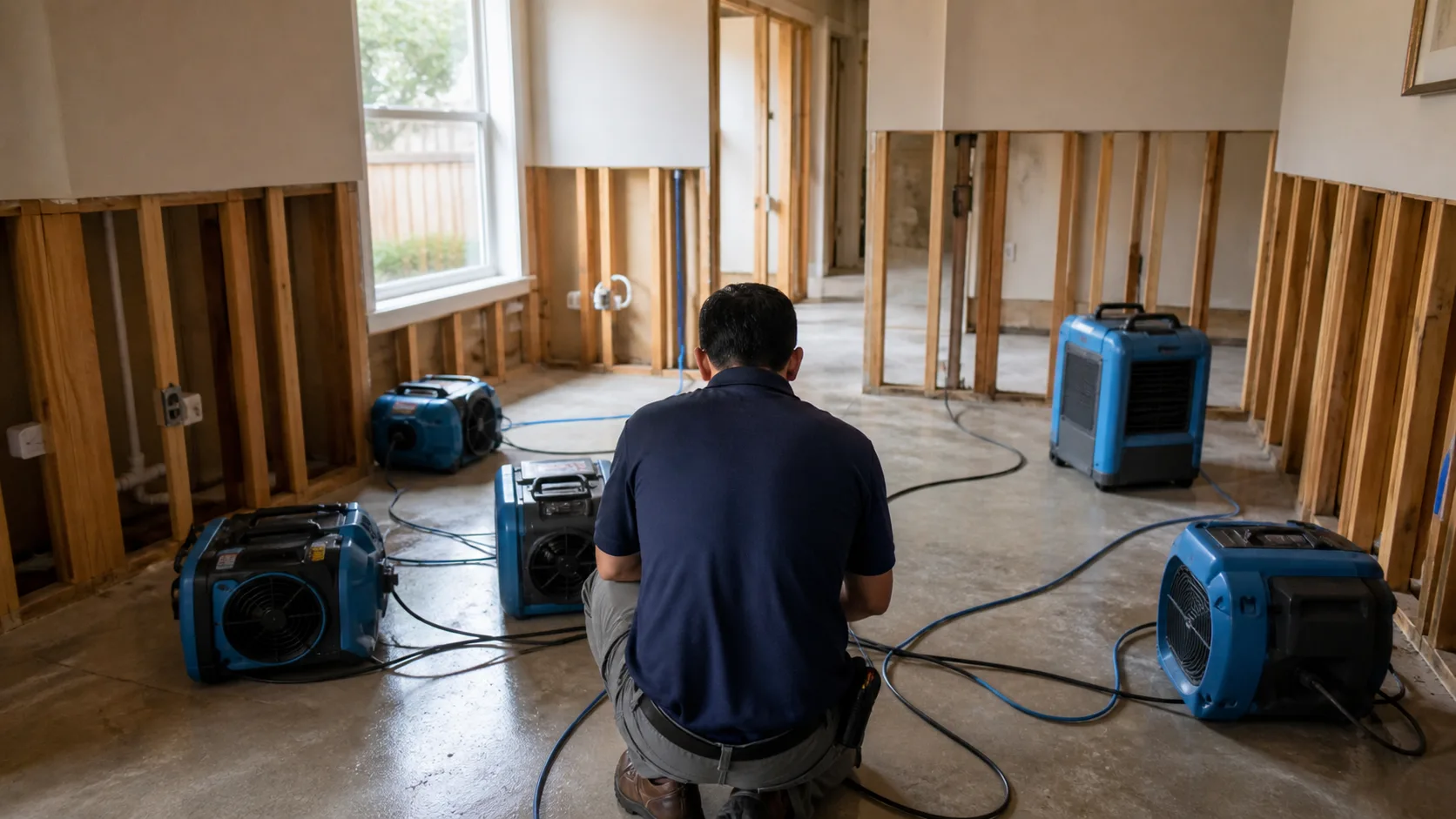
A water damage restoration technician kneels in a room with exposed wall studs and five blue air movers drying the concrete floor.
Questions, answered

Friendswood Water Damage Questions

Who does water damage mitigation in Friendswood, TX?
TruePoint Restoration serves Friendswood across Galveston and Harris county. Local and owner-operated, we handle emergency water extraction, structural drying, and insurance-grade documentation. Call or text (346) 271-7004 with your location and a photo of the damage for an honest arrival window.
Does Friendswood flood?
Friendswood has a long and serious flooding history — its location along Clear Creek and Mary's Creek has led to repeated flooding in major rain events, including catastrophic flooding during Hurricane Harvey. That makes flood insurance especially important here. Note that outside flooding is covered only by a separate flood policy, while sudden interior failures like a burst pipe are usually covered by homeowners.
Why does Friendswood flood so much?
Friendswood sits along Clear Creek and Mary's Creek in a low-lying part of the Clear Creek watershed, so heavy or prolonged rain can push those creeks over their banks into neighborhoods. The area's flat terrain and clay soil, which sheds water rather than absorbing it, add to the problem. Many Friendswood homes carry flood insurance for exactly this reason — and it's worth confirming yours.
How fast can you respond in Friendswood?
Same day, usually within hours — and after a flood event, fast documented mitigation is critical to protecting both your home and your claim. With Gulf humidity, mold can start within 24 to 48 hours. Call (346) 271-7004, text a photo, and we'll give you an arrival window.
Do you document Friendswood flood and water damage for insurance?
Yes, and in a flood-prone town like Friendswood that's essential. Yes. We document losses — source of loss, moisture readings, drying logs, photos — in the format adjusters expect, and help you keep the homeowners and flood coverage pieces straight.
What's the difference between water mitigation and water restoration?
Mitigation stops the damage in progress—extraction, drying, mold prevention in the first 24-48 hours. Restoration rebuilds what's damaged: new drywall, flooring, paint. We do mitigation. You need restoration after. Both matter; mitigation prevents the bill from doubling.
When should I call a water mitigation company?
Call the moment water stops flowing or pooling. Wet carpet, damp walls, water in the attic—don't wait. Every hour counts in Houston humidity. We move fast because slow costs you. Call or text (346) 271-7004 right now if water's sitting in your home.
What exactly does a water mitigation company do?
We extract standing water, run dehumidifiers and air movers to dry structural materials to verified standards, scan for hidden moisture, prevent mold, and document everything for your adjuster. We're the first responders—we stop the bleeding before restoration crews rebuild.
Does TruePoint do fire and smoke restoration in Friendswood?
Yes, on both the Galveston County and Harris County sides of town. Fire and smoke damage runs through the same crew as our water work, which matters here because the two arrive together — the fire makes the smoke, the fire department makes the water. Send photos and your address to (346) 271-7004 for an honest read on what the loss needs.
How much water does the fire department put in a house, and does that get dried?
More than most homeowners expect. Hose lines move water by the hundreds of gallons a minute, and on a slab-on-grade Friendswood home that water runs flat across the floor into every room, then wicks up the drywall and under the cabinets where nobody sees it. It is on the same clock as any other water loss, which is why smoke cleanup and structural drying run together — skip the drying and you finish the fire job with a mold job.
We had a fire last winter and the smell came back in July. Why?
Heat and humidity reactivate smoke residue. Soot left in porous material — attic insulation, subfloor, the back of a cabinet — goes quiet in cool dry weather and starts releasing odor again when Gulf humidity and attic temperatures climb. A smell that returns is evidence the source was never fully removed, and no amount of fogging or sealing fixes that without going back to the residue.
My Friendswood home has flooded before. Does that change how you dry it?
It changes what we look for. Houses along Clear Creek and Mary's Creek that have been through more than one event usually carry patched flood cuts, insulation replaced unevenly, and framing that has been wet before, so moisture gets read in the old and the new material separately instead of assuming the wall is uniform. What we find in those prior repairs matters to the claim as much as what we dry.
How high should drywall be cut after a flood?
Above the visible waterline, and by a real margin — commonly to the next convenient height such as two feet or four feet — because water wicks up gypsum board well past where it looks wet. Cut too low and you close saturated board and insulation behind the patch. Floodwater from outside is contaminated, so the insulation behind that cut comes out with it rather than being dried.
Does a flood take longer to dry than a burst pipe?
The drying itself is similar. The difference is how much has to come out before drying starts — clean water from a supply line lets most materials dry in place, while creek or storm water is contaminated and the porous materials it touched get removed instead. That removal step is why a flood job feels slower and far more destructive even when the equipment runs about the same number of days.
Water or fire damage right now?

Talk to someone who documents it properly.

Certified water and fire damage mitigation across Pearland, Manvel, Friendswood and the Greater Houston area. Text a photo of what you are seeing and we will tell you whether it needs professional drying.

Call or text (346) 271-7004