Service Areas · August 15, 2026

Water Damage Mitigation in Pasadena, TX

Local water damage mitigation in Pasadena, TX. Same-day extraction, structural drying, and insurance documentation for southeast Harris county homes with older housing stock and aging plumbing.

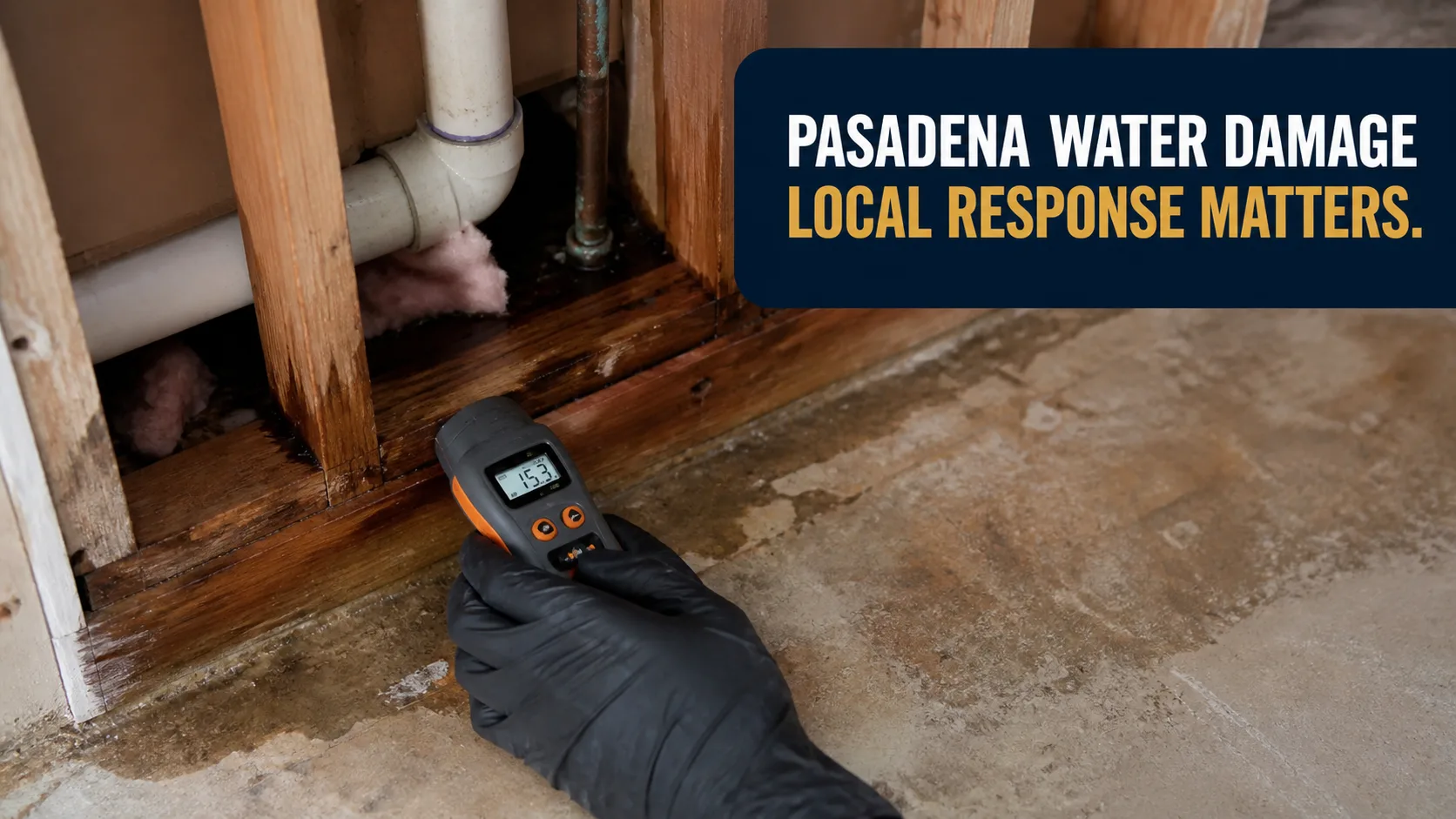
A gloved technician holds a moisture meter displaying "15.3" against a water-damaged wooden wall with exposed pipes and insulation. Caption on image: PASADENA WATER DAMAGE LOCAL RESPONSE MATTERS.
The short answer

TruePoint Restoration serves Pasadena across southeast Harris county — same-day emergency extraction, structural drying, and insurance-grade documentation from a local, owner-operated crew. Pasadena's older housing stock brings aging-plumbing failures: seized valves, corroded connectors, and water heaters past their service life. Call or text **(346) 271-7004** with your location and a photo of the damage for an honest arrival window.
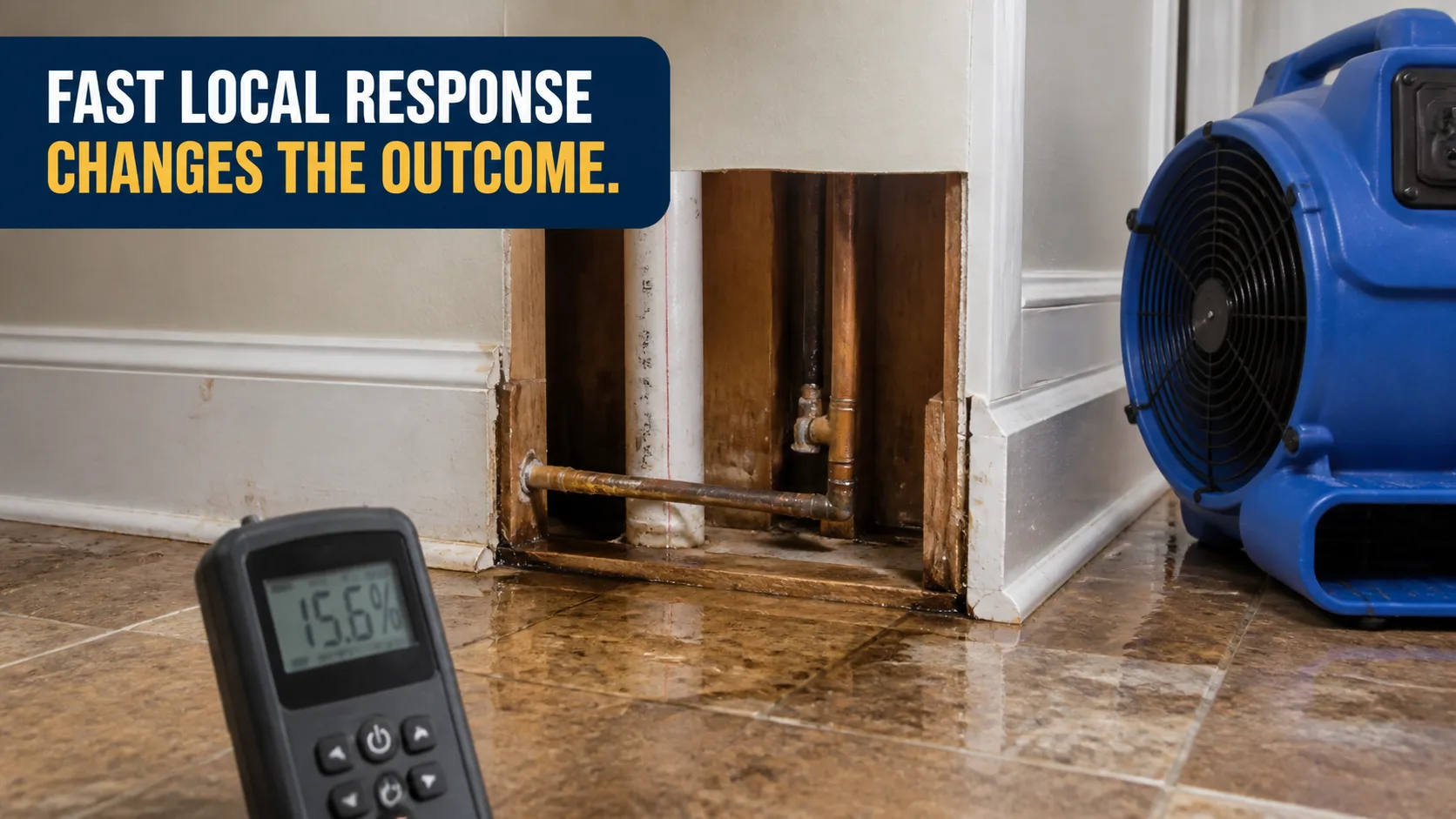
A water-damaged wall with exposed pipes and standing water on a tiled floor, with a moisture meter displaying 15.6% and a blue industrial fan nearby. Caption on image: FAST LOCAL RESPONSE CHANGES THE OUTCOME.

Local to Pasadena

Pasadena’s older neighborhoods fail in ways that reward experience — aging plumbing, original water heaters, dated valves. TruePoint Restoration is local and owner-operated, with a team that knows those patterns and documents the loss so an insurer can’t wave it off as a maintenance issue.

Pasadena is Harris County, hard against the Houston Ship Channel, and the city grew with the refineries. Most of the housing north of Spencer went up between the late 1940s and the early 1960s for people working the plants, and that construction date is the single most useful fact about a Pasadena loss.

What causes water damage in Pasadena homes

  • Aging plumbing. Older supply lines and slab plumbing develop leaks; seized shut-off valves make a small leak worse because they won’t close.
  • Water heaters past their service life. Original tanks in older homes fail — worth knowing your water heater’s age.
  • Attic HVAC condensate leaks dropping water through ceilings all summer.
  • Low-lying flooding. Ship Channel-area and bayou-adjacent parts of Pasadena have flooding history — a flood-insurance matter distinct from interior leaks.

Plaster does not behave like drywall

Houses of that era have lath-and-plaster walls and ceilings, and plaster fails in a way drywall does not. Drywall wets, swells, sags, and either dries or comes out. Plaster blisters — the wet plaster loses its grip on the lath behind it, the key breaks, and a whole panel separates and stays up until it does not.

You can dry the surface and still have a ceiling that is no longer attached to anything. That is why a plaster ceiling that took water gets sounded and probed rather than metered and signed off, and why the remove-or-dry decision has a different answer here than it does in a 2010 subdivision. Plaster is also heavy, so a saturated ceiling panel is a genuine safety problem in a way a sagging sheet of drywall is not. Stay out from under it.

Post-war systems, all aging out at once

The same houses carry the rest of that era: cast iron drain lines, galvanized supply in places, original shut-off valves that have not been turned in decades, and branch wiring that predates equipment grounding.

The valves are the part owners underestimate. A leak you could stop in thirty seconds becomes an hour of spreading water because the angle stop under the sink will not close and the main is buried under fifty years of yard.

The wiring is the fire half. Terminations loosen across decades of thermal cycling, and the failure appears at outlets, switches and panel lugs — electrical fire damage, which leaves corrosive chloride-bearing residue rather than ordinary wood smoke, and which starts inside a wall where nobody can see it.

Ship channel adjacency

Bayou-adjacent and low-lying parts of the city have taken water repeatedly, and with industrial neighbors, floodwater here should be assumed contaminated rather than merely dirty. Slab plumbing under an older Pasadena house is the separate and more common problem.

What we do

  1. Map the water with moisture meters and thermal imaging.
  2. Extract and dry with commercial equipment to a verified dry standard.
  3. Prevent mold by beating the 24-to-48-hour window.
  4. Document for insurance — establishing a sudden cause, which matters on older homes.

What a Pasadena job costs

Older houses cost more to restore than newer ones of the same size, for physical reasons.

  • Plaster removal and disposal is heavier, slower and dustier than drywall removal, and it needs containment that drywall often does not.
  • Access. Reaching a leak inside an original wall assembly means opening more of it.
  • Contamination category. Sewage from a failing cast iron main, or floodwater off a bayou, both convert drying into removal.
  • Pre-1978 finishes. Lead and asbestos considerations are a real scoping factor, and a contractor who does not raise them is not doing the job properly.

A contained clean-water loss caught the same day is low thousands. Plaster ceilings down across several rooms, or a Category 3 backup in an original house, runs to five figures.

The maintenance argument, and how to beat it

On a seventy-year-old house the carrier’s first instinct is that the failure was gradual and therefore excluded. That is the most common route to a denied water damage claim in this part of the county.

What defeats it is a sudden, dated cause: the plumber’s written finding, the photographs from the day you discovered it, and a mitigation file that shows readings and materials rather than adjectives.

Pasadena is inland enough that wind and hail normally stays on the homeowners policy. Flood is separate, as always.

Tonight, and it costs nothing

  1. Turn every angle stop under every sink and toilet, and the main. Replace any that will not move.
  2. Photograph every ceiling, dated, and note any that already sag or ring hollow.
  3. If you smell hot plastic anywhere, kill that circuit and call a licensed electrician.

Where TruePoint stops

We are a mitigation contractor. Plumbing repair, electrical work, HVAC, roofing, reconstruction and public adjusting belong to other licenses, and on a house this age you will need at least two of them.

Our work is the water and the residue — containment, extraction, plaster and material removal where it cannot be saved, documented drying, soot and odor, and a file built to survive an argument. Pasadena and neighboring Baytown down the channel: call or text (346) 271-7004.

If you have water damage right now

Stop the source if you safely can (the house main if a valve won’t close), cut power near standing water, lift belongings, photograph everything, then call or text (346) 271-7004. Honest answer, every time.

Serving Pasadena and the surrounding Greater Houston metro. See all our service areas.
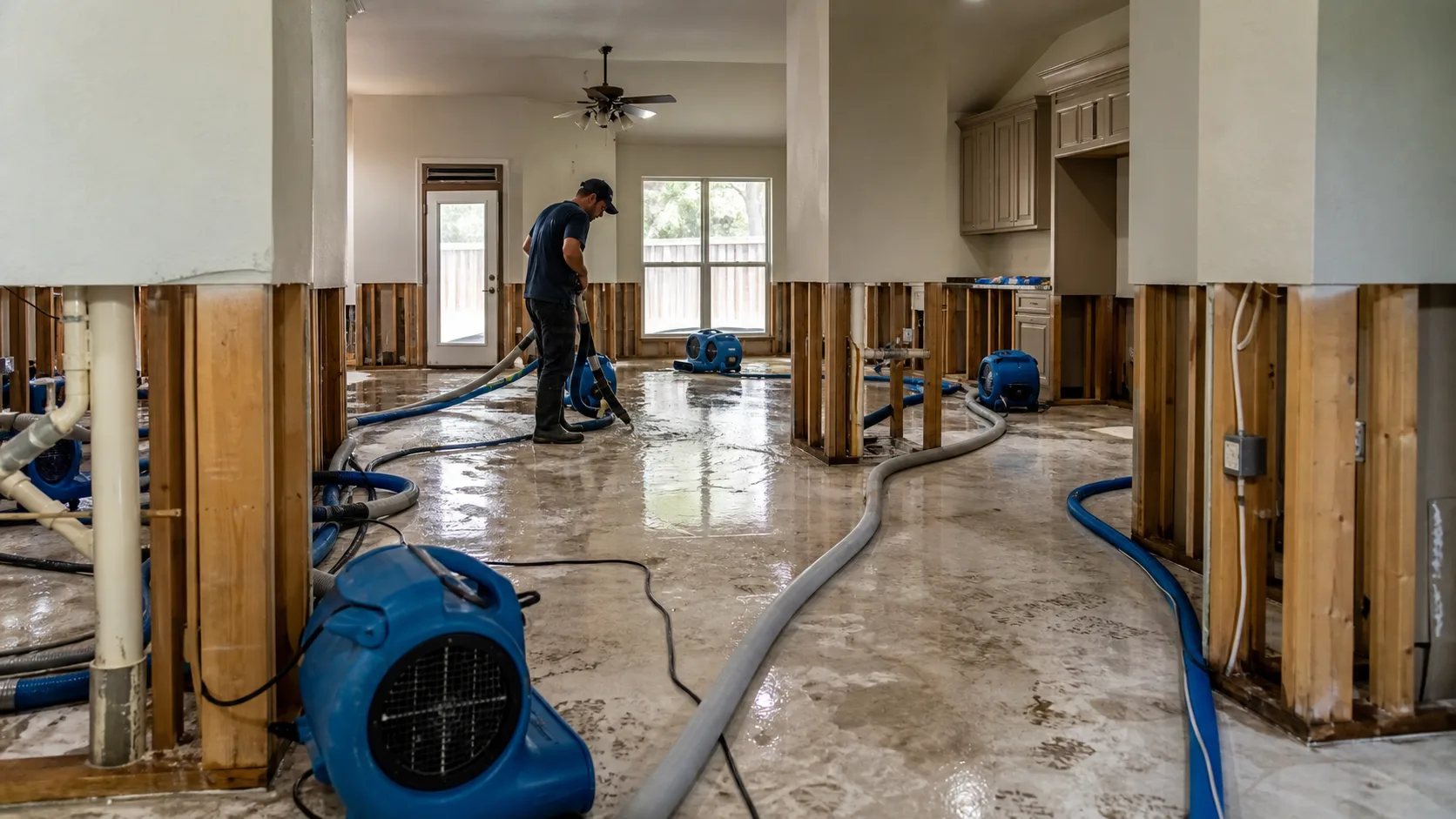
A technician in a blue shirt and boots uses a water extraction tool on a wet concrete floor in a home with exposed wall studs and several blue air movers.
Questions, answered

Pasadena Water Damage Questions

Who does water damage mitigation in Pasadena, TX?
TruePoint Restoration serves Pasadena across southeast Harris county. Local and owner-operated, we handle emergency water extraction, structural drying, and insurance-grade documentation. Call or text (346) 271-7004 with your location and a photo of the damage for an honest arrival window.
Does Pasadena's older housing cause more water damage?
Older homes tend to have aging plumbing — original galvanized or older copper lines, dated supply valves, and water heaters past their service life. These fail more often and in ways newer homes don't: seized shut-off valves, corroded connectors, and slow leaks that go unnoticed. In Pasadena's older neighborhoods, knowing the age of your plumbing and water heater helps you get ahead of a failure.
Does Pasadena flood?
Parts of Pasadena, given its low-lying southeast Harris location near the Ship Channel and bayous, have flooding history in major rain events and tropical systems. But most Pasadena water-damage calls are interior failures — aging plumbing, water heaters, and HVAC. Outside flooding needs separate flood insurance; sudden interior failures are usually covered by homeowners.
How fast can you respond in Pasadena?
Same day, usually within hours. Because we're local to the Houston metro, you're not waiting on an out-of-area crew — and with mold able to start within 24 to 48 hours in our humidity, fast arrival matters. Call (346) 271-7004 and we'll give you an honest arrival window.
Do you handle insurance claims for Pasadena water damage?
Yes. We document Pasadena losses — moisture readings, affected materials, drying logs, photos — in the format adjusters expect. On older homes especially, clear documentation of a sudden cause helps keep a claim from being disputed as a maintenance issue.
What's the difference between water mitigation and remediation?
Mitigation stops the bleeding — extraction, drying, mold prevention within 24-48 hours. Remediation rebuilds after. We do mitigation. Your contractor or insurance adjuster handles remediation (drywall replacement, flooring, etc.). Skip mitigation, mold sets in and remediation costs triple.
What does water mitigation actually include?
Extracting standing water, running dehumidifiers and air movers until moisture readings hit safe levels, pulling up wet carpet if needed, thermal imaging to find hidden water, and documenting everything for your claim. We don't rebuild — we stop the damage from getting worse.
How much does water mitigation cost?
Depends on square footage, water source, and how long it sat. A typical bedroom leak: $1,200–$2,500. Major extraction: $3,000–$6,000+. Most homeowners don't pay it — their insurance does after we file the claim. Call us for a real number based on your damage.
Who handles fire and smoke damage restoration in Pasadena, TX?
TruePoint Restoration works fire and smoke losses across Pasadena alongside our water work. The older housing here means plaster, original wood trim, and painted surfaces where a wet rag on soot sets a permanent stain, so identifying the residue before anybody cleans is the step that saves material. Send photos and your address to (346) 271-7004 for a straight answer.
There was an industrial fire nearby and my Pasadena house smells like smoke. Does that count as damage?
It can, and it is worth documenting rather than airing out and hoping. Smoke from a nearby industrial or commercial fire enters through fresh-air intakes, attic vents, and open windows, then settles into filters, insulation, carpet, and soft contents where it keeps releasing odor for weeks. Photograph and date what you find, keep the HVAC filters you replace, and get the residue identified before cleaning changes the evidence.
Our Pasadena house has plaster walls. Can soot come off them?
Often, if the dry pass comes first. Plaster is harder and less porous than modern drywall, so soot lifted dry with a HEPA vacuum and a chemical sponge frequently comes off a painted plaster wall that would be ruined on gypsum board. Water is the failure mode — plaster that gets saturated during cleaning or from hose water softens, blisters, and pulls away from the lath, so wet methods stay minimal and controlled.
I rent in Pasadena and the unit flooded. Who calls a mitigation company?
The owner or the property manager authorizes the work, because it is their structure and usually their policy that pays to dry it. Your renters policy covers your belongings, which is a separate claim you file yourself. Photograph everything the day it happens and keep your notice to the landlord in writing — in a duplex or a rental with a slow manager, that record is what protects you when the drying starts late.
What are pinhole leaks, and why do Pasadena homes get them?
A pinhole is a corrosion failure that eats through a supply line from the inside, and it shows up in older copper and galvanized systems that have been in service for decades. The tells are discolored water, pressure that has quietly dropped, and a small persistent damp spot on a ceiling or wall — and where one appears, others on the same run are usually not far behind. Repair or repiping is plumbing work; the soaked building materials are ours.
Do you work on small commercial buildings in Pasadena?
Yes. Storefronts, offices, and small shops along the Spencer, Shaver, and Red Bluff corridors fail the same way houses do — attic HVAC, water heaters, supply lines, roof intrusion — with the added problem that every day the space is closed costs money. Commercial drying is planned around keeping the space usable while equipment runs, and around documentation the business-interruption side of a claim can rely on.
Water or fire damage right now?

Talk to someone who documents it properly.

Certified water and fire damage mitigation across Pearland, Manvel, Friendswood and the Greater Houston area. Text a photo of what you are seeing and we will tell you whether it needs professional drying.

Call or text (346) 271-7004