Service Areas · August 15, 2026

Water Damage Mitigation in Katy, TX

Local water damage mitigation in Katy, TX. Same-day extraction, structural drying, and insurance documentation for Harris, Fort Bend, and Waller county homes near the Barker and Addicks reservoirs.

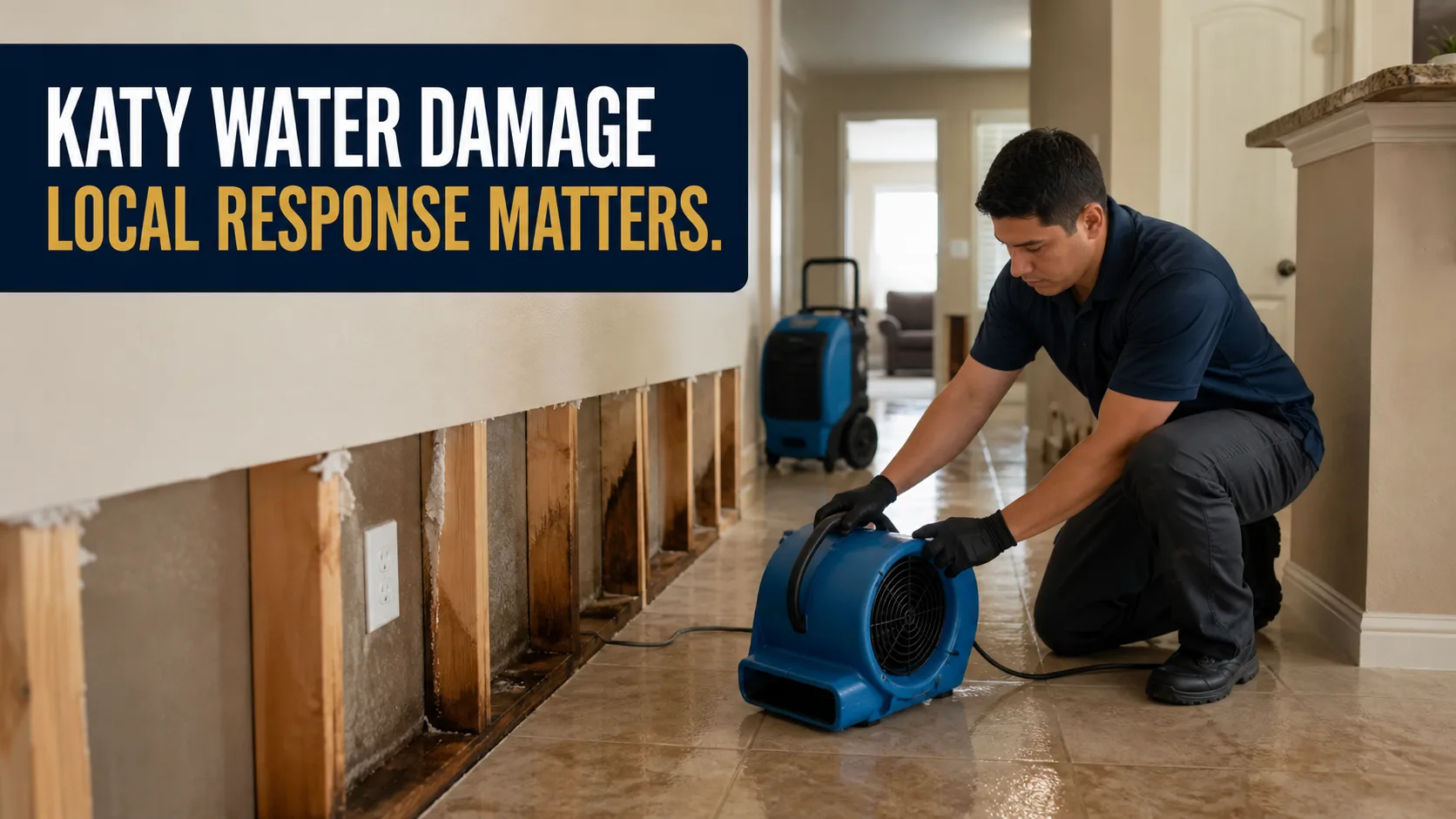
A water damage restoration technician kneels on a wet tiled floor, positioning a blue industrial fan to dry a wall where drywall has been removed, exposing wet wooden studs. Caption on image: KATY WATER DAMAGE LOCAL RESPONSE MATTERS.
The short answer

TruePoint Restoration serves Katy across Harris, Fort Bend, and Waller county — Cinco Ranch, Cross Creek Ranch, Firethorne, and beyond. Same-day emergency extraction, structural drying, and insurance-grade documentation from a local, owner-operated crew. Katy knows flooding — Harvey and the Barker/Addicks reservoirs — but most of our calls here are everyday failures: attic HVAC leaks, burst pipes, and appliance floods. Call or text **(346) 271-7004** with your location and a photo.
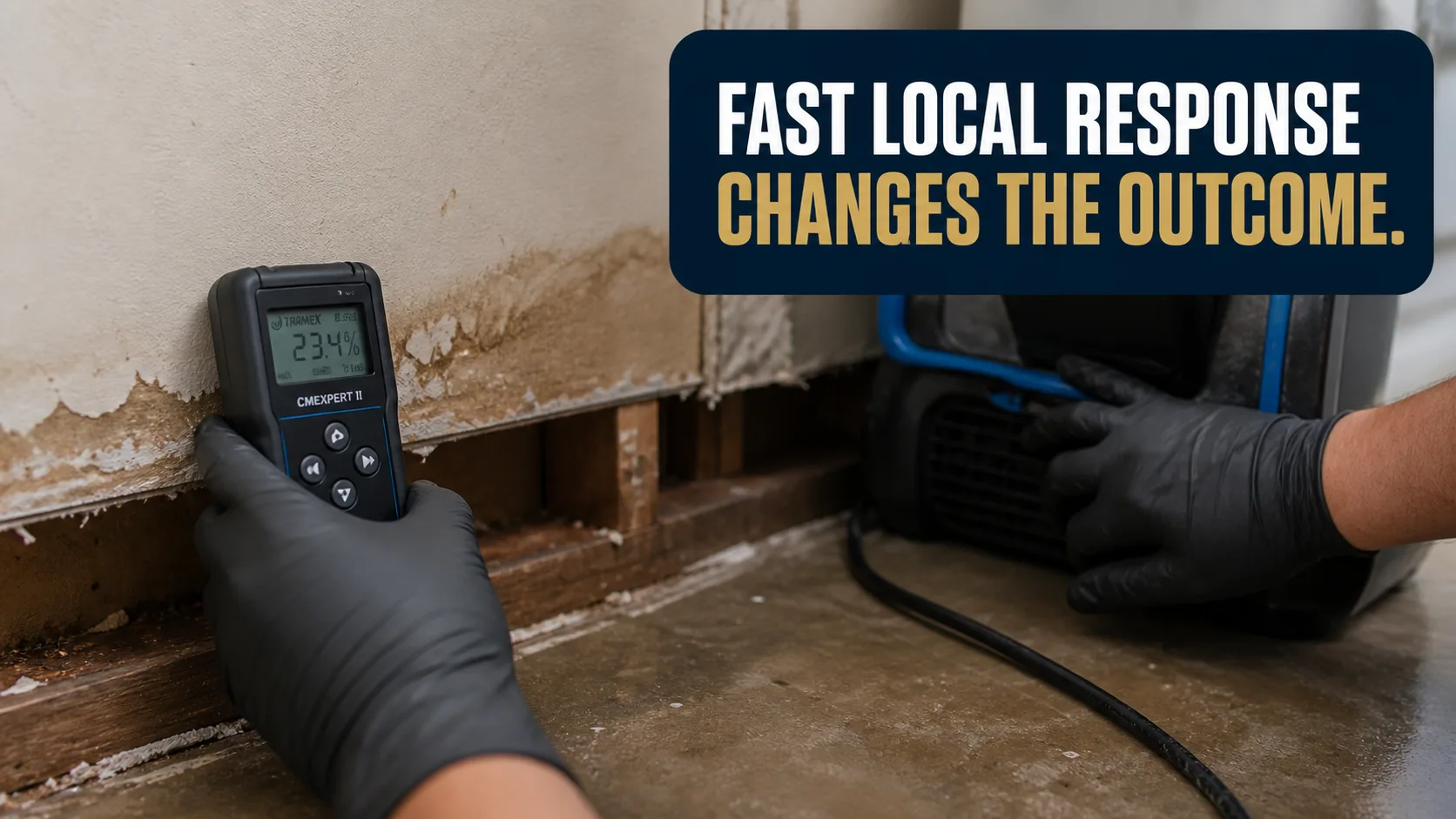
A technician wearing black gloves uses a moisture meter on a water-damaged wall, while another technician adjusts a water extraction machine. Caption on image: FAST LOCAL RESPONSE CHANGES THE OUTCOME.

Local to Katy

Katy is big and spread out, which is exactly why local response matters. TruePoint Restoration is owner-operated in the Greater Houston area, so you’re not waiting on a franchise crew routed in from another region while water spreads through your walls and floors. Local number, local crew, fast arrival.

Katy is not one jurisdiction. The old city sits where Harris, Fort Bend and Waller counties meet and runs its own fire department, while most of what people call Katy is unincorporated Harris or Fort Bend County served by emergency services districts. Which side of a county line your subdivision falls on decides your permits and your drainage district.

What causes water damage in Katy homes

  • Attic HVAC condensate leaks. Katy’s AC systems live in the attic; a clogged condensate line drops water through the ceiling all summer.
  • Appliance and supply-line failures. A burst washer hose or dishwasher line releases hundreds of gallons — a common call in Katy’s many newer homes.
  • Water heater failures, often in the attic, dropping water straight down.
  • Reservoir and storm flooding. Areas influenced by the Barker and Addicks reservoirs have serious flooding history — Harvey put water in thousands of Katy homes. That’s a flood-insurance matter, distinct from an inside pipe failure.

The reservoirs, and what 2017 actually taught

Addicks and Barker are dry reservoirs. They hold nothing most of the year, they are designed to fill, and the land inside their pools includes neighborhoods that were built there. In 2017 the pools filled beyond design and controlled releases were made into Buffalo Bayou, so homes flooded in two distinct ways — inside the pool from impoundment, and downstream from the release.

Both are flood. Neither is a homeowners claim. And both produced the same paperwork problem: owners who could not prove what their house was like beforehand, or what was actually done to dry it afterward.

Where water came from a neighbor’s failure rather than a reservoir — an upstairs unit, a shared wall, a builder defect — the recovery route is subrogation, and that only works if the cause was documented before the repair.

Newer houses fail differently

Cinco Ranch, Cross Creek, Firethorne and the rest are two-story, engineered-lumber, PEX-and-manifold construction with the air handler in the attic and a second-floor laundry more often than not. That combination produces a specific Katy loss: a supply failure on the second floor that is already in two ceilings, the cavity between the floors, and the stairwell before anybody hears it.

The counter is cheap. Leak detectors under the upstairs laundry, behind the refrigerator, and in the attic drain pan cost less than the deductible and catch exactly this failure.

Outdoor kitchens and the grill fire

The other Katy pattern is a fire that starts outside and comes in — built-in grills, gas runs to outdoor kitchens, and covered patios sharing a roof structure with the house. A patio fire reaches the attic through the soffit and puts smoke through the whole upper floor while the flame stays outdoors. What to do after a house fire applies from the first minute, and the HVAC goes off before anything else.

What we do

  1. Map the water with moisture meters and thermal imaging.
  2. Extract and dry with commercial equipment until readings are normal.
  3. Prevent mold by beating the 24-to-48-hour window.
  4. Document for insurance in the format adjusters expect.

Cost, and the two-story multiplier

  • Which floor it started on. Second-floor water is a two-ceiling job with a wall cavity in between, and it costs roughly double the ground-floor equivalent.
  • Engineered lumber. I-joists and laminated beams are strong and thin, and they tolerate prolonged saturation far worse than dimensional lumber. Drying them properly takes longer and is not optional. A caught-fast single-room loss is low thousands. Second-floor water down through the ground floor, or reservoir flooding, reaches five figures. How mitigation is priced in Houston lays out the line items.

Insurance in a designated flood pool

Katy’s wind and hail normally sits on the homeowners policy. This is inland, not coastal windstorm territory. Flood is the separate one, and inside the reservoir pools it is the only policy that responds.

Two specifics. Flood policies carry a waiting period, so buying one when a storm is already named accomplishes nothing. And if your subdivision is on the Fort Bend side, your flood map, your drainage district and your MUD are different from your neighbor’s across the county line.

Free, tonight

  1. Check whether you are inside the Addicks or Barker pool. The county floodplain viewer answers it in a minute.
  2. Confirm your flood policy exists and is past its waiting period.
  3. Look at the attic drain pan and the secondary line, and put a detector in the pan.
  4. Photograph every room, dated, and the outdoor kitchen gas connections too.

What TruePoint does in Katy

We are a mitigation contractor. Not plumbers, not electricians, not HVAC, not a rebuild company, and not public adjusters.

We do moisture mapping, extraction, containment, drying with daily logged readings, removal of what cannot be saved, smoke and soot work, and documentation an adjuster can work from. Katy across all three counties, and south into Richmond and Rosenberg: call or text (346) 271-7004.

If you have water damage right now

Stop the source if you safely can, cut power near standing water, lift your belongings, photograph everything, then call or text (346) 271-7004. If it doesn’t need professional drying, we’ll tell you.

Serving Katy and the surrounding Greater Houston metro. See all our service areas.
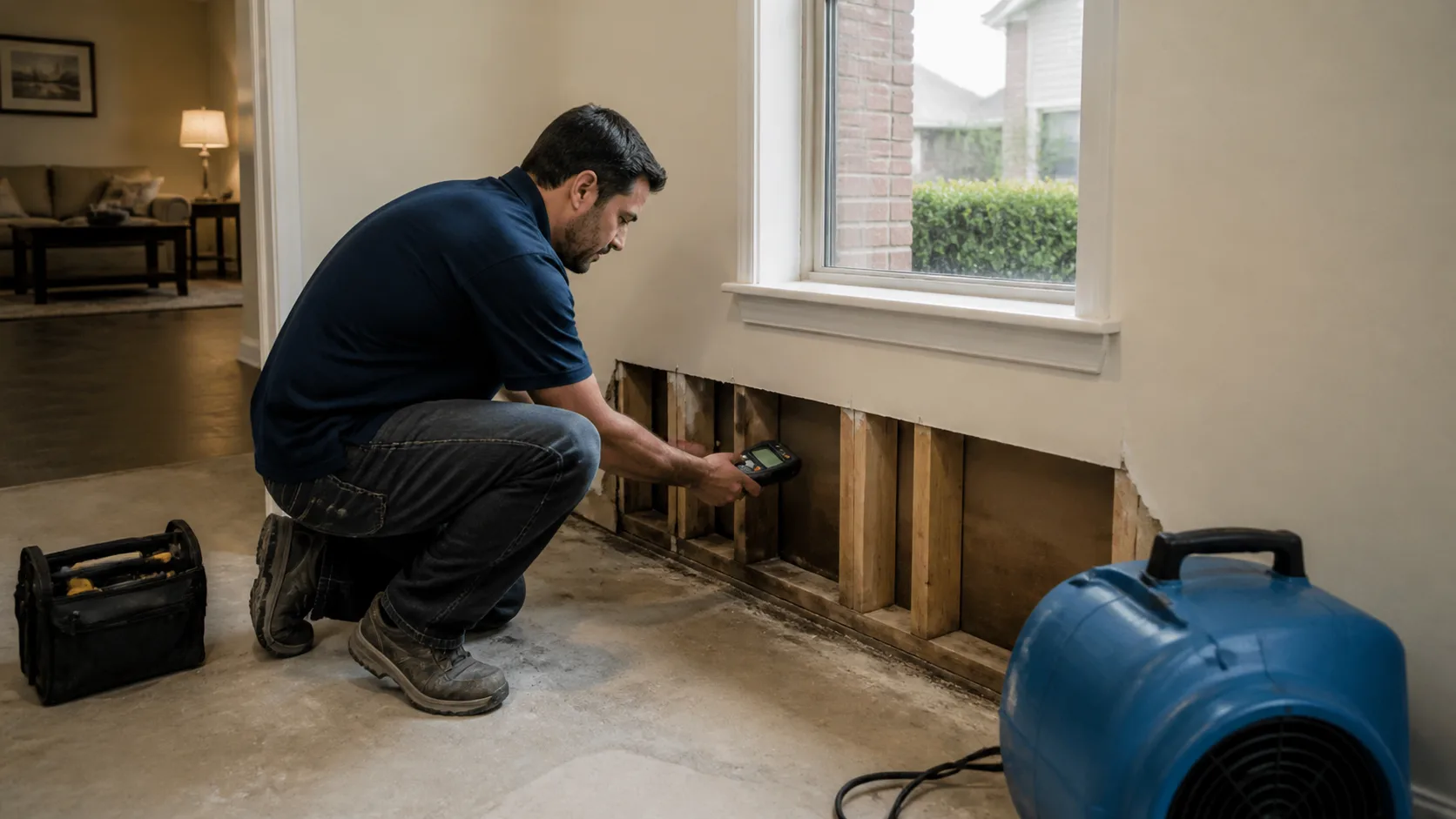
A technician kneels to inspect a water-damaged wall with exposed studs and insulation, using a moisture meter, with a blue air mover on the floor nearby.
Questions, answered

Katy Water Damage Questions

Who does water damage mitigation in Katy, TX?
TruePoint Restoration serves Katy across its Harris, Fort Bend, and Waller county neighborhoods — Cinco Ranch, Cross Creek Ranch, Firethorne, and the rest. We're local and owner-operated, handling emergency extraction, structural drying, and insurance-grade documentation. Call or text (346) 271-7004 with your location and a photo for an honest arrival window.
Does Katy flood a lot?
Katy has real flooding history, especially in areas influenced by the Barker and Addicks reservoirs — Hurricane Harvey caused catastrophic flooding here in 2017. That said, most Katy water-damage calls are everyday failures, not floods: attic HVAC leaks, burst pipes, and appliance failures. It matters because outside flooding needs separate flood insurance, while a sudden pipe or appliance failure is usually covered by homeowners.
How fast can you respond in Katy?
Same day, usually within hours. Katy's a big, spread-out community, so getting a local crew moving fast matters — mold can start within 24 to 48 hours in Houston humidity. Call (346) 271-7004, text a photo, and we'll give you an arrival window and tell you what to do in the meantime.
My Katy home has a lot of newer construction — does that change anything?
Newer Katy homes fail in specific ways: appliance supply lines and connectors that reach the end of their service life, water heaters and HVAC units in the attic, and builder-grade fittings. Newer doesn't mean immune — a burst washer hose or a clogged AC condensate line floods a two-year-old house just as fast as an old one. Fast extraction and drying is the same either way.
Do you handle insurance claims for Katy water damage?
Yes. We document Katy losses — moisture readings, affected materials, drying logs, timestamped photos — the way adjusters expect. Good documentation is often what keeps a Katy claim from being disputed or underpaid.
What's the difference between water mitigation and remediation?
Mitigation stops the damage — we extract water, dry the structure, and prevent mold within 24-48 hours. Remediation comes after: repairs, rebuilding, replacing materials. We handle mitigation. Your contractor or insurance adjuster coordinates remediation. Both matter, but mitigation is the emergency.
How much does water damage mitigation cost?
Depends on square footage, water type (clean vs. contaminated), and how long it's been sitting. A single room runs $800–$2,500. A whole house can hit $5,000–$15,000+. Insurance usually covers it if you file. Call with photos and we'll give you a real number, not a guess.
What exactly is included in water mitigation?
Water extraction with pumps and vacuums, structural drying using dehumidifiers and air movers, moisture mapping to catch hidden wet spots, mold prevention, and insurance-grade documentation. We leave when moisture readings are normal — not when the room looks dry.
Do you handle fire and smoke damage in Katy?
Yes, across Katy's Harris, Fort Bend, and Waller County neighborhoods — Cinco Ranch, Cross Creek Ranch, Firethorne, and the rest. Fire work means securing the structure, taking soot off in a dry pass first, cleaning to the residue type, deodorizing at the source, and drying the hose water out of the building. Photos and an address sent to (346) 271-7004 get you an honest read on scope.
How do outdoor kitchen and grill fires damage a Katy house?
They damage the part of the house nobody inspects. Built-in grills and outdoor kitchens sit tight against the rear wall on a lot of Katy patios, and a grease flare-up sends heat and smoke straight up into the soffit, the trim, and the attic vents above it. Even with no flame spread you get scorched siding, melted trim, and smoke residue in the attic that carries odor down into the second floor.
We had a fire in the attached garage. Why is the whole house sooty?
Because a garage shares an attic plane and a door with the living space. Garage fires burn what is stored there — fuel, paint, tires, lithium tool and vehicle batteries — and that produces a heavy, oily black soot that pushes under the connecting door and up through the shared attic into every room. Those residues are among the hardest to clean and the most likely to need sealing before anything gets repainted.
My Katy home is inside the reservoir flood pool. What does that mean for a claim?
It means documenting the source matters more here than almost anywhere. Water that reaches the house from outside — reservoir release, bayou, or street flooding — falls under a flood policy, while a pipe or appliance failure inside the house falls under homeowners, and after the fact the two can look identical on a wet floor. Photograph the water line on the walls, the direction the water travelled, and the failed component before anything gets moved.
A freeze split my outdoor spigot and water got into the wall. Is that common in Katy?
It is one of the most common freeze losses out here. Hose bibs and irrigation backflow assemblies on Katy's larger lots sit exposed on exterior walls, and when the split is behind the siding the water runs into the stud bay and along the bottom plate instead of onto the patio where you would notice it. Disconnect hoses before a freeze and insulate the backflow assembly — that is most of the prevention right there.
My Katy house is two years old. Is a failed connector a warranty issue or an insurance claim?
Often both, and they answer different questions. A builder warranty tends to cover the defective part and the workmanship, while your homeowners policy covers the resulting damage to the structure and contents — the drying, the drywall, the flooring. Keep the failed hose or connector; it is the evidence for whichever conversation you end up in, and it is what a subrogation claim against the manufacturer runs on.
Water or fire damage right now?

Talk to someone who documents it properly.

Certified water and fire damage mitigation across Pearland, Manvel, Friendswood and the Greater Houston area. Text a photo of what you are seeing and we will tell you whether it needs professional drying.

Call or text (346) 271-7004