
Service Areas · August 15, 2026

Water Damage Mitigation in Missouri City, TX

Local water damage mitigation in Missouri City, TX. Same-day extraction, structural drying, and insurance documentation for Fort Bend county homes along Oyster Creek, from Sienna to Quail Valley.

A technician kneels on a wet floor, using a moisture meter to inspect a water-damaged wall with exposed framing and pipes, while a blue air mover dries the area. Caption on image: MISSOURI CITY WATER DAMAGE LOCAL RESPONSE MATTERS.
The short answer

TruePoint Restoration serves Missouri City across Fort Bend county — Sienna, Quail Valley, Lake Olympia, and beyond. Same-day emergency extraction, structural drying, and insurance-grade documentation from a local, owner-operated crew. From established neighborhoods to newer master-planned communities, Missouri City homes fail through attic HVAC leaks, water heaters, and appliance connectors — plus Oyster Creek flooding in heavy rain. Call or text **(346) 271-7004** with your location and a photo.

A technician wearing a cap and gloves kneels, holding a moisture meter to a water-damaged wall with exposed studs and insulation, next to a blue air mover and a clipboard. Caption on image: FAST LOCAL RESPONSE CHANGES THE OUTCOME.

Local to Missouri City

Missouri City spans older established neighborhoods and fast-growing master-planned communities, and a local crew that knows both gets you dried out faster. TruePoint Restoration is local and owner-operated — local number, local response, insurance-grade documentation.

Missouri City is mostly Fort Bend County with a slice in Harris, and it splits cleanly in two. Quail Valley and the older northern neighborhoods date to the late 1960s and 1970s and are laid out around a golf course on low ground. Sienna and the southern master-planned communities are twenty-first-century construction with an association that governs the outside of your house. The two halves need different work and produce different arguments with insurers.

What causes water damage in Missouri City homes

  • Attic HVAC condensate leaks. The AC lives in the attic; a clogged condensate line drops water through ceilings all summer — our number-one call type across the metro.
  • Appliance and connector failures. Supply lines and connectors reach end of life on a warranty-window schedule, newer homes included.
  • Water heater failures in attics and closets.
  • Oyster Creek / Brazos flooding. Watershed areas have flooding history — a flood-insurance matter distinct from interior leaks.

Quail Valley: golf-course drainage and 1970s systems

Building around a course means the fairways doubled as drainage, and the houses sit low relative to the detention that serves them. It also means fifty-year-old original systems — cast iron drains, galvanized supply in places, original wall assemblies, and the wiring of that era.

The mold profile follows from the age. A 1972 wall cavity that took water holds old paper-faced drywall, old insulation, and joints that have moved, so black mold after water damage is a live technical question here rather than a scare word. Growth needs 24 to 48 hours, and the food source is already inside the wall.

Master-planned Missouri City, and the covenant problem

In Sienna and the newer sections the technical work is straightforward and the paperwork is not. Covenants regulate what can sit on your driveway and for how long, where a dumpster or a container may be placed, what color a replaced fence panel has to be, and whether equipment can run overnight.

None of that stops mitigation, but it changes logistics, and discovering it on day three costs you days. Tell your restoration contractor which association you are in on the first call, and get the architectural request moving alongside the drying rather than after it.

The other newer-home issue is odor rather than water. Tight modern envelopes hold smoke — a small kitchen or garage fire in a well-sealed house puts residue into every fabric in the building, and smoke smell removal in a tight house is a longer job than the same fire in a drafty 1970s one.

What we do

  1. Map the water with moisture meters and thermal imaging.
  2. Extract and dry with commercial equipment to a verified dry standard.
  3. Prevent mold by beating the 24-to-48-hour window.
  4. Document for insurance as adjusters expect.

What it costs on either side of the city

  • Age of the assemblies. Opening a 1972 wall to reach a leak finds materials that come out rather than dry. Opening a 2015 wall usually does not.
  • Whether mold is already present. Mitigation and remediation are separate scopes with separate pricing, and once growth is established you pay for both. Mold coverage is capped on most Texas policies, which makes the 24-to-48-hour window a financial number rather than only a technical one.
  • Access and association logistics in the master-planned sections.

A contained same-day loss is a low-thousands job on either side of town. A 1970s Quail Valley wall cavity with established growth, or a whole-house smoke job in a sealed newer home, reaches five figures. The Houston pricing structure applies here as everywhere in the metro.

Fort Bend County is not coastal

This matters more than most owners realize. Fort Bend is not one of the coastal counties in the state windstorm pool’s territory, so wind and hail here normally sits on the homeowners policy rather than on a separate windstorm policy — unlike Galveston County twenty-five miles away.

Flood is still separate, always. And on a 1970s house the argument to expect is “gradual” rather than “not covered” — long-term seepage from an aging supply line is excluded on most policies where a sudden failure is not. The date you discovered it, and the photographs from that day, are the whole defense.

Free things worth doing tonight

  1. Photograph every room and every ceiling, dated, including the ones with nothing wrong.
  2. On an older house, check under every sink for green corrosion on the shut-offs. That is the first sign.
  3. Find your association’s rules on dumpsters, containers and exterior work, and save the contact.
  4. Confirm whether your policy carries a mold sublimit, and what it is.

The limits of our scope

TruePoint Restoration does mitigation, and remediation of the loss itself. Plumbing repair, electrical, HVAC, roofing, reconstruction and public adjusting are not ours, and we name the trade rather than take the job.

Moisture mapping, extraction, containment, documented drying, mold remediation where growth has started, smoke and odor work, and the file your adjuster needs. Missouri City, Quail Valley, Sienna, and neighboring Sugar Land: call or text (346) 271-7004.

If you have water damage right now

Stop the source if you safely can, cut power near standing water, lift belongings, photograph everything, then call or text (346) 271-7004. Honest answer, every time.

Serving Missouri City and the surrounding Greater Houston metro. See all our service areas.
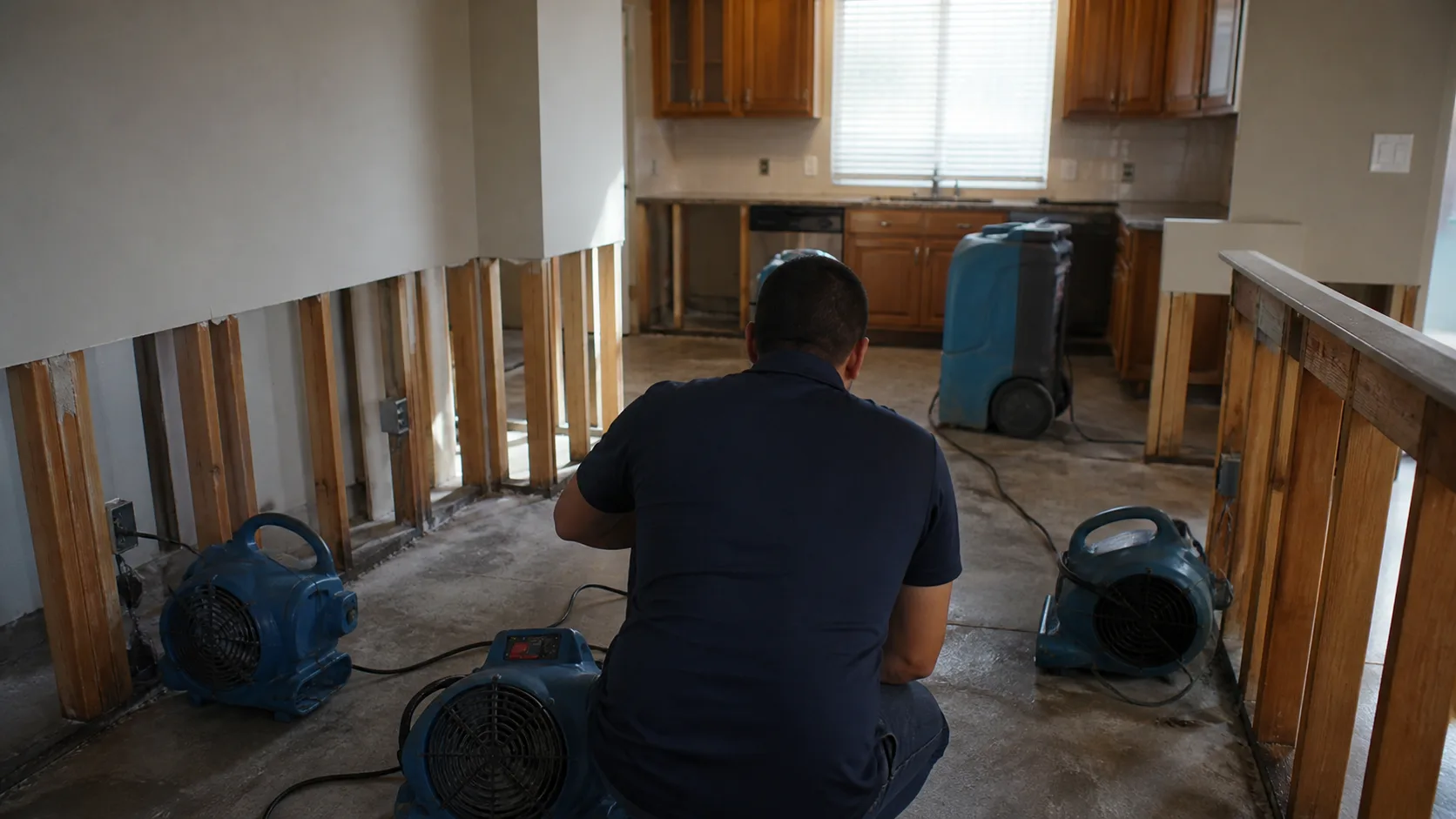
A technician kneels on a concrete floor in a water-damaged kitchen with exposed wall studs and multiple drying fans.
Questions, answered

Missouri City Water Damage Questions

Who does water damage mitigation in Missouri City, TX?
TruePoint Restoration serves Missouri City across Fort Bend county — Sienna, Quail Valley, Lake Olympia, and the surrounding communities. Local and owner-operated, we handle emergency extraction, structural drying, and insurance-grade documentation. Call or text (346) 271-7004 with your location and a photo for an honest arrival window.
Does Missouri City flood?
Areas near Oyster Creek and the Brazos River watershed have flooding history in major rain events. But most Missouri City water-damage calls are interior failures — attic HVAC leaks, water heater failures, and burst supply lines — not creek flooding. For coverage, outside flooding needs a separate flood policy, while sudden interior failures are usually covered by homeowners.
How fast can you respond in Missouri City?
Same day, usually within hours. With Houston humidity, mold can begin within 24 to 48 hours, so fast local response matters across Missouri City's communities. Call (346) 271-7004, send a photo, and we'll give you an honest arrival window and guidance for the meantime.
Do Missouri City's master-planned homes still get water damage?
Yes. From established Quail Valley to newer Sienna, Missouri City homes fail through the same channels: attic HVAC condensate leaks, water heater failures, and appliance and connector failures. Newer homes aren't immune — supply lines and connectors reach end of service life on a schedule regardless of the home's age. Fast extraction and documented drying is the same answer either way.
Do you document Missouri City water damage for insurance?
Yes — our team has hands-on mitigation work. We document Missouri City losses with moisture readings, affected materials, and drying logs in the format Texas adjusters expect, which is often what separates a smooth claim from a disputed one.
What's the difference between water damage mitigation and remediation?
Mitigation stops the damage and dries it out—extraction, dehumidifiers, thermal imaging, documentation. Remediation comes after and handles reconstruction: replacing drywall, flooring, cabinetry. We do mitigation. Once we've dried and documented, your insurance adjuster approves the rebuild scope, and a general contractor handles that work.
How much does water damage mitigation cost?
Depends on square footage affected, source (HVAC leak versus Oyster Creek flooding), and how fast you call. A 500-sq-ft attic extraction and dry runs $1,500–$3,500. Insurance covers it under your policy if it's sudden and accidental. Call with photos and location—we'll quote it straight.
What exactly happens when you mitigate water damage?
We extract standing water, set commercial dehumidifiers and air movers, run thermal imaging to find hidden moisture in walls and attics, monitor until dry-standard is hit, then document everything for insurance. Goal: beat mold growth (24–48 hours) and give your adjuster what they need to approve the repair claim.
Do you handle fire and smoke damage in Missouri City?
Yes, throughout Missouri City's Fort Bend communities, from Quail Valley to Sienna and Lake Olympia. Smoke behaves differently in a 1970s house than in a new one — older construction gives it more paths through wall cavities and open returns, while newer open plans move it faster and further — so the assessment starts with the house itself before anybody starts cleaning. Send photos and your address to (346) 271-7004 for an honest read on the job.
Are Quail Valley's older homes at higher risk of an attic fire?
The 1970s-era housing around Quail Valley carries a few risks worth checking. Older recessed can lights buried under blown insulation run hot, decades-old wiring and panels were never sized for today's loads, and attic-mounted equipment sits in the middle of all of it. A fire that starts above the ceiling is also the kind that burns longest before anyone in the house notices it.
How long does fire and smoke cleanup take?
Three things set the timeline: how far the smoke travelled, what kind of residue it left, and whether the fire department put water into the structure. A light smoke event confined to one room can be days. A room that burned, with contents to clean, odor work, and drying running at the same time, is measured in weeks — and the reconstruction after that is a separate job on its own schedule.
Water is coming from behind my built-in refrigerator. What is it?
Nine times out of ten it is the ice-maker supply line or the saddle valve feeding it. The leak is slow, it runs behind a heavy built-in that nobody pulls out, and it soaks the wall base, the subfloor, and often the hardwood in the next room before anything shows. By the time boards cup or the baseboard stains, it has usually been running for weeks.
How do you know when my house is actually dry?
By measurement, not by look or feel. Moisture readings are taken from the affected materials and compared against the same material in an unaffected part of the house, and the equipment stays until the wet material reads at that baseline, with temperature and humidity logged each day so the progress is on paper. A room that looks and feels dry on day two is routinely still wet inside the wall.
Does running the drying equipment run up my electric bill?
It adds to it. Air movers and dehumidifiers draw real power and run continuously for several days, which shows up as a noticeable bump on one billing cycle. It is a small fraction of what a stalled dry-out costs, and documented power use is generally treated as part of the mitigation on a claim — switching the equipment off at night to save money is the expensive choice.
Water or fire damage right now?

Talk to someone who documents it properly.

Certified water and fire damage mitigation across Pearland, Manvel, Friendswood and the Greater Houston area. Text a photo of what you are seeing and we will tell you whether it needs professional drying.

Call or text (346) 271-7004