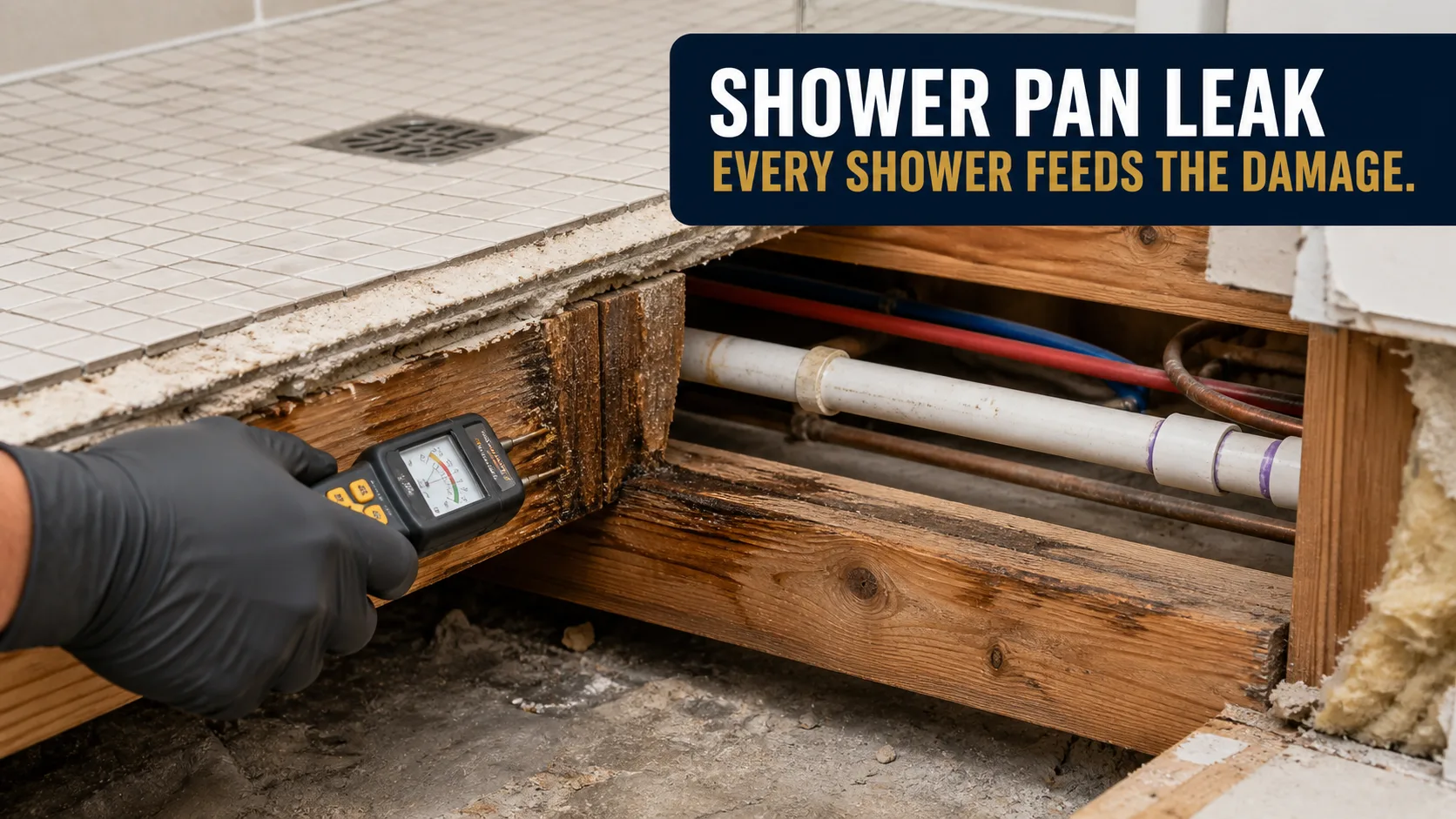
If a ceiling below a shower stains, tiles sound hollow, or a musty smell settles into the bathroom, suspect the pan — the waterproof membrane under the shower floor. Confirm with a flood test: plug the drain, fill with an inch of water, mark it, wait four hours. A failed pan cannot be fixed with grout or caulk; the shower floor gets rebuilt. Until it does, every shower delivers water into the subfloor — so stop using that shower and get the wet structure metered.
What the pan is (and what grout isn’t)
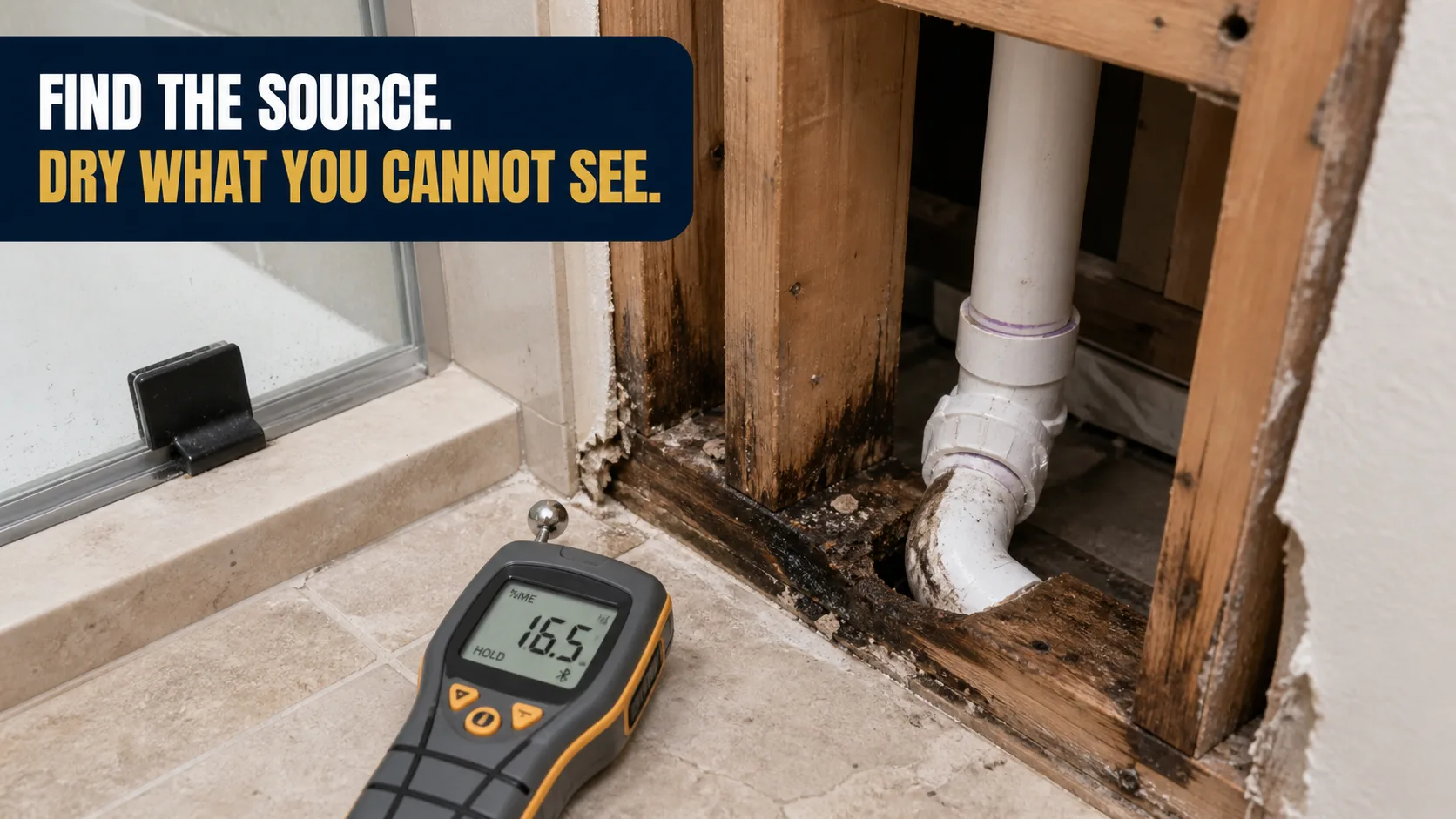
Here is the misunderstanding at the heart of most shower leaks: tile and grout are not waterproof. They are the wear surface. Water passes through grout slowly and constantly — by design. What keeps it out of your house is the membrane underneath: a pan liner under the mortar bed (older tiled showers), a bonded sheet or liquid membrane (newer builds), or a one-piece molded base.
The pan is buried under the mortar and tile. You will never see it fail. You only see what it lets through.
The first signs
- Ceiling stain below the shower — the classic upstairs-bathroom presentation
- Musty smell in the bathroom that cleaning does not remove
- Hollow-sounding or loose floor tiles; grout cracking and re-cracking at the floor
- Baseboard or drywall staining on walls adjacent to the shower
- Slab homes: flooring failing just outside the shower — the water fans out along the slab
Warning signs, grouped by what they tell you
The membrane is passing water right now:
- A ceiling stain below an upstairs shower that darkens after a long shower and fades between them
- Flooring failing just outside the shower in a single-story home — the water fans out along the slab rather than dropping
- Baseboard or drywall staining on the wall behind or beside the enclosure
The structure underneath has been wet a while:
- Floor tiles sounding hollow when tapped, or grout that cracks again within weeks of being repaired
- A soft, springy feel underfoot at the shower threshold
- A musty smell that cleaning does not remove — a smell like that is a moisture finding first
The failure is intermittent, which is still a failure: staining that appears after a long shower and not a short one. Partial pan failures leak by usage pattern, and a leak that only shows sometimes still runs every time the water reaches that corner.
Confirm it: the flood test
- Seal the drain with a test plug or inflatable stopper (hardware store, a few dollars) — a rag is not a seal.
- Fill the pan with 1–2 inches of cold water. Stay below the curb.
- Mark the water line with tape.
- Wait 4–8 hours without using the shower.
- Level dropped, or moisture appeared below/beside? The pan or its drain connection leaks. Level held? Your leak is elsewhere — the door seals, the curb, the valve in the wall, or the tub next to it.
The distinction matters enormously for cost: a failed drain connection is a plumber and a day; failed membrane is a shower floor rebuild.
What to do if the pan failed
- Stop using that shower. Every use is a metered delivery of water into the structure. Use another bathroom.
- Photograph everything — the ceiling below, the test result with your tape mark, all staining. Date it: for a gradual failure, the discovery date is your claim’s anchor.
- Get the structure metered. A pan that failed recently wet a small zone; one that failed a year ago has been feeding the subfloor, joists, and ceiling cavity below on a daily schedule. What the rebuild costs depends on this answer, and you want it measured before any contractor quotes you. (346) 271-7004.
- Then rebuild the pan with a tile contractor — and flood-test the new pan before the tile goes down. Insist on it; good contractors do it unprompted.
What does this cost, and which number is which?
Three numbers from three trades, and the one nobody quotes is the one that moves.
- The tile contractor’s rebuild — demolition, new membrane, mortar bed, new tile — commonly runs $2,000 to $5,000, and more when the lower walls have to come down to reach the corners properly.
- Structural repair, if the framing rotted. The line item nobody quotes until the floor is open, and it comes first in the sequence, because nothing gets rebuilt over rotted joists.
- The drying and removal, set by how long the pan has been failing rather than by the size of the shower.
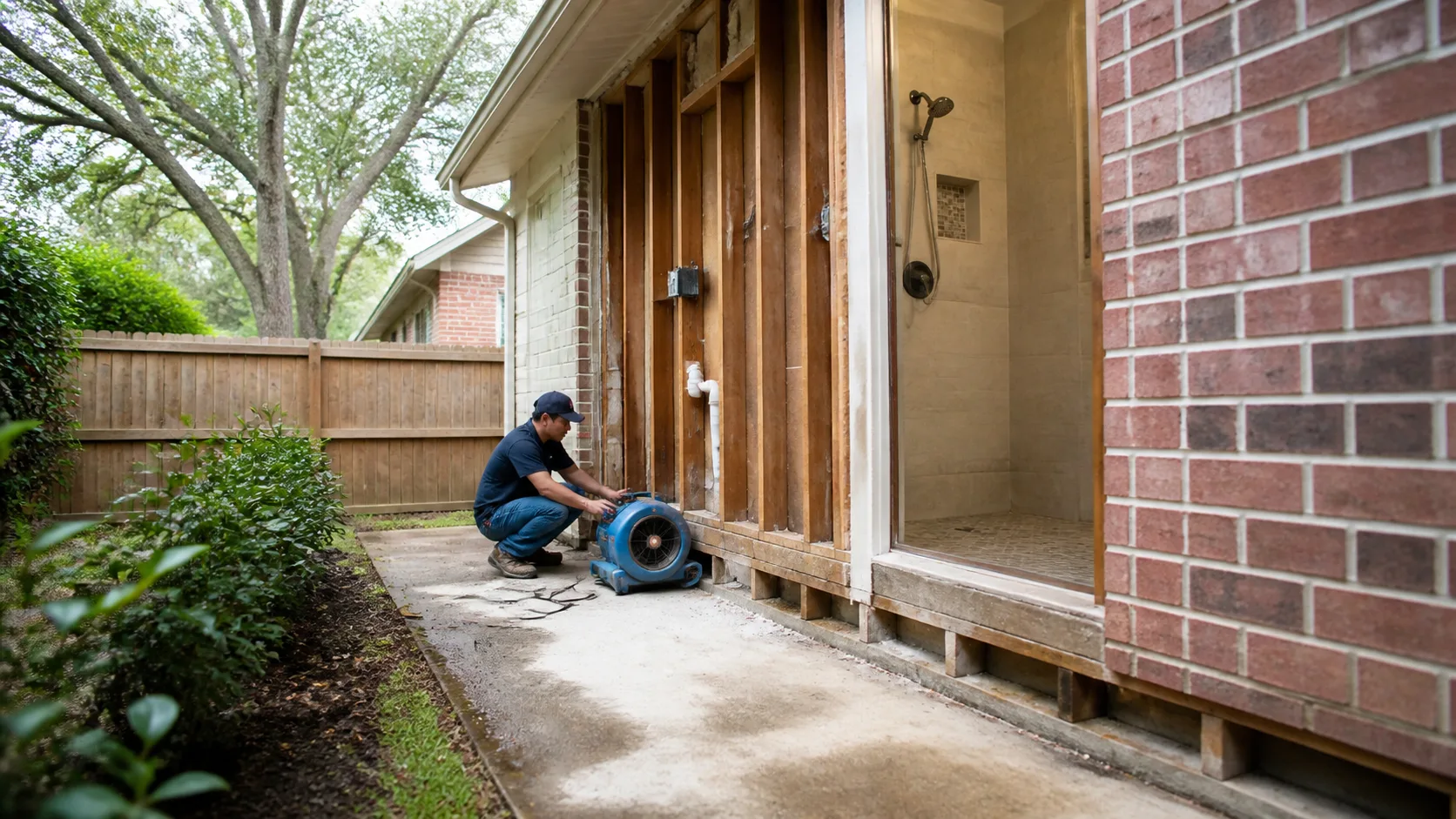
What moves that third number: how long it ran, where the water went, how much material comes out, and whether growth started. Two-story homes leak downward and show a ceiling stain within weeks. Slab homes leak sideways along the top of the slab, under the bathroom flooring and into the bottom plates of the walls, and show nothing for a year — which is why the slab version is usually the more expensive one by the time anybody finds it. Mortar bed, subfloor, wall bottoms and drywall that wicked above the salvage line are removals rather than drying, and enclosed daily wetting is as favorable as conditions for growth get.
Meter it before you collect bids, not after. A rebuild quote written without knowing what is wet under the floor is a quote that changes once the floor is open. The pricing structure is in what mitigation costs in Houston.
How long does the structure take to dry?
Five to seven days once the wet material is exposed, and longer with a mortar bed involved — mortar and concrete give up moisture slowly, so they are the last materials to reach dry standard.
Two things have to happen before the clock even starts. The shower has to stop being used, because drying cannot outrun a daily delivery of water. And the cavity has to be opened — the bathroom floor or the ceiling below — because nothing dries inside a closed assembly in Gulf Coast humidity. After that, daily readings end the job rather than the calendar.
Does insurance cover a shower pan leak?
This is one of the harder claims to get paid, and it helps to know why before you file. Pan failures are gradual by nature, so most policies exclude the pan repair itself while sometimes covering sudden resulting damage. A membrane that has been passing water for a year does not look sudden to an adjuster, whatever the discovery date says.
Where coverage exists it hinges on documentation: the date you found it, photographs from that day including the flood test with your tape mark, and a professional moisture map showing the real extent. Stop using the shower the day you find it and keep the receipts. If a claim comes back denied, there is usually a specific reason and a route back, and if the ceiling below is involved, ceiling water damage covers that half of the job.
What NOT to do
- Don’t accept “we’ll regrout and seal it” as a pan repair. Sealers slow the symptom while the structure stays on the receiving end.
- Don’t keep using the shower “just until the remodel.” Weeks of daily soakings are exactly how a drying job becomes a demolition job.
- Don’t let a new pan go in over an unmetered subfloor. Wet structure sealed under a new shower is the industry’s most reliable mold factory.
The free things worth doing tonight
- Stop using that shower. Every use is a measured delivery of water into the structure, and this is the only step that stops the damage tonight.
- Run the flood test — drain plugged, an inch or two of cold water, tape at the water line, four to eight hours.
- Look at the ceiling below with a flashlight at a low angle, not straight on, and press it with a fingertip.
- Tap across the shower floor tiles with a knuckle and listen for the hollow ones.
- Touch the baseboards on every wall around and behind the shower, at their lowest inch.
- Photograph everything with the date stamp on — the taped water line before and after, the ceiling, all staining — and write down today’s date as the discovery date.
- Do not regrout, recaulk, or repaint before it is metered. Sealing the symptom loses the evidence and keeps the water in.
Prevention and early detection
Pans age with the house — there is no maintenance that extends a buried membrane. What you can do:
- Re-caulk the floor-to-wall joints and curb annually; movement joints are where early water intrusion starts
- Treat any hollow tile, recurring grout crack, or below-shower stain as a flood-test trigger, not a cosmetic note
- In upstairs bathrooms, glance at the ceiling below monthly — it is your pan’s early-warning display
- Buying a house? Flood-test the showers during inspection. It is free and it finds five-figure problems.
Where the tile contractor ends and we begin
TruePoint Restoration is not a tile contractor and not a plumbing company. We do not rebuild shower pans, set membranes, lay mortar beds, or replace drain assemblies, and we say that on the phone rather than after the estimate. The rebuild belongs to a tile contractor, the drain connection to a plumber, and structural repair of rotted joists to a carpenter.
What we do is the water they leave behind, and the measurement that tells everybody what they are dealing with: metering the subfloor, joists, wall bottoms and the ceiling cavity below to find the real edge of the wet zone, opening what has to be opened, removing material that cannot be dried, drying the rest with logged daily readings, and handing you a documented file your adjuster can use. Get that measurement before you collect rebuild bids — it changes the scope of every one of them.
Send photos of the ceiling below and your flood test result to (346) 271-7004. We serve Pearland, Manvel, Friendswood, League City and the Greater Houston area.