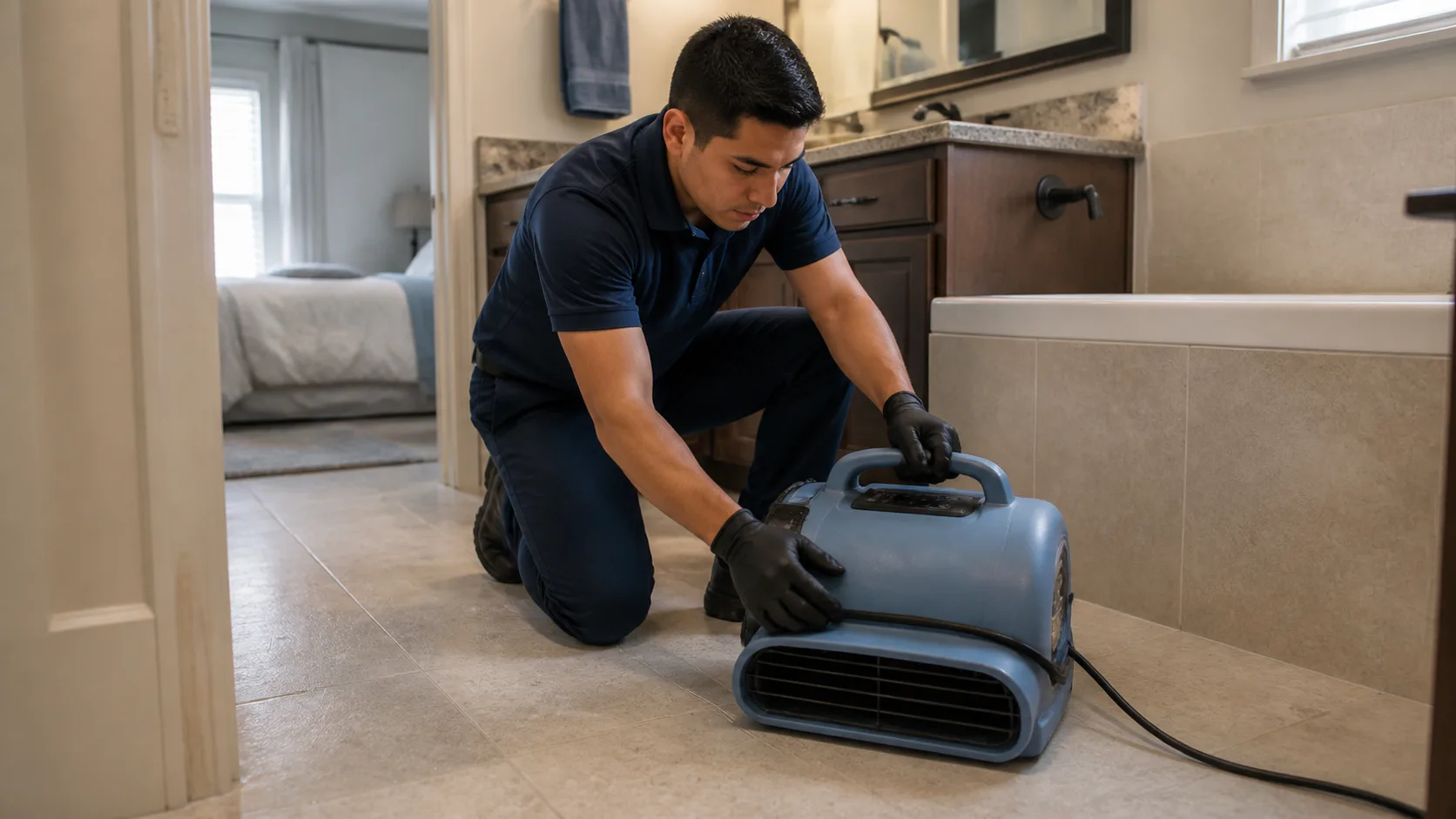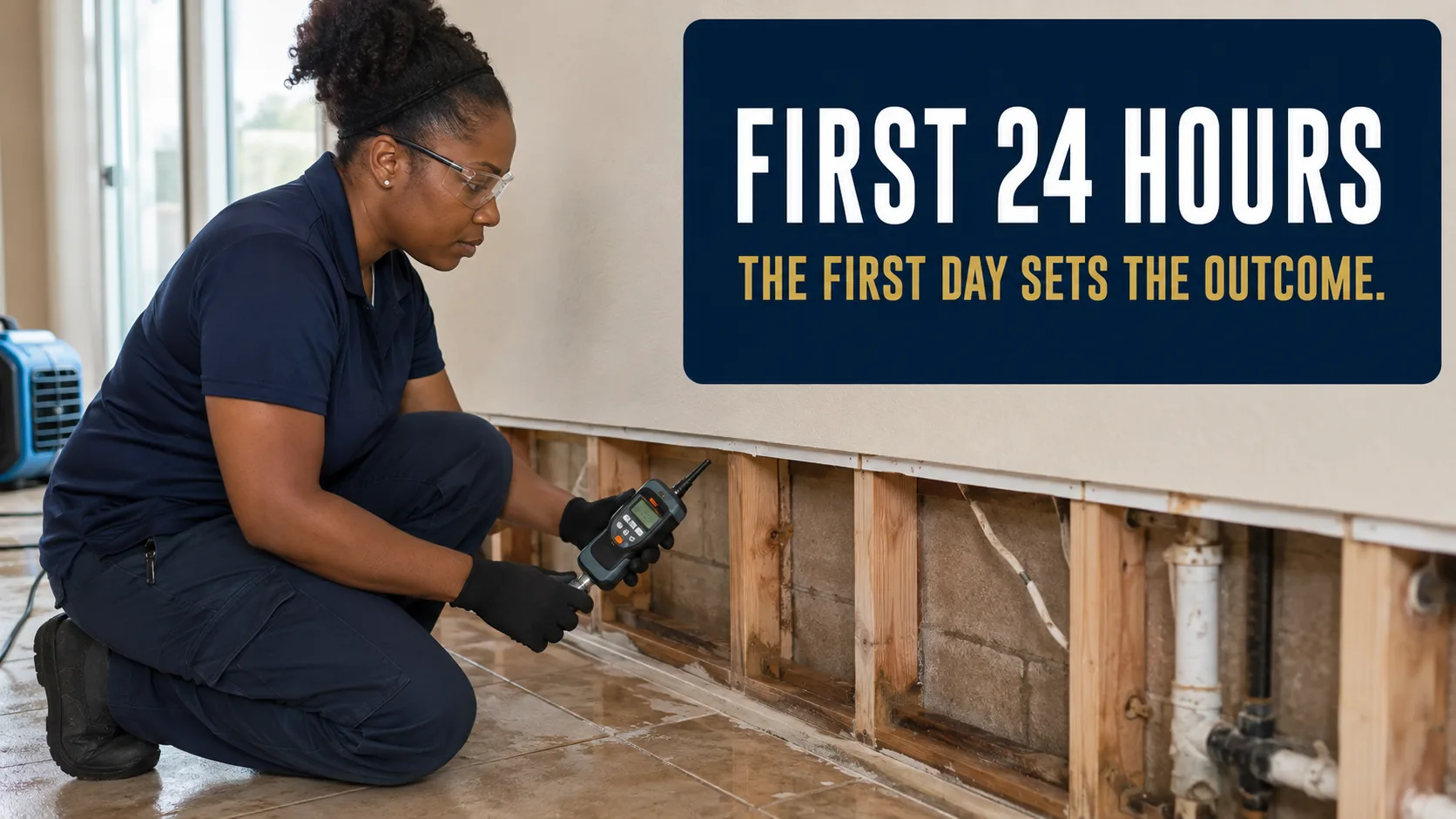
Stop the water at the main shutoff, then make the area electrically safe. Photograph and video everything before you move anything. Get extraction and metered drying started the same day — in Houston humidity, wet materials can begin growing mold within 24 to 48 hours. Report the claim once the response is underway, and keep the part that failed.
When water shows up where it shouldn’t be, every hour matters. The first 24 hours after a leak or flood determine whether you’re looking at a $3,000 cleanup or a $30,000 mold remediation six months later.
Here’s the playbook our crews wish every Pearland homeowner had on day one.
Hour 0–1: Stop the water and stay safe
Find the source and shut it off. If it’s a burst pipe, close the main shutoff valve (usually near the water meter at the front of the house). If it’s a sewer backup or roof leak, get out of the affected room and turn off the breaker for that section of the house at the panel — wet drywall and live electrical do not mix.
Do not walk through standing water if you can hear or see anything electrical operating in the same room. Period.
Hour 1–4: Document everything
Before you move a single piece of furniture, take pictures. Wide shots, close-ups, the source of the leak, every damaged item. Insurance adjusters reward documentation — and the more you have, the less they’ll question.
Take video too. Walk through the room narrating what you see. It takes ninety seconds and it can save you thousands.
What to photograph, exactly
Documentation is free and it expires. Once material is moved, cut out, or dried, the evidence is gone — so shoot it now, in this order, before anyone touches anything.
- Wide shot of every affected room from the doorway, before you step in. Two per room, opposite corners.
- The water line on walls, baseboards and furniture legs. Put something in frame for scale — a shoe, a ruler, your hand.
- The source. The failed connector, the split pipe, the pan, the ceiling opening. Then a close-up of the part itself.
- The ceiling from below and, if it is safe, the space above it. Do not go into an attic with a sagging ceiling under you.
- Contents. Every damaged item, and the labels or model plates on anything expensive.
- A slow walkthrough video with the phone held level, narrating what you are seeing and the date out loud.
- The meter, if you can find it, showing the dial moving or stopped after you closed the main.
- Check the date stamp is on, then back the whole album up off the phone the same day — email it to yourself or push it to cloud storage.
Then keep the failed part. Bag it, label it, put it in the garage. It is the single most useful object in the whole file.
Hour 4–12: Call us, then call your insurance
This is the part homeowners get wrong. They call insurance first, the adjuster takes 48 hours to schedule a visit, and by then mold spores have already settled into the drywall.
Call a certified mitigation company first. We can be on-site in 60 minutes, start water extraction, and document everything in a way your adjuster will accept. Then call your insurance — we’ll work directly with them on the claim.
What the first day costs, and what waiting adds
Mitigation is priced on how much material got wet, how deeply, for how long, and whether the water was clean or contaminated. A single room caught the same day — extraction, a few days of equipment, daily readings — is a low four-figure job in most Houston homes. The same failure found after a long weekend, with water under cabinets and into wall cavities, is a different scope: more equipment, more days, and usually the removal of drywall, baseboards, insulation and flooring that could have been dried if anyone had reached them sooner.
Two things drive that gap, and neither is the volume of water.
- Time. Materials dried inside roughly 24 to 48 hours usually stay in the house. Materials still wet after that usually come out — and along the Gulf Coast the ambient humidity keeps them from drying on their own, so the clock runs at its fast end. What that turns into is on mold after water damage.
- Category. Clean supply water, gray water from an appliance discharge, and sewage are three different jobs. Contamination decides what gets cleaned and what gets thrown away, regardless of how wet it is.
For a covered sudden loss, mitigation is generally paid by the claim above your deductible, because drying is the loss-prevention work the policy asks you to do. Get the moisture readings and a line-item scope in writing before work begins. How long drying takes sets the rest of the schedule.
Hour 12–24: Drying, not just mopping
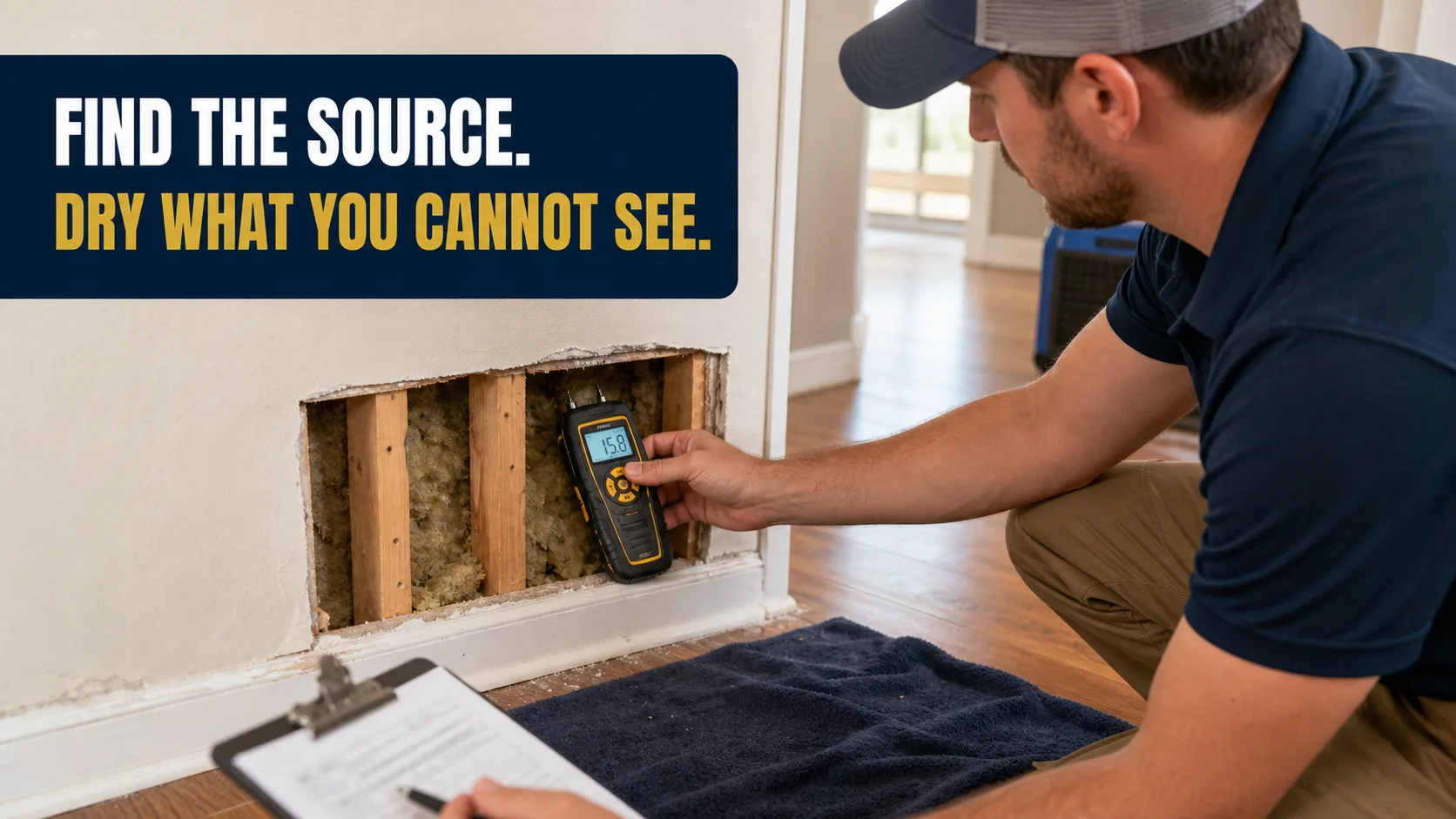
Surface water is the easy part. The water that soaked into your subfloor, your wall cavities, and your insulation is what causes the real damage. That requires industrial dehumidifiers and air movers running for 3–5 days, with moisture readings taken twice daily.
If anyone tells you your house “looks dry” after a single mop-up, get a second opinion.
Where the water goes after the floor looks dry
Water moves sideways and down, and it does it faster than anyone expects. On the slab-on-grade construction that covers most of Pearland and the surrounding area, water that lands in a kitchen spreads flat across the slab and travels under cabinet kicks, under wall bottom plates, and into the next room without ever showing on the surface.
The places it hides, and what gives it away:
- Under cabinet toe kicks. Nothing visible until the cabinet base swells or the finish lifts.
- Inside wall cavities, wicking up drywall from the bottom plate. The tell is a baseboard that has darkened, a nail head that has rusted, or paint that has bubbled six inches off the floor.
- Under vinyl plank and laminate. These finishes hold water underneath rather than showing it. Cupping or a hollow sound underfoot means it is there.
- Under the pad in carpeted rooms, often several feet past where the carpet feels damp.
- In insulation, which holds many times its weight in water and gives none of it back on its own.
- Down through a ceiling into the room below, when the source is upstairs or in the attic.
The smell arrives late. A musty odor is not an early warning — it means something has been wet long enough for growth to start. If the water came from underneath rather than above, that is a different problem with a different first move: slab leak repair covers detection before demolition.
What your carrier does with a same-day response
Every homeowners policy asks two things of you after a loss: report it, and prevent further damage. Starting mitigation the same day is that second duty being performed, and it is the reason waiting for an adjuster before extracting water works against you rather than for you.
The distinction that decides most water claims is speed, not volume. A supply line that let go this morning is a sudden and accidental discharge, and that is generally covered. The same line weeping behind a cabinet for four months is gradual damage, which is excluded on nearly every homeowners form in Texas. Your photographs, the failed part, and the timestamped drying logs are what establish which one you had.
So report the claim the same day, in writing, and keep the confirmation. Say what you saw, when you found it, and what you did about it — and say you do not know when that is the truthful answer. Guessing at how long something had been leaking puts an estimate into the file as though it were a fact. The coverage lines are in does insurance cover water damage, and what to do if the answer comes back wrong is in water damage claim denied.
What we do, and why we do it this way
When TruePoint Restoration responds to a water damage call in Pearland, the first thing we do is take moisture readings of every wall, floor, and structural element in the affected area. We document everything for your insurance file. Then we extract, dry, and monitor — and we don’t pull our equipment out until the moisture levels match your home’s pre-loss baseline.
The reason: mold grows when moisture content stays above 16% for more than 48 hours. We’ve seen too many “fixed” jobs come back as mold remediations six weeks later. Drying right the first time is the cheapest mitigation there is.
The Houston calendar, and why it matters tonight
Water losses here are seasonal, and knowing which season you are in tells you what to check first.
- December through February. Freeze events. Southern homes run supply lines through uninsulated attics, so a hard freeze bursts pipes across whole neighborhoods in the same 48 hours — and most of them start running during the thaw, a day or two later, not during the cold. Prevention is in the freeze checklist.
- March through October. Air conditioning. Attic air handlers pull gallons of condensate a day out of Gulf air, condensate lines clog in the humidity, and secondary pans overflow through ceilings. The routine that stops it is drain line maintenance.
- June 1 through November 30. Hurricane season, peaking in August and September. Roof intrusion and rising water are covered by different policies, and flood coverage carries a 30-day waiting period — the timing is in hurricane season prep.
- Year round. Expansive clay shifts under slabs between drought shrink and rain swell, stressing under-slab supply lines. Hard water shortens the life of water heaters and braided connectors, which is why connector replacement runs on a warranty window.
Where we fit, and where we don’t
TruePoint Restoration is a mitigation company, and being clear about the edges of that saves you a phone call. We do not repair plumbing, service HVAC systems, do electrical work, put on roofs, or rebuild what has to come out. If a pipe is still leaking, you need a licensed plumber in parallel with us — not after us — and the two trades are not interchangeable. Anything involving a gas appliance or an electrical panel near standing water stops being a homeowner job entirely.
What we do is extraction, containment, structural drying with logged daily moisture readings, mold remediation, and smoke and soot cleanup on the fire side. We hand you a documented file — moisture map, daily logs, timestamped photographs, and a scope written in line items an adjuster can read without translation. Whether you use us or someone else, that documentation is what a claim runs on.
We work out of Pearland and cover Manvel, Friendswood, League City, Pasadena, Sugar Land and the Greater Houston area. (346) 271-7004, or claims@truepointrestoration.com.
If you’re in the middle of a water damage event right now, stop reading and call us at (346) 271-7004. We’ll be there in 60 minutes.